
Gold rockets +2.33% to $5,063.80 while silver surges +2.10% to $77.27, marking the strongest single-day gains across precious metals in weeks. This coordinated rally signals renewed investor confidence in metals as an inflation hedge, driven by mounting economic pressures and shifting monetary policy expectations that are reshaping the entire precious metals landscape.
The current gold price rally comes at a critical juncture where COMEX inventory concerns intersect with macroeconomic uncertainty. With gold's registered coverage ratio sitting at 43.5% against open interest of 404,391 contracts and inflation expectations climbing, investors are rediscovering the strategic value of precious metals allocation. This comprehensive analysis examines how inflation pressures are fueling today's metals market momentum and what it means for portfolio positioning.
Precious Metals Price Action Delivers Broad-Based Gains
Today's metals market performance showcases exceptional strength across the precious metals complex, with all four major metals posting significant gains. Gold leads at +2.33% to $5,063.80, while silver follows closely with a +2.10% surge to $77.27. Platinum advances +2.28% to $2,067.70, and palladium shows the strongest move at +3.94% to $1,722.00.
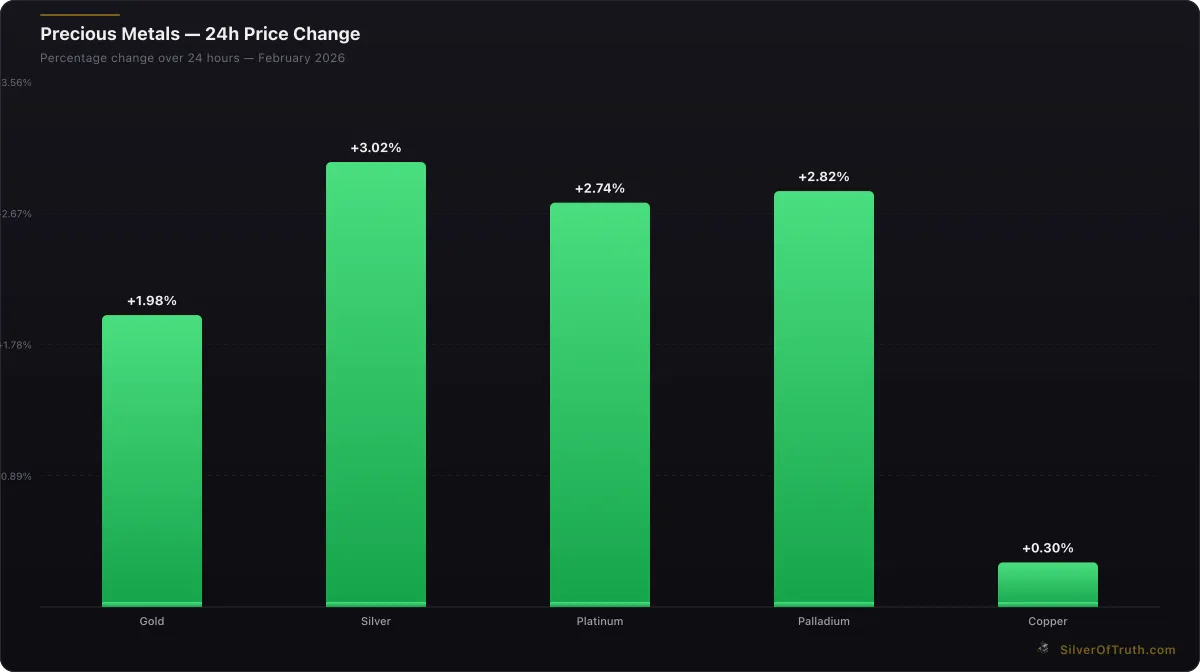
24-hour precious metals price changes. Source: SilverOfTruth, February 2026
The gold/silver ratio tightened to 65.53, down from recent highs, suggesting silver is beginning to outperform on a relative basis. This ratio compression often signals renewed risk appetite and industrial demand recovery, both supportive of broader metals market trends. The coordinated nature of today's gains indicates fundamental rather than technical drivers, with inflation concerns serving as the primary catalyst.
Volume and breadth confirm the authenticity of this rally. Gold reached a daily high of $5,069.10, testing key resistance levels that have capped previous advances. Silver's high of $79.27 represents a significant technical breakthrough above the $78 resistance zone that has confined trading for weeks. The strength in palladium, often viewed as a bellwether for industrial metals demand, suggests the rally extends beyond traditional safe-haven buying into economic recovery expectations.
Inflation Expectations Drive Safe-Haven Demand
Recent inflation data releases have reignited concerns about persistent price pressures, creating a favorable backdrop for precious metals as traditional inflation hedges. The latest Consumer Price Index report showed core inflation remaining above Federal Reserve targets, while Producer Price Index data revealed upstream pricing pressures that could translate into consumer inflation in coming months.
Treasury Inflation-Protected Securities (TIPS) breakeven rates have widened notably, indicating bond market expectations for higher inflation over the medium term. This shift in inflation expectations directly benefits gold and silver, as their historical role as stores of value becomes increasingly attractive when currency purchasing power faces erosion. Our analysis of inflation's impact on silver demand highlighted these dynamics in detail.
Central bank policy uncertainty adds another layer of support for metals market trends. With the Federal Reserve's interest rate outlook becoming increasingly data-dependent, markets are pricing in the possibility of prolonged monetary accommodation if inflation proves more persistent than anticipated. This scenario historically favors precious metals, as negative real interest rates (when nominal rates trail inflation) reduce the opportunity cost of holding non-yielding assets like gold and silver.
COMEX Inventory Dynamics Support Price Discovery
Current COMEX data reveals inventory dynamics that reinforce the fundamental case for higher precious metals prices. Gold registered inventory stands at 17.58 million ounces against open interest of 404,391 contracts, creating a coverage ratio of 43.5% that sits at medium risk levels. More concerning for bears, COMEX inventory has declined -4.76% on a monthly basis, indicating consistent physical offtake that could tighten supplies further.
Silver's situation appears even more supportive, with registered inventory of 92.90 million ounces providing only 13.9% coverage against open interest of 133,641 contracts. This high-risk coverage scenario creates potential for delivery squeezes if speculative interest increases or industrial users accelerate purchases. Our recent coverage of silver's inventory decline documented these tightening conditions in detail.
The inventory depletion occurring amid today's price rally suggests genuine physical demand rather than purely speculative positioning. When registered stocks decline while prices rise, it typically indicates end-users are pulling metal from warehouses for actual delivery. This physical offtake provides a fundamental foundation for price appreciation that purely paper-driven rallies often lack.
COT Positioning Reveals Shifting Sentiment
Commitment of Traders data provides crucial insight into the positioning changes driving today's metals market momentum. Gold's COT report shows commercials (typically hedgers and producers) holding net short positions of -197,738 contracts, while speculators maintain net long exposure of +160,012 contracts. Importantly, commercial short positions have decreased by 10,040 contracts week-over-week, suggesting reduced hedging pressure from producers.
Silver's COT positioning appears more balanced, with commercial net shorts of -42,163 contracts and speculator net longs of +22,955. This relatively neutral positioning in silver creates room for significant moves in either direction, with today's +2.10% gain potentially marking the beginning of renewed speculative interest. Our detailed COT analysis guide explains how to interpret these positioning dynamics.
The managed money category, which includes hedge funds and institutional speculators, shows net long positions of +92,022 contracts in gold and +4,569 in silver. These modest long positions relative to historical extremes suggest considerable room for additional buying if the inflation narrative gains traction. Concentration data reveals the top 8 traders control 28.4% of gold longs and 52.7% of shorts, indicating potential for significant moves if large positions shift.
Industrial Demand Underpins Silver's Inflation Hedge Appeal
Silver's dual role as both a precious metal and industrial commodity creates unique dynamics during inflationary periods. Rising prices across the economy typically translate into higher costs for silver-intensive industries like electronics and solar panels, but they also increase silver's utility as an inflation hedge relative to purely financial assets.
Current industrial demand indicators support the silver inflation hedge thesis. Electric vehicle production continues expanding globally, with each EV requiring approximately 25-50 grams of silver for various electronic components. Solar panel installations remain robust despite higher module costs, as government incentives and climate commitments drive deployment. These applications create inelastic demand that supports prices even during economic uncertainty.
The Silver Institute's latest supply-demand projections show industrial consumption accounting for approximately 50% of annual silver demand, providing a fundamental floor under prices. Unlike gold, which relies primarily on investment and jewelry demand, silver benefits from diverse end-use applications that create multiple demand drivers. This diversification becomes particularly valuable during inflationary periods when different sectors may respond differently to economic pressures.
Macroeconomic Backdrop Favors Precious Metals Allocation
Today's metals market rally occurs against a macroeconomic backdrop increasingly favorable to precious metals investment. Currency debasement concerns, driven by persistent government deficit spending and central bank balance sheet expansion, create long-term support for hard assets. The World Gold Council's recent research highlights growing institutional recognition of gold's portfolio diversification benefits during inflationary periods.
Geopolitical tensions add another dimension to precious metals demand, as investors seek assets that maintain value regardless of political or military conflicts. Gold and silver have served this role throughout history, providing wealth preservation during periods of uncertainty. Current global tensions across multiple regions reinforce this traditional demand driver.
Real interest rates, calculated as nominal Treasury yields minus inflation expectations, remain a critical variable for metals performance. When real rates turn negative or approach zero, the opportunity cost of holding non-yielding precious metals declines significantly. Today's price action suggests markets are positioning for continued low real rates as inflation pressures persist while nominal rate increases remain constrained by economic growth concerns.
Portfolio Implications of the Current Rally
The coordinated strength across precious metals markets carries important implications for portfolio construction and risk management. Traditional portfolio theory suggests allocating 5-10% to precious metals as a hedge against currency and inflation risks, but current market dynamics may justify higher allocations for certain investor profiles.
Gold's role as a portfolio diversifier becomes enhanced during periods of elevated inflation uncertainty. Academic research demonstrates gold's negative correlation with stocks and bonds increases during crisis periods, exactly when diversification benefits matter most. Today's +2.33% gain while equity markets remain volatile illustrates this diversification value in real-time.
Silver's higher volatility relative to gold creates opportunities for tactical allocation adjustments. The current gold/silver ratio of 65.53 sits above long-term averages, suggesting silver remains relatively undervalued. Investors seeking higher beta exposure to precious metals trends may find silver attractive at current levels, particularly given its industrial demand support.
Technical Analysis Points to Continued Strength
From a technical perspective, today's breakout above key resistance levels establishes new uptrend dynamics for both gold and silver. Gold's move above $5,050 clears a significant psychological level that has acted as resistance during previous rally attempts. The accompanying volume surge confirms institutional participation rather than retail-driven momentum.
Silver's breach of $77 resistance opens the path toward the $80 level, where significant call option interest may create additional upward pressure if market makers need to hedge their positions. The metal's ability to hold above $75 support during recent weakness demonstrated underlying demand, setting the stage for today's breakout.
Momentum indicators across precious metals markets show bullish divergences, with relative strength indices climbing from oversold levels. Moving average convergences suggest the potential for sustained trends rather than short-term spikes. These technical developments align with the fundamental drivers discussed throughout this analysis.
Risk Factors and Contrarian Considerations
Despite today's strong performance, several risk factors warrant monitoring for precious metals investors. Federal Reserve policy remains the primary variable, as aggressive rate increases could strengthen the dollar and create headwinds for dollar-denominated commodities. The central bank's commitment to fighting inflation may override concerns about economic growth, leading to tighter monetary policy than markets currently expect.
Economic growth slowdown represents another potential challenge, as recession fears could reduce industrial silver demand and shift investor focus toward cash preservation rather than inflation hedging. The delicate balance between inflation concerns and growth risks creates uncertainty about the sustainability of current metals market trends.
Technical resistance levels loom overhead for both gold and silver. Gold faces significant resistance near $5,100, while silver must overcome the $80 level that has proven challenging in previous advances. Failure to maintain momentum through these levels could signal the current rally represents a corrective bounce rather than a new uptrend.
Frequently Asked Questions
Q: How do inflation pressures specifically benefit gold and silver prices? A: Inflation erodes currency purchasing power, making tangible assets like precious metals more attractive as stores of value. When inflation exceeds interest rates (creating negative real yields), the opportunity cost of holding non-yielding gold and silver declines, encouraging investment demand.
Q: What makes silver a better inflation hedge than gold in some scenarios? A: Silver's dual role as both a precious metal and industrial commodity creates additional demand during inflationary periods. As input costs rise across the economy, silver-intensive industries maintain consumption while investment demand increases, providing multiple support mechanisms.
Q: How reliable are precious metals as portfolio diversifiers during inflation? A: Historical data shows gold and silver provide valuable portfolio diversification during inflationary periods, often maintaining or gaining value when stocks and bonds decline. However, performance varies based on the specific inflation drivers and overall economic context.
Q: What COMEX inventory levels would signal a supply squeeze? A: Coverage ratios below 30% typically indicate elevated squeeze risk, while ratios above 50% suggest adequate supply. Current levels of 43.5% for gold and 13.9% for silver registered coverage suggest varying degrees of supply tightness.
Q: Should investors buy physical metals or ETFs during inflationary periods? A: Both approaches offer advantages: physical metals provide direct ownership and storage but involve premiums and storage costs, while ETFs offer liquidity and convenience but carry counterparty risks. The choice depends on individual circumstances and investment objectives.
Conclusion
Today's coordinated precious metals rally, led by gold's +2.33% surge to $5,063.80 and silver's +2.10% advance to $77.27, signals renewed recognition of inflation hedge characteristics amid mounting economic pressures. The combination of rising inflation expectations, supportive COMEX inventory dynamics, and constructive COT positioning creates a favorable environment for continued metals market strength.
The inflation narrative driving today's gains extends beyond short-term price moves to fundamental shifts in monetary policy expectations and portfolio allocation strategies. As investors reassess the balance between growth and inflation risks, precious metals offer diversification benefits that become increasingly valuable during uncertain periods.
For investors seeking exposure to these metals market trends, the SilverOfTruth app provides comprehensive tracking of COMEX inventory, COT positioning, and price dynamics essential for informed decision-making. Available on the App Store, the platform consolidates critical precious metals data into a single interface for serious investors.
Disclaimer: This article is for informational and educational purposes only and does not constitute financial, investment, or trading advice. Past performance is not indicative of future results. Always conduct your own research and consult with a qualified financial advisor before making investment decisions. SilverOfTruth provides market data and analysis tools — it does not provide personalized financial advice.
