

Silver's role in solar panels represents one of the most significant and rapidly growing sources of industrial demand for the precious metal. With solar energy installations surging globally and each panel requiring substantial silver content, this application has become a cornerstone of the structural silver demand story that underpins current market dynamics.
At current silver prices of $77.27 per ounce, understanding how solar panels consume this precious metal provides crucial insight into why silver supply deficits are expected to persist despite rising prices. The photovoltaic industry's insatiable appetite for silver's unique properties creates an inelastic demand driver that traditional precious metals analysis often overlooks.
This comprehensive analysis examines exactly how much silver each solar panel contains, why no substitute can match silver's performance in photovoltaic applications, and what the explosive growth in solar installations means for global silver markets through 2030 and beyond.
How Much Silver Does a Solar Panel Use?
Modern crystalline silicon solar panels contain between 15-30 grams of silver per panel, with the industry average settling around 20 grams (approximately 0.64 troy ounces) for residential installations. Commercial and utility-scale panels often use slightly more due to their larger size and enhanced conductivity requirements.
This silver content exists primarily in the form of silver paste, which is screen-printed onto silicon wafers to create the electrical pathways that collect and conduct the electricity generated by photovoltaic cells. The silver forms a grid pattern on the front of each cell, with additional silver used for interconnections between cells within a panel.
| Panel Type | Silver Content (grams) | Silver Content (troy oz) | Typical Application | |---|---|---|---| | Residential Monocrystalline | 18-22g | 0.58-0.71 oz | Rooftop installations | | Commercial Polycrystalline | 20-25g | 0.64-0.80 oz | Business/industrial | | Utility-Scale Bifacial | 25-30g | 0.80-0.96 oz | Solar farms | | High-Efficiency PERC | 22-28g | 0.71-0.90 oz | Premium installations |
The variation in silver content depends on several factors including cell efficiency targets, panel size, silver paste formulation, and manufacturing techniques. Higher efficiency panels generally require more silver to minimize electrical losses and maximize power output, creating a direct correlation between performance and silver consumption.
According to data from the Silver Institute, the global solar industry consumed approximately 140 million ounces of silver in 2025, representing roughly 12% of total annual silver demand. This figure has grown from just 40 million ounces in 2010, illustrating the dramatic expansion of solar silver consumption over the past decade and a half.
Why Solar Panels Require Silver: Unique Properties
Silver's dominance in photovoltaic applications stems from its exceptional combination of electrical, thermal, and chemical properties that no other material can fully replicate. Understanding these characteristics explains why industrial silver demand remains inelastic even at elevated price levels.
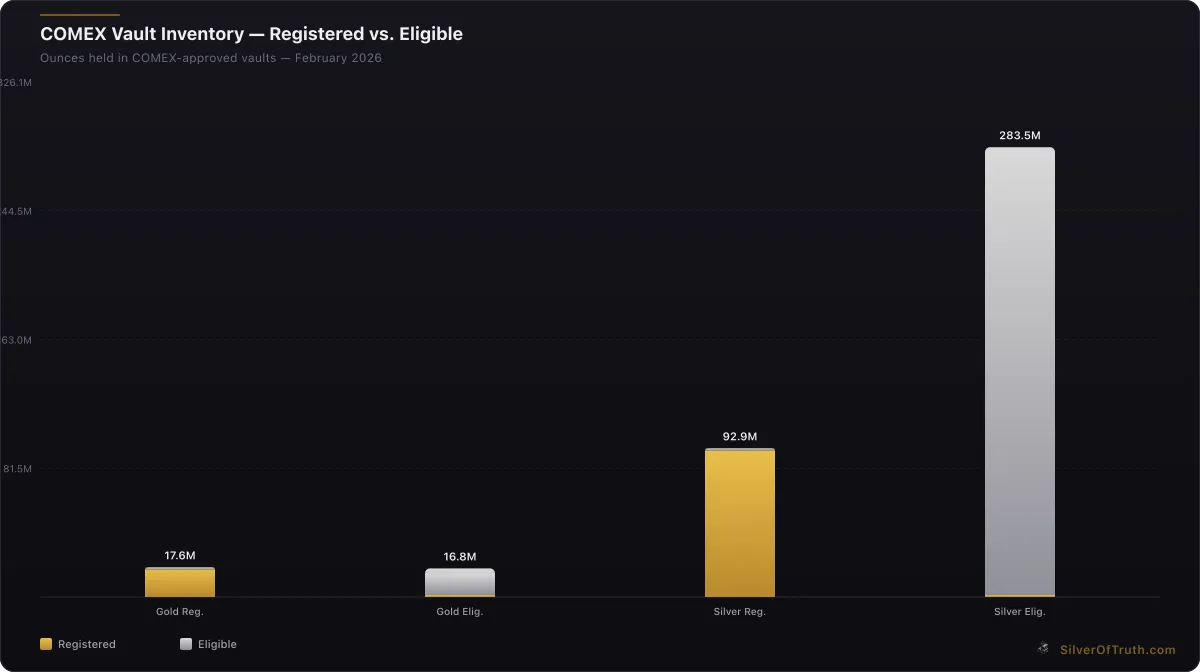
Source: SilverOfTruth COMEX data, February 2026
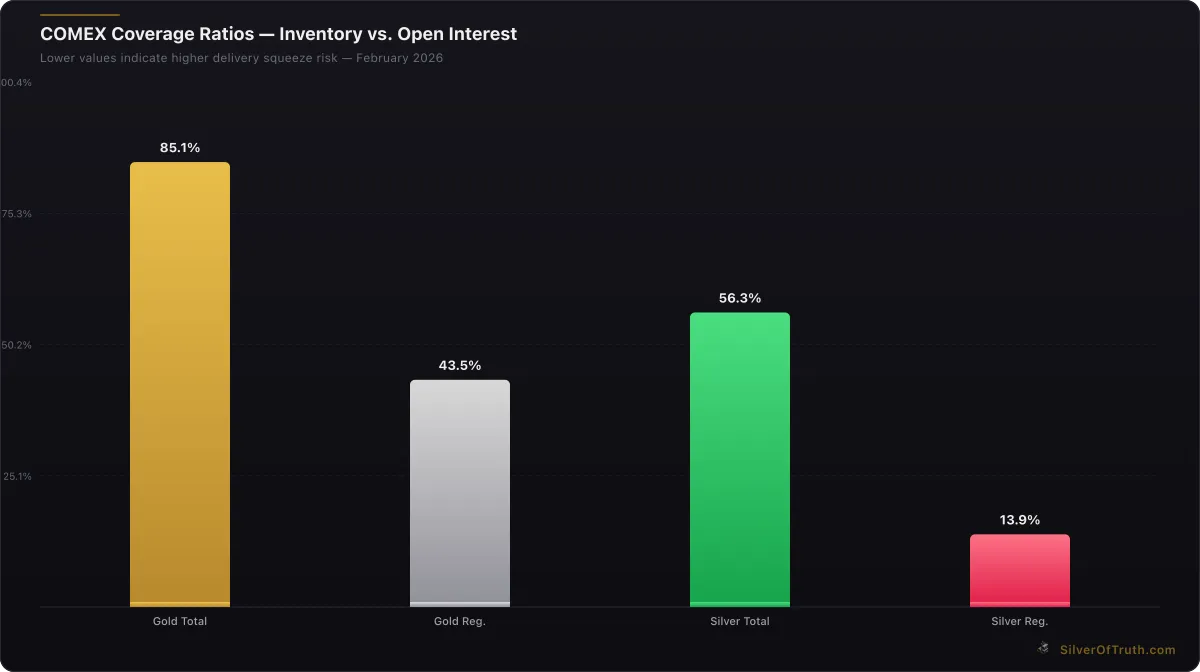
COMEX coverage ratios — lower values indicate higher delivery squeeze risk. Source: SilverOfTruth, February 2026
Electrical Conductivity Excellence
Silver possesses the highest electrical conductivity of all elements, with a conductivity rating of 63.0 × 10^6 siemens per meter at room temperature. This superior conductivity is critical in solar panels because any resistance in the electrical pathways results in power losses that directly reduce the panel's energy output and economic value.
Copper, silver's closest competitor in conductivity, measures approximately 94% of silver's performance. While this difference might seem minimal, in solar applications where efficiency gains of even 1-2% can justify significant cost premiums, silver's conductivity advantage translates to measurably higher electricity generation over a panel's 25-30 year lifespan.
The financial impact becomes clear when considering utility-scale installations: a 100MW solar farm might generate an additional $500,000-$1 million in electricity revenue over its lifetime by using silver instead of copper conductors, easily justifying the higher material costs.
Corrosion Resistance and Longevity
Solar panels must withstand decades of exposure to moisture, temperature fluctuations, UV radiation, and atmospheric pollutants. Silver's exceptional corrosion resistance ensures that electrical connections remain intact throughout the panel's operational life, preventing the degradation that would reduce power output over time.
Alternative metals like aluminum or copper can develop oxide layers that increase resistance and reduce conductivity. While coatings can provide temporary protection, they may fail over extended periods, particularly under the thermal stress of solar installations where panel temperatures routinely exceed 150°F (65°C).
High-Temperature Performance
Silver maintains its electrical properties across the wide temperature range that solar panels experience, from sub-zero winter conditions to extreme summer heat. This thermal stability is crucial for consistent performance, as electrical resistance in many materials increases significantly with temperature.
The coefficient of thermal expansion for silver also closely matches that of silicon, reducing mechanical stress on solder joints and electrical connections as panels heat and cool with daily temperature cycles. This compatibility minimizes the risk of connection failures that could render entire sections of a panel inoperable.
Solar Silver Consumption by Panel Technology
Different solar panel technologies exhibit varying silver consumption patterns, with newer high-efficiency designs generally requiring more silver per watt of capacity. This trend creates an interesting dynamic where technological improvements intended to reduce overall material usage often increase silver intensity.
Monocrystalline Silicon Panels
Monocrystalline panels, which dominate the residential market with approximately 60% market share, typically use 18-22 grams of silver per panel. These panels achieve efficiencies of 20-22% and require precise silver grid patterns to maximize current collection from their uniform silicon structure.
The manufacturing process involves screen-printing silver paste in increasingly fine lines to minimize shading while maximizing conductivity. Advanced monocrystalline panels now use finger widths as narrow as 30 microns, requiring ultra-pure silver formulations that maintain conductivity despite reduced cross-sectional area.
Polycrystalline Silicon Panels
Polycrystalline panels use slightly more silver (20-25 grams per panel) to compensate for their lower base efficiency of 17-19%. The varied grain structure in polycrystalline silicon creates additional electrical resistance that manufacturers offset by increasing silver content in the conductive pathways.
While polycrystalline technology has been losing market share to monocrystalline alternatives, it remains significant in utility-scale installations where lower costs can offset efficiency disadvantages, particularly in regions with abundant land availability.
Bifacial and PERC Technologies
Advanced panel technologies like PERC (Passivated Emitter and Rear Cell) and bifacial panels require 25-30 grams of silver per panel due to their enhanced electrical collection systems. PERC panels add a reflective layer that increases efficiency but requires additional silver interconnections to capture the additional current generation.
Bifacial panels, which generate electricity from both front and rear surfaces, need silver pathways on both sides of the cell structure. While this doubles certain silver requirements, the increased power output (typically 10-20% higher than traditional panels) makes the additional silver cost economically justifiable.
Global Solar Silver Demand Projections
The International Energy Agency's latest renewable energy forecasts indicate that global solar capacity will triple from 2025 to 2030, reaching over 3,000 GW of cumulative installed capacity. This expansion trajectory suggests that solar silver consumption will increase dramatically even if per-panel silver content remains constant.
Regional Demand Drivers
China continues to dominate both solar manufacturing and installation, accounting for approximately 70% of global panel production and 40% of new installations. Chinese domestic demand for silver in solar applications reached an estimated 60 million ounces in 2025, with exports adding another 40 million ounces of embodied silver content.
The United States solar market, driven by federal tax incentives and state renewable portfolio standards, consumed approximately 25 million ounces of silver through solar installations in 2025. The Inflation Reduction Act's manufacturing incentives are expected to increase domestic solar silver demand as U.S. panel production capacity expands.
European solar installations, spurred by energy security concerns and accelerated renewable targets following geopolitical tensions, accounted for roughly 20 million ounces of silver consumption in 2025. Germany, Spain, and the Netherlands lead regional demand, with distributed solar installations requiring higher silver intensity than utility-scale projects.
India's ambitious solar expansion program, targeting 280 GW of solar capacity by 2030, represents a rapidly growing source of silver demand. Current installations consume approximately 15 million ounces annually, but this figure could double by decade's end as the program accelerates.
Demand Growth Scenarios
Conservative estimates, assuming modest efficiency improvements and stable silver loading per panel, project solar silver demand reaching 180-200 million ounces annually by 2028. This represents a 30-40% increase from current levels and would make solar applications the largest single source of industrial silver demand.
Aggressive scenarios, incorporating accelerated deployment schedules and limited success in silver thrifting (reducing silver content per panel), suggest demand could reach 220-250 million ounces by 2028. Such demand levels would represent nearly 20% of total annual silver mine production, creating significant supply pressure in conjunction with other industrial applications.
The growing silver supply deficit becomes more acute when considering that solar demand is largely inelastic—panels must function properly regardless of silver prices, limiting the industry's ability to reduce consumption in response to price increases.
Silver Substitution Challenges in Solar Technology
Despite silver's high cost relative to alternative conductors, successful substitution remains limited due to performance trade-offs that would reduce panel efficiency and long-term reliability. Multiple research programs have attempted to reduce silver consumption, with mixed results that highlight the metal's irreplaceable properties.
Copper Alternatives and Limitations
Copper represents the most viable silver substitute from a conductivity standpoint, offering 94% of silver's electrical performance at roughly 1% of the cost. However, copper's susceptibility to oxidation creates significant reliability concerns in outdoor applications spanning multiple decades.
Manufacturers have experimented with copper-core conductors with silver coating, reducing total silver content by 40-60% while maintaining surface conductivity. However, these hybrid approaches add manufacturing complexity and potential failure points where the silver coating might degrade, exposing the underlying copper to corrosion.
Field testing of copper-enhanced solar panels has shown acceptable short-term performance, but questions remain about degradation rates over 20-25 year operational periods. Most manufacturers avoid copper substitution in premium panels where warranties and performance guarantees create long-term liability exposure.
Aluminum and Other Alternatives
Aluminum conducts electricity at only 61% of silver's efficiency, making it unsuitable for fine-line applications where current density is critical. While aluminum can work for broader electrical pathways, the increased cross-sectional area required would create excessive shading on solar cells, reducing overall panel efficiency.
Nickel, tin, and other conductive metals have been evaluated but face similar trade-offs between conductivity, corrosion resistance, and manufacturability. Most alternative formulations require significant increases in conductor width or thickness, offsetting cost savings through reduced panel efficiency.
Silver Thrifting vs. Efficiency Demands
The solar industry has made modest progress in "silver thrifting"—reducing silver consumption per watt of panel capacity through improved manufacturing techniques and paste formulations. Average silver loading has decreased from approximately 130mg per watt in 2016 to roughly 75-85mg per watt in 2025.
However, this efficiency improvement is being offset by the industry's simultaneous push for higher-efficiency panels that require more precise, silver-intensive electrical pathways. PERC, TOPCon, and heterojunction technologies all use more silver per panel than basic monocrystalline designs, creating a tug-of-war between material cost reduction and performance optimization.
The net result is that silver consumption per panel has remained relatively stable despite technological advances, with efficiency gains consuming most of the material savings achieved through improved manufacturing processes.
Economic Impact on Silver Markets
Solar silver demand creates unique market dynamics that differ significantly from traditional precious metals applications. Unlike jewelry or investment demand, which can fluctuate with economic cycles and price movements, solar demand exhibits strong price inelasticity driven by the long-term nature of solar investments and the critical importance of panel reliability.
Price Elasticity Analysis
Economic analysis suggests that solar silver demand exhibits an elasticity coefficient of approximately -0.15, meaning that a 10% increase in silver prices typically reduces consumption by only 1.5%. This low elasticity reflects several factors:
Solar panels are long-term investments with 25-30 year operational lives, making upfront material costs a small fraction of lifetime economic value. For a typical residential installation costing $15,000-25,000, the silver content represents only 2-4% of total system cost even at current elevated silver prices.
Panel manufacturers face strong competitive pressure to maintain efficiency ratings and warranties, limiting their flexibility to reduce silver content in response to price fluctuations. Performance degradation that might save $50-100 in silver costs could reduce a panel's lifetime electricity generation by thousands of dollars.
Supply Chain Integration
The solar industry's silver supply chain has become increasingly integrated, with major panel manufacturers securing long-term supply agreements directly with silver refiners and recyclers. This vertical integration reduces spot market exposure but creates committed demand that persists regardless of short-term price volatility.
Companies like LONGi Solar, JinkoSolar, and Canadian Solar have established strategic partnerships with silver suppliers to ensure consistent material availability for production scaling. These agreements often include minimum purchase commitments that provide floor-level demand support for silver markets.
Recycling and Secondary Supply
Solar panel recycling remains in early stages but represents a potential future source of silver supply. Panels installed in the early 2000s are beginning to reach end-of-life, though the recycling infrastructure to recover their silver content economically is still developing.
Current estimates suggest that panel recycling could eventually recover 80-90% of embedded silver content, but the timeline for meaningful recycling volumes extends beyond 2035 as most panels haven't reached their 25-30 year design life. Near-term silver demand must therefore be met primarily through mining production and above-ground stocks.
Integration with Broader Silver Demand Trends
Solar silver consumption doesn't exist in isolation but interacts with other major industrial demand categories to create compounding supply pressure. Understanding these interactions helps explain why solar growth contributes to broader silver market tightness beyond just the direct consumption numbers.
Electronics and Technology Synergies
The same technological advancement driving solar adoption also increases silver demand in complementary applications. Smart inverters, energy storage systems, and electrical vehicle charging infrastructure all require silver-intensive components that multiply the metal's exposure to renewable energy growth.
5G telecommunications infrastructure deployment often accompanies solar installation projects, as renewable energy sites require advanced communication systems for grid integration and remote monitoring. This convergence creates regional demand clusters where multiple silver-intensive technologies are implemented simultaneously.
Electric vehicle adoption, closely correlated with solar energy deployment in many markets, adds additional industrial silver demand through battery management systems, charging infrastructure, and vehicle electronics. A typical EV uses 25-50 grams of silver, creating demand synergies with residential solar installations.
Medical and Industrial Applications
The COVID-19 pandemic highlighted silver's antimicrobial properties, spurring demand growth in medical applications, water treatment, and air purification systems. These applications often exhibit similar price inelasticity to solar demand, as performance and safety requirements limit substitution options.
Industrial processes ranging from chemical catalysis to electronics manufacturing continue expanding their silver consumption as global manufacturing capacity increases. Many of these applications compete directly with solar demand for the same high-purity silver grades, creating supply chain bottlenecks during periods of rapid growth.
Investment Demand Interactions
Solar demand growth has begun influencing precious metals investment strategies, as investors recognize the structural demand implications for silver markets. This creates feedback loops where solar-driven supply deficits attract investment flows that further tighten physical markets.
Exchange-traded funds focused on silver miners or industrial metals often cite solar demand as a key investment thesis, channeling capital toward silver-leveraged equities and commodities. This financial flow amplification multiplies the market impact of underlying physical demand trends.
Future Technology Developments and Implications
Emerging solar technologies could significantly alter silver consumption patterns over the next decade, with some innovations potentially increasing demand while others might enable meaningful substitution. Monitoring these technological developments provides early indicators of future silver demand trajectories.
Perovskite and Tandem Cell Technologies
Perovskite solar cells, which can be layered with traditional silicon cells to create high-efficiency tandem designs, may require different silver formulations and quantities. Early research suggests that perovskite cells might use less silver per cell but could require silver nanoparticles or specialized conductive layers.
If perovskite-silicon tandems achieve commercial viability with efficiencies exceeding 35%, the resulting cost-per-watt improvements might justify higher silver consumption per panel. This premium technology segment could drive silver intensity upward even as mainstream panels become more efficient.
Concentrated Solar Power Integration
Concentrated solar power (CSP) systems, which use mirrors to focus sunlight for thermal electricity generation, require significant silver content in their reflective surfaces and heat transfer systems. While CSP represents a smaller market than photovoltaics, growth in this sector adds incremental silver demand.
Hybrid systems combining photovoltaic panels with thermal collection for combined electricity and heat generation are emerging in commercial applications. These systems typically require 30-50% more silver than traditional PV installations due to their dual functionality and enhanced electrical interconnection requirements.
Manufacturing Process Innovations
Advanced manufacturing techniques like screen printing with finer resolution, laser processing, and electroplating might enable reduced silver consumption per panel while maintaining performance. However, these same technologies often enable higher-efficiency designs that offset material savings.
Additive manufacturing approaches using silver nanoparticles could revolutionize solar cell production, potentially reducing silver consumption through precise material placement. However, nanoparticle formulations often require higher silver purity and specialized processing, which might increase net demand despite reduced quantities per panel.
FAQ
How much silver is in a typical solar panel?
A typical residential solar panel contains 18-22 grams (0.58-0.71 troy ounces) of silver. Commercial and utility-scale panels may use 25-30 grams due to their larger size and higher efficiency requirements. The silver exists primarily as conductive paste printed onto silicon wafers to create electrical pathways.
Can solar panels work without silver?
While alternative materials like copper could theoretically replace silver, they would significantly reduce panel efficiency and long-term reliability. Silver's superior conductivity and corrosion resistance are critical for maintaining performance over a solar panel's 25-30 year lifespan. Substitution attempts have been largely unsuccessful in commercial applications.
What percentage of global silver demand comes from solar panels?
Solar panels consumed approximately 140 million ounces of silver in 2025, representing about 12% of total annual silver demand. This percentage has grown rapidly from just 5% in 2015 and is projected to reach 15-18% by 2030 as solar installations accelerate globally.
How does silver price affect solar panel costs?
Silver represents only 2-4% of total solar system installation costs, so price changes have minimal impact on solar adoption rates. A 50% increase in silver prices might raise panel costs by 1-2%, which is easily offset by ongoing efficiency improvements and manufacturing scale benefits.
Will silver recycling from old solar panels reduce demand?
Solar panel recycling will eventually recover significant silver quantities, but meaningful volumes won't emerge until the 2040s when panels installed in the 2010s reach end-of-life. Current recycling infrastructure can recover 80-90% of embedded silver, but near-term demand must be met through mining and existing stocks.
Solar panels represent a structural demand driver for silver that will intensify over the coming decade as renewable energy deployment accelerates globally. With each panel requiring 15-30 grams of irreplaceable silver content and installation rates climbing rapidly, this application alone could consume 200+ million ounces annually by 2030.
The inelastic nature of solar silver demand, combined with declining mine supply and growing industrial applications, creates compelling supply-demand dynamics for silver markets. Track real-time silver prices and inventory data in the SilverOfTruth app, available on the App Store.
Understanding how solar energy growth drives silver consumption provides crucial context for evaluating precious metals markets and the broader energy transition's commodity implications. As solar becomes the world's dominant electricity source, silver's role as the critical conductive metal positions it at the center of the renewable energy revolution.
Disclaimer: This article is for informational and educational purposes only and does not constitute financial, investment, or trading advice. Past performance is not indicative of future results. Always conduct your own research and consult with a qualified financial advisor before making investment decisions. SilverOfTruth provides market data and analysis tools — it does not provide personalized financial advice.