
Despite silver's impressive 2.81% surge to $77.81 on February 13th, a complex web of inflation dynamics and macroeconomic pressures continues to weigh on the white metal's longer-term momentum. While today's price action suggests renewed optimism, underlying CPI fluctuations and Federal Reserve policy expectations are creating cross-currents that savvy precious metals investors cannot ignore. Understanding how inflation data translates into silver price movements has become critical for positioning in today's volatile macro environment, particularly as our comprehensive analysis in the Silver Investing 101 hub demonstrates the metal's evolving role as both an industrial commodity and monetary hedge.
Quick Answer: CPI fluctuations create conflicting signals for silver by influencing real interest rates, dollar strength, and inflation expectations. While rising CPI typically supports precious metals through debasement fears, volatile inflation readings can strengthen the dollar and raise real yields, creating headwinds for non-yielding assets like silver.
The relationship between Consumer Price Index readings and silver prices has grown increasingly nuanced in 2026's complex monetary environment. Traditional correlations between inflation data and precious metals have been disrupted by Federal Reserve policy pivots, geopolitical tensions, and silver's expanding industrial applications in green technology. Today's market dynamics require investors to look beyond headline CPI numbers to understand the deeper mechanisms driving silver's price action.
What Makes CPI Data So Critical for Silver Investors?
The Consumer Price Index serves as the Federal Reserve's primary gauge for inflation targeting, directly influencing monetary policy decisions that cascade through precious metals markets. When CPI readings exceed expectations, they typically signal potential Fed hawkishness, leading to higher real interest rates that compete with non-yielding assets like silver. Conversely, below-trend CPI data can spark dovish expectations and weaken the dollar, traditionally benefiting precious metals.
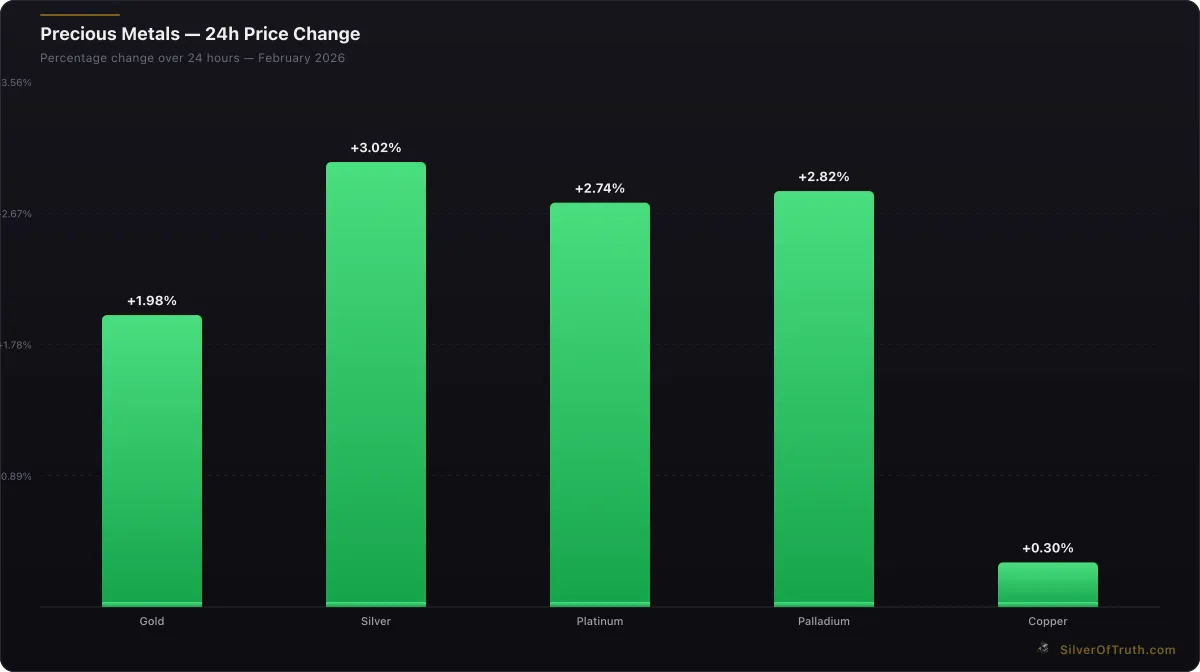
24-hour precious metals price changes. Source: SilverOfTruth, February 2026
Recent Bureau of Labor Statistics data shows core CPI running at 3.2% year-over-year as of January 2026, still well above the Fed's 2% target despite months of gradual deceleration. This persistent inflation has created a policy dilemma: aggressive tightening risks recession while accommodation risks re-accelerating price pressures. Silver finds itself caught in this monetary policy crossfire, as the metal's dual nature as both industrial input and store of value creates competing price pressures.
The complexity deepens when considering inflation expectations versus actual readings. Market-based measures like the 5-year, 5-year forward inflation expectation rate currently trade near 2.4%, suggesting long-term confidence in Fed credibility. However, shorter-term expectations remain elevated, creating volatility in real yield calculations that directly impact silver's relative attractiveness compared to Treasury Inflation-Protected Securities (TIPS).
How Do Real Interest Rates Shape Silver's Macro Environment?
Real interest rates—nominal yields minus inflation expectations—represent perhaps the most critical macro variable for silver pricing. When real rates rise, they increase the opportunity cost of holding non-yielding precious metals, while negative real rates typically support gold and silver by making cash and bonds less attractive stores of value.
Current market conditions show 10-year Treasury yields near 4.1% against inflation expectations of roughly 2.4%, implying real rates around 1.7%. This positive real rate environment has historically created headwinds for precious metals, as investors can achieve positive real returns through government bonds without the storage costs and volatility associated with physical metals.
However, silver's industrial demand profile provides some insulation from pure monetary dynamics. Unlike gold, which serves primarily as a monetary metal, silver's consumption in solar panels, electric vehicles, and 5G infrastructure creates fundamental demand that persists regardless of real rate fluctuations. Our Silver Supply Deficit analysis highlights how structural deficits in the physical market can override short-term monetary headwinds.
The Federal Reserve's dot plot projections suggest potential rate cuts later in 2026 if inflation continues moderating, which could shift real rate calculations in silver's favor. Market pricing currently reflects approximately 75 basis points of cuts by year-end, though this remains contingent on economic data cooperation. Track these evolving dynamics with our Inflation Calculator to understand real return implications for your precious metals allocation.
What Role Does Dollar Strength Play in Silver's Inflation Response?
The U.S. Dollar Index (DXY) serves as a critical transmission mechanism between inflation data and precious metals prices. CPI releases that exceed expectations often strengthen the dollar by raising expectations for continued Fed hawkishness, creating headwinds for dollar-denominated commodities including silver. Conversely, below-trend inflation readings can weaken the dollar and support precious metals pricing.
Recent dollar strength has coincided with mixed inflation signals, as markets grapple with sticky services inflation against moderating goods prices. The dollar's role as the global reserve currency amplifies these effects, as international investors often view dollar strength as reducing the appeal of alternative stores of value like precious metals.
Silver's international pricing dynamics add another layer of complexity. While U.S. CPI data directly influences domestic monetary policy, silver trades globally with significant demand centers in Asia and Europe. Shanghai Gold Exchange premiums and London Bullion Market pricing can diverge from COMEX futures based on regional inflation expectations and currency movements.
Geopolitical factors further complicate the dollar-silver relationship. BRICS nations' efforts to reduce dollar dependence in international trade could potentially insulate precious metals from some dollar-driven volatility, though this remains a long-term structural shift rather than near-term price driver. Our analysis of de-dollarization trends explores these evolving dynamics.
Why Are Inflation Expectations More Important Than Actual CPI?
Forward-looking inflation expectations often drive precious metals pricing more than backward-looking CPI data. Market participants price securities based on anticipated future conditions, making measures like breakeven inflation rates and consumer inflation sentiment critical leading indicators for silver performance.
The University of Michigan's consumer sentiment survey includes questions about inflation expectations that can signal shifts in public perception before they appear in official statistics. When consumers expect higher future inflation, they may increase purchases of real assets including precious metals as hedges against currency debasement. Conversely, falling inflation expectations can reduce precious metals' appeal as protective assets.
Professional forecasters surveyed by the Federal Reserve Bank of Philadelphia provide another crucial data point. Their quarterly Survey of Professional Forecasters includes long-term inflation projections that influence institutional portfolio allocation decisions. Recent surveys show professional economists expecting inflation to gradually return to the Fed's 2% target by 2027, though with considerable uncertainty around the path and timing.
Market-based measures derived from Treasury Inflation-Protected Securities provide real-time insight into investor inflation expectations. The 10-year breakeven inflation rate currently trades near 2.3%, suggesting markets expect moderate inflation over the next decade. However, these measures can be distorted by liquidity conditions and technical factors, requiring careful interpretation alongside survey-based measures.
How Does Silver's Industrial Demand Interact with Inflation Pressures?
Silver's extensive industrial applications create unique dynamics during inflationary periods that distinguish it from purely monetary metals like gold. Industrial users of silver—including electronics manufacturers, solar panel producers, and medical device companies—face input cost pressures when inflation drives up raw material prices, potentially reducing demand even as monetary factors support precious metals.
However, inflation also increases the nominal prices of finished goods containing silver, which can maintain or expand profit margins for producers even as input costs rise. Solar panel manufacturers, for example, may pass through higher silver costs to customers while benefiting from government subsidies that support renewable energy adoption regardless of commodity price fluctuations.
The timing of industrial demand responses to inflation differs significantly from investment demand. Industrial users often hedge future silver needs through forward contracts, insulating their operations from short-term price volatility while creating more stable long-term demand. Investment demand, conversely, can shift rapidly based on changing inflation expectations and monetary policy signals.
Silver's role in emerging technologies adds another dimension to its inflation relationship. Electric vehicle production, 5G infrastructure deployment, and advanced medical applications all require silver inputs that become more expensive during inflationary periods. However, these technological trends represent structural demand growth that typically continues despite temporary price fluctuations. Our comprehensive silver industrial demand analysis explores these evolving consumption patterns.
What Do Current COMEX Positioning Signals Reveal About Inflation Hedging Demand?
COMEX futures positioning data provides insight into how different market participants respond to inflation dynamics. Current data shows silver's total COMEX inventory at 376.4 million ounces with registered stocks at 92.9 million ounces, representing a coverage ratio of just 12.98% against open interest of 143,180 contracts. This tight inventory situation suggests strong physical demand despite macro headwinds.
Commercial traders—primarily producers and industrial users—maintain a net short position of 45,725 contracts in silver futures according to the latest CFTC Commitments of Traders data. This positioning reflects hedging activity as miners lock in current prices and industrial users secure future supply. The magnitude of commercial shorts has actually decreased recently, suggesting less aggressive hedging as inflation expectations moderate.
Managed money funds, often viewed as speculative investors, hold a modest net long position of 4,983 contracts in silver. This relatively small speculative interest contrasts with the extreme positioning often seen during precious metals rallies, suggesting room for additional investment demand if inflation fears resurge. Monitor these positioning shifts with our COT Dashboard to track evolving sentiment.
The concentration data reveals top four traders hold 35.6% of all short positions while top four longs control just 22.6%, indicating asymmetric positioning that could amplify price moves if shorts begin covering positions. This setup becomes particularly relevant if inflation data surprises to the upside and triggers renewed precious metals buying from inflation-conscious investors.
How Should Investors Position for Ongoing Inflation Volatility?
Navigating silver's response to inflation fluctuations requires understanding both the metal's monetary properties and its industrial demand fundamentals. Rather than attempting to time short-term CPI releases, successful precious metals investors typically focus on longer-term trends in monetary policy, currency debasement, and structural supply-demand imbalances.
Portfolio allocation strategies should consider silver's correlation with other asset classes during different inflation regimes. During periods of rising inflation expectations, silver often outperforms stocks and bonds while underperforming during deflation scares or periods of stable, moderate inflation. Historical analysis shows silver's best performance occurs during stagflation periods when economic growth slows while inflation remains elevated.
Physical silver ownership provides the purest exposure to inflation hedging benefits, though investors should consider storage costs and liquidity needs. Our Physical Silver Guide offers comprehensive analysis of coins versus bars, storage options, and dealer premium considerations. Use our Stack Calculator to evaluate allocation sizes based on portfolio objectives and inflation protection goals.
Mining stocks offer leveraged exposure to silver prices while providing dividend income and potential growth from operational improvements. However, mining equities carry additional risks including operational challenges, regulatory changes, and equity market correlation that may reduce their effectiveness as pure inflation hedges. Our detailed Mining Stock Analysis hub explores these trade-offs in depth.
What Does Technical Analysis Suggest About Silver's Inflation Response?
Silver's current price action at $77.81 represents a significant technical development following today's 2.81% surge from a low of $73.75. This $4.06 intraday range demonstrates the volatility that characterizes precious metals during periods of macro uncertainty. The break above $77.00 resistance suggests potential for further upside if inflation concerns resurge or dollar weakness develops.
The Gold/Silver Ratio currently trades at 64.99, well below its long-term average of approximately 68, indicating silver's relative strength compared to gold. This ratio often serves as a gauge for risk appetite in precious metals markets, with lower ratios suggesting stronger industrial demand and higher risk tolerance among metal investors. Track current ratio levels with our Gold/Silver Ratio Calculator to identify strategic allocation opportunities.
Momentum indicators suggest silver remains in a consolidation phase despite today's strength, with longer-term trends dependent on resolution of macro uncertainties including Federal Reserve policy direction and global economic growth prospects. Support levels appear solid near $73.00 based on recent trading action, while resistance emerges around $80.00 based on previous peaks.
Volume patterns in both futures and ETF markets suggest measured institutional participation rather than panic buying or selling, indicating markets are processing inflation data rationally rather than emotionally. This measured response suggests silver prices remain driven by fundamental factors rather than speculative positioning, which typically supports more sustainable price moves.
The path forward for silver's inflation response depends heavily on upcoming economic data releases and Federal Reserve communications. Key indicators to monitor include monthly CPI reports, Fed meeting minutes, employment data that influences inflation expectations, and any shifts in central bank rhetoric regarding policy normalization timelines.
For investors seeking comprehensive precious metals market intelligence, the SilverOfTruth app consolidates real-time pricing, inventory tracking, and positioning analysis into a single mobile command center. Available on the iOS App Store, the app provides institutional-grade market data and AI-powered analysis to help navigate complex macro environments like today's inflation-driven market conditions. Our Silver Investing 101 hub offers additional educational resources for understanding how macroeconomic factors influence precious metals performance across different market cycles.
Frequently Asked Questions
Q: How quickly do CPI releases impact silver prices? A: Silver typically reacts within minutes to hours of major CPI releases, with initial moves often driven by algorithmic trading. However, sustained price trends develop over days to weeks as markets digest broader implications for Federal Reserve policy and real interest rates.
Q: Is silver a better inflation hedge than gold? A: Silver offers higher volatility and potential returns during inflationary periods but also carries greater downside risk. Gold provides more stable purchasing power preservation, while silver's industrial demand can amplify both upside and downside moves during economic transitions.
Q: Should investors buy silver when CPI exceeds expectations? A: CPI surprises create short-term volatility but long-term silver performance depends more on sustained inflation trends, monetary policy responses, and structural supply-demand factors. Focus on allocation consistency rather than timing individual data releases.
Q: How do international inflation rates affect silver prices? A: Global inflation trends influence currency exchange rates, international trade flows, and industrial demand patterns that impact silver pricing. However, U.S. CPI data typically has the greatest immediate impact due to the dollar's reserve currency status and Fed policy influence.
Q: Can silver maintain value during deflation? A: Deflation scenarios typically pressure commodity prices including silver, though the metal's monetary properties and supply constraints can provide some downside protection. Historical performance during deflationary periods shows significant volatility with eventual recovery as monetary policies respond.
Sources
- Bureau of Labor Statistics Consumer Price Index: https://www.bls.gov/cpi/
- CFTC Commitments of Traders Reports: https://www.cftc.gov/dea/futures/other_lf.htm
- Federal Reserve Economic Data: https://fred.stlouisfed.org/
- CME Group COMEX Data: https://www.cmegroup.com/markets/metals.html
- University of Michigan Consumer Sentiment Survey: https://data.sca.isr.umich.edu/
- World Gold Council Research: https://www.gold.org/goldhub/data
Disclaimer: This article is for informational and educational purposes only and does not constitute financial, investment, or trading advice. Past performance is not indicative of future results. Always conduct your own research and consult with a qualified financial advisor before making investment decisions. SilverOfTruth provides market data and analysis tools — it does not provide personalized financial advice.