


The Federal Reserve's monetary policy decisions hinge critically on employment data, but emerging evidence of significant Federal Reserve revisions to jobs numbers could fundamentally alter the central bank's hawkish stance. With gold trading at $5,078.50/oz and silver at $82.33/oz according to SilverOfTruth data, potential data corrections could create the perfect storm for a precious metals rally as markets reassess Fed policy assumptions. Historical precedent shows that major employment data revisions have consistently preceded precious metals bull runs, as investors lose faith in the Fed's data-driven approach.
Current market positioning suggests traders are already hedging against this possibility, with COMEX silver showing elevated risk levels and positioning data indicating potential for explosive upside moves.
The Employment Data Foundation of Fed Policy
The Federal Reserve's dual mandate of price stability and maximum employment places extraordinary weight on monthly jobs reports. The Bureau of Labor Statistics' nonfarm payrolls data directly influences Federal Open Market Committee decisions, with strong employment numbers typically supporting hawkish policy stances that pressure precious metals prices.
However, the jobs data impact on monetary policy becomes problematic when initial reports prove inaccurate. The BLS conducts quarterly benchmark revisions and annual comprehensive revisions that can significantly alter the employment picture.
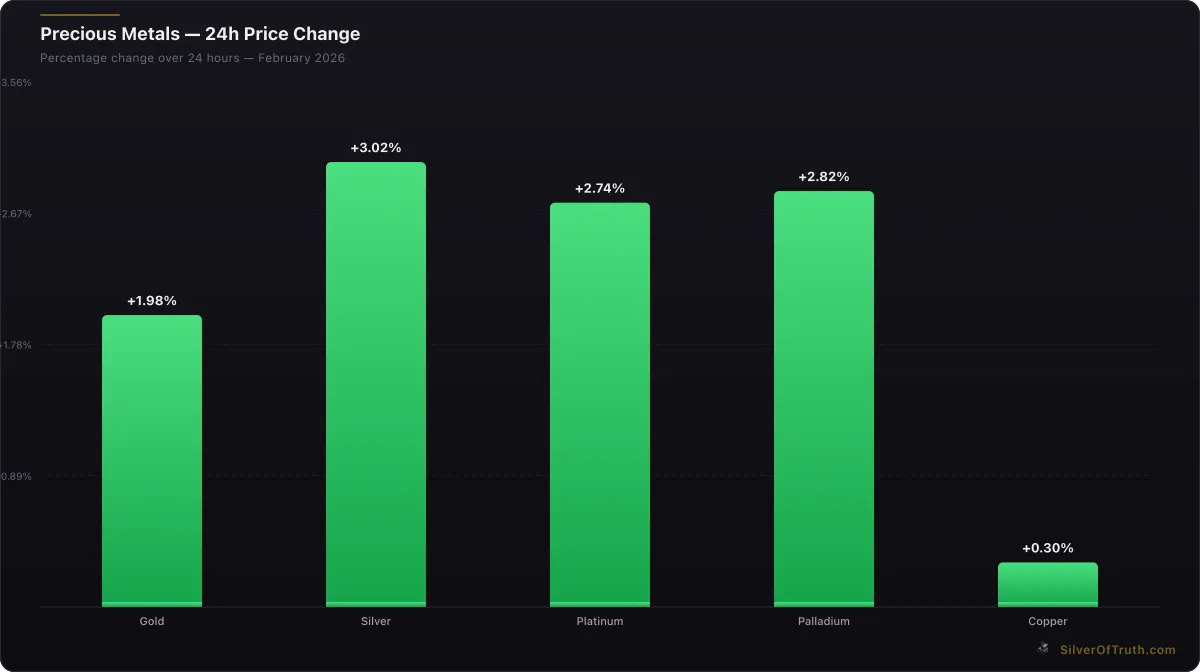
24-hour precious metals price changes. Source: SilverOfTruth, February 2026
According to Federal Reserve research, these revisions have averaged 0.1% of total employment over the past decade, but individual monthly revisions can exceed 100,000 jobs. Recent social media discussions and market analyst commentary have highlighted unusually large divergences between initial payroll reports and subsequent revisions.
The Philadelphia Federal Reserve's early benchmark revisions suggested potential overstatement of job creation in several metropolitan areas, raising questions about national data accuracy. When employment data undergoes major downward revisions, it typically signals the economy was weaker than initially perceived during the revision period. This scenario has historically preceded Fed policy pivots toward accommodation, creating bullish conditions for precious metals as real interest rates decline and inflation hedging demand increases.
Current Market Positioning Reveals Hedging Activity
According to SilverOfTruth's latest COMEX data, silver inventory shows concerning tightness with total stocks at 381.57 million ounces and a coverage ratio of just 53.3%. The registered coverage ratio of only 13.71% indicates HIGH risk conditions, suggesting limited deliverable silver relative to outstanding futures contracts. This positioning becomes critical when considering potential Fed policy shifts.
CFTC Commitment of Traders data shows commercial traders (typically the smart money) holding net short positions of -45,725 contracts in silver, down from more extreme levels but still indicating producer hedging against higher prices. Gold positioning reveals similar dynamics with commercials net short -207,778 contracts according to the latest COT report. However, the recent reduction in speculative long positions suggests market participants are positioning for volatility rather than expressing directional conviction.
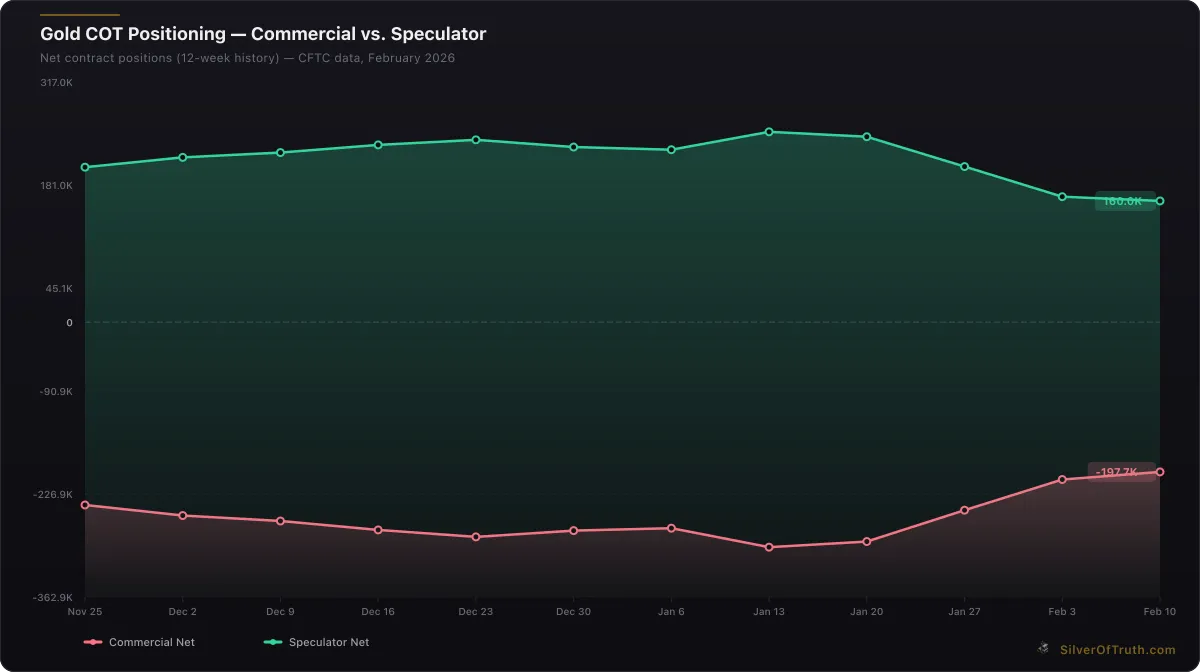
Gold COT positioning: commercial hedgers (red) vs. speculators (green). Source: CFTC via SilverOfTruth, February 2026
The current gold/silver ratio at 61.68 sits below its long-term average, historically indicating silver may outperform gold during precious metals rallies. This positioning aligns with our analysis in understanding the Gold/Silver Ratio, where we detailed how ratio compression often signals broader precious metals strength.
Historical Precedent: Data Revisions Drive Policy Pivots
The 2001-2003 period provides a compelling case study for how employment data revisions influenced Fed policy and precious metals prices. Initial jobs reports in late 2001 suggested economic resilience following the dot-com crash, supporting the Fed's cautious approach to rate cuts.
However, comprehensive benchmark revisions in 2002 revealed the economy had lost significantly more jobs than initially reported. These revisions contributed to the Fed's decision to cut rates to 1%, creating the monetary conditions that drove gold from $300 to over $400 per ounce by 2004.
Similarly, the 2008 financial crisis was preceded by employment data that initially understated job losses. When benchmark revisions revealed the true extent of labor market weakness, the Fed's emergency accommodation measures included quantitative easing programs that drove gold from $800 to over $1,900 per ounce by 2011.
More recently, 2019 benchmark revisions showed significantly slower job growth than initially reported, contributing to the Fed's decision to cut rates despite initially hawkish projections. Gold rallied from $1,200 to $1,550 during this period, demonstrating how data corrections can reshape policy expectations. The pattern remains consistent: major downward employment revisions typically precede Fed policy accommodation, creating bullish conditions for precious metals as real interest rates decline and currency debasement concerns increase.
Current Economic Context Amplifies Revision Impact
The potential for significant employment data revisions carries amplified importance in today's economic environment. The Federal Reserve has maintained elevated interest rates based partly on labor market strength, with Chairman Powell frequently citing job market resilience as justification for maintaining restrictive policy. However, recent economic indicators suggest potential weakness that employment data may not fully capture.
The Sahm Rule, which uses unemployment rate changes to identify recession beginnings, shows concerning trends despite strong headline payroll numbers. This divergence often indicates data collection or seasonal adjustment issues that manifest in subsequent revisions.
Additionally, the rise of gig economy employment and remote work has complicated traditional job counting methodologies. The BLS has acknowledged challenges in accurately capturing non-traditional employment arrangements, potentially leading to systematic overstatement of formal employment relationships.
Current inflation data shows persistent above-target readings despite Fed tightening, suggesting either policy transmission lags or economic strength that may prove illusory if employment data undergoes significant downward revision. As we explored in our COMEX inventory analysis, monetary policy uncertainty typically drives physical precious metals demand.
Silver's Technical Setup Suggests Explosive Potential
SilverOfTruth's current silver price of $82.33/oz represents a critical technical juncture, with the metal trading within range of key resistance levels that have historically preceded major breakouts. The combination of tight COMEX inventory conditions and potential Fed policy pivot creates favorable conditions for significant price appreciation.
The silver market's unique industrial and monetary demand profile makes it particularly sensitive to Fed policy changes. Industrial demand provides a price floor during economic uncertainty, while monetary demand can drive explosive rallies when currency debasement concerns emerge.
Current COMEX registered silver inventory at 98.14 million ounces represents just 13.71% coverage of open interest, creating potential for delivery stress if investment demand increases following Fed policy shifts. This dynamic differs significantly from gold, where larger inventory buffers provide more price stability during demand surges.
Our analysis of physical versus paper silver markets shows growing divergence between futures prices and physical premiums, indicating underlying supply tightness that could amplify price moves during periods of increased investment demand. The silver market's smaller size compared to gold means that relatively modest investment flows can generate disproportionate price impacts. If employment data revisions trigger broader precious metals demand, silver's leveraged response could significantly outperform gold, as historically observed during monetary accommodation cycles.
COMEX Delivery Dynamics Signal Potential Stress
Current COMEX delivery data shows minimal activity with zero contracts standing for delivery in both gold and silver, suggesting market complacency about physical supply availability. However, this apparent calm often precedes periods of increased delivery demand when monetary policy uncertainty emerges. The relationship between registered inventory and open interest provides early warning signals for potential delivery stress.
Silver's 13.71% registered coverage ratio approaches levels that have historically triggered significant price volatility, particularly when combined with policy uncertainty. Gold's coverage ratio of 43.05% appears more comfortable, but the absolute decline in registered inventory (-1.40% recently) indicates ongoing physical demand that could accelerate if Fed policy shifts toward accommodation. The concentration of deliverable gold in relatively few depositories creates potential bottlenecks if delivery demand increases suddenly.
Historical analysis shows that COMEX delivery stress often coincides with major precious metals rallies, as paper market participants seek physical settlement while available inventory proves insufficient to meet demand without significant price adjustments.
Global Central Bank Context Supports Rally Potential
Beyond Federal Reserve policy, global central bank gold purchases have reached historic levels, with net purchases exceeding 1,000 tonnes annually according to World Gold Council data. This institutional demand provides fundamental support for precious metals prices regardless of short-term Fed policy adjustments. Central bank diversification away from dollar-denominated assets accelerates during periods of U.S. monetary policy uncertainty, creating additional demand for precious metals as reserve assets.
Recent purchases by emerging market central banks suggest this trend continues despite elevated prices. The Shanghai Gold Exchange premium to London spot prices indicates persistent Eastern demand that could absorb additional Western supply if Fed policy changes trigger profit-taking in dollar-denominated assets. This global demand backdrop provides downside protection while amplifying upside potential.
Currency debasement concerns extend beyond the United States, with major central banks maintaining accommodative policies that support precious metals as inflation hedges. The potential for coordinated global accommodation following employment data revisions could create synchronized precious metals demand across multiple currencies.
FAQ Section
What are Federal Reserve employment data revisions?
The Bureau of Labor Statistics conducts quarterly benchmark revisions and annual comprehensive revisions to employment data, often significantly adjusting initial job creation numbers. These revisions can influence Federal Reserve policy decisions when they reveal economic conditions different from initially reported.
How do employment data revisions affect precious metals prices?
Major downward employment revisions typically indicate weaker economic conditions than initially perceived, often prompting the Federal Reserve to adopt more accommodative monetary policy. Lower interest rates and increased money supply generally support precious metals prices as inflation hedges and currency alternatives.
What makes current market conditions favorable for a precious metals rally?
Current COMEX inventory shows elevated risk conditions, particularly in silver with only 13.71% registered coverage of open interest. Combined with potential Fed policy uncertainty from employment data revisions, these conditions historically precede significant precious metals price appreciation.
Should investors focus on gold or silver during potential Fed policy shifts?
Both metals typically benefit from accommodative monetary policy, but silver often provides leveraged exposure due to its smaller market size and dual industrial/monetary demand. The current gold/silver ratio at 61.68 suggests silver may outperform during a broad precious metals rally.
How can investors track these developments?
Monitor Federal Reserve communications, employment data revisions, and COMEX inventory levels through reliable sources. The SilverOfTruth app provides real-time precious metals data including inventory levels, positioning data, and price alerts to help investors stay informed of developing market conditions.
Conclusion: Positioning for Policy Pivot Potential
The convergence of questionable employment data accuracy, elevated precious metals positioning risk, and historical precedent creates compelling conditions for a significant precious metals rally driven by Federal Reserve revisions to monetary policy assumptions. Current market positioning suggests sophisticated investors are already hedging against this possibility.
Gold at $5,078.50/oz and silver at $82.33/oz according to SilverOfTruth data represent elevated absolute levels, but technical and fundamental conditions support further appreciation if Fed policy shifts toward accommodation. The combination of tight COMEX inventory, concentrated short positioning, and potential policy uncertainty creates asymmetric risk/reward favoring precious metals ownership.
Smart money positioning through physical precious metals ownership and mining stock analysis provides exposure to this potential policy pivot while maintaining diversification across the precious metals complex. The SilverOfTruth app offers comprehensive market intelligence for tracking these developing conditions — available now on the App Store for real-time precious metals command center functionality.
Disclaimer: This article is for informational and educational purposes only and does not constitute financial, investment, or trading advice. Past performance is not indicative of future results. Always conduct your own research and consult with a qualified financial advisor before making investment decisions. SilverOfTruth provides market data and analysis tools — it does not provide personalized financial advice.