
Platinum surged 2.3% to $2,067.70 per ounce while palladium climbed an impressive 3.9% to $1,722 per ounce, marking the strongest daily performance for both platinum group metals (PGMs) in recent weeks. This platinum price increase and palladium demand surge reflects a convergence of supply constraints, automotive sector recovery, and evolving geopolitical metals impact that's reshaping the precious metals landscape beyond traditional gold and silver dynamics.
Unlike gold and silver, which often move in tandem during broad precious metals rallies, platinum and palladium's industrial applications make them uniquely sensitive to automotive production cycles, emission standards, and supply chain disruptions. Today's gains signal that institutional investors and industrial users are repositioning ahead of what many analysts see as a structural shift in PGM fundamentals.
Automotive Sector Recovery Drives Platinum Price Increase
The automotive industry's gradual recovery from pandemic-era disruptions has created renewed palladium demand as manufacturers ramp up production of gasoline-powered vehicles. Despite the long-term transition to electric vehicles, internal combustion engines still dominate global auto production, with palladium serving as the primary catalyst in gasoline engine emissions systems.
Recent data from major automakers suggests production schedules are accelerating, particularly in emerging markets where gasoline vehicles maintain strong market share. Ford's announcement of increased production at its Michigan plants and Toyota's expansion in Southeast Asian markets have rippled through PGM trading desks, contributing to today's price surge.
Platinum, traditionally used in diesel catalytic converters, faces a more complex demand picture. However, its growing role in hydrogen fuel cell technology and industrial applications has created new demand vectors. The European Union's renewed focus on hydrogen infrastructure has sparked institutional interest in platinum as a strategic material for the energy transition.
Our analysis of recent mining sector developments shows production costs rising across major PGM producers, creating a fundamental floor for prices even as demand fluctuates.
Geopolitical Tensions Reshape PGM Supply Chains
The geopolitical metals impact on platinum and palladium markets has intensified as Western nations reassess supply chain dependencies. Russia and South Africa collectively control approximately 80% of global palladium and platinum production, respectively, making these metals vulnerable to geopolitical disruptions.
Recent tensions in Eastern Europe have prompted strategic stockpiling by major industrial consumers, particularly automotive manufacturers who learned painful lessons about supply chain fragility during the semiconductor crisis. This precautionary demand has created a structural bid under PGM prices that wasn't present in previous decades.
South Africa's ongoing power grid challenges have also constrained platinum production from the world's largest producer. Load shedding and infrastructure degradation at major mining operations like Impala Platinum and Anglo American Platinum have reduced output below capacity, tightening the physical supply of platinum available to global markets.
The London Bullion Market Association's latest data shows declining PGM vault holdings in London, traditionally the global trading hub for these metals. This inventory drawdown suggests strong physical demand is exceeding mine supply, creating the supply-demand imbalance driving today's price gains.
Understanding these supply dynamics becomes crucial when analyzing how geopolitical tensions affect palladium flows and broader precious metals positioning.
Industrial Demand Beyond Automotive Applications
While automotive applications dominate PGM demand, growing industrial usage has created additional price support. Platinum's catalytic properties make it essential in chemical processing, petroleum refining, and emerging hydrogen technologies. The global push toward green hydrogen production has sparked institutional interest in platinum as a critical material for electrolysis systems.
Palladium's role extends beyond catalytic converters into electronics, dentistry, and jewelry manufacturing. The semiconductor industry's recovery has increased palladium consumption for electronic components, adding to automotive demand pressures.
Recent industrial silver demand trends show how technology sectors can drive precious metals prices through steady, long-term consumption patterns. Similar dynamics appear to be developing for platinum and palladium as new applications emerge.
Chinese manufacturing data suggests robust industrial activity that requires PGM inputs, particularly in chemical processing and electronics assembly. Despite broader economic concerns about China's growth trajectory, specific industrial sectors requiring PGMs continue expanding, supporting demand projections.
Supply Constraints Meet Rising Demand
The fundamental driver behind today's platinum price increase and palladium demand surge lies in the intersection of constrained supply and recovering demand. Mine production in South Africa faces ongoing challenges from power shortages, labor disputes, and aging infrastructure. These operational issues have reduced output below historical norms just as demand begins recovering from pandemic lows.
Russian supply remains technically available but faces logistical and financial system constraints that complicate transactions for Western buyers. This has effectively reduced available supply for major consuming regions, forcing buyers to compete for limited production from other sources.
The World Gold Council's latest commodity report highlights how supply disruptions in one precious metal often spill over into related markets. Today's PGM gains may partially reflect portfolio rebalancing as investors seek exposure to industrial precious metals with improving fundamentals.
Recycling typically provides 20-30% of annual PGM supply through catalytic converter recovery and industrial scrap processing. However, supply chain disruptions have affected recycling operations, reducing this alternative source just when primary mine production faces constraints.
Technical Analysis and Price Momentum
Platinum's move above $2,060 breaks key resistance levels that had capped prices for several weeks. The metal now trades near its highest levels since early 2023, with technical indicators suggesting further upside potential if industrial demand continues strengthening.
Palladium's 3.9% gain pushes prices toward the psychologically important $1,750 level. Options activity suggests institutional positioning for higher prices, with call buying concentrated around $1,800 and $1,900 strikes for March and April expirations.
Both metals have significantly outperformed gold and silver on a relative basis, suggesting sector rotation into industrial precious metals. This divergence often signals fundamental changes in market dynamics rather than temporary trading patterns.
Comparing today's performance to recent platinum positioning analysis shows how quickly sentiment can shift when supply-demand fundamentals change.
Investment Implications and Portfolio Considerations
The geopolitical metals impact on PGM markets creates both opportunities and risks for precious metals investors. Unlike gold and silver, which serve primarily as monetary metals and stores of value, platinum and palladium prices depend heavily on industrial demand cycles and specific applications.
Investors considering PGM exposure should understand these metals' correlation with automotive production, emission standards, and emerging technology adoption. The transition to electric vehicles represents a long-term headwind for traditional automotive demand, but growing hydrogen fuel cell applications may offset this decline for platinum.
Portfolio allocation to PGMs typically serves as a diversification tool within broader precious metals exposure rather than a core holding. Their industrial applications provide different risk characteristics compared to monetary metals, potentially offering hedging benefits during specific economic scenarios.
Mining stock exposure to PGM producers offers leveraged plays on price movements but carries operational risks from the concentrated geographic production base. South African miners face particular challenges from power grid instability and political risk factors.
Market Outlook and Future Catalysts
Several factors could sustain the current platinum price increase and palladium demand trends over coming months. The automotive sector's production ramp-up appears sustainable given robust consumer demand for vehicles in major markets. Industrial applications continue expanding, particularly in chemical processing and emerging energy technologies.
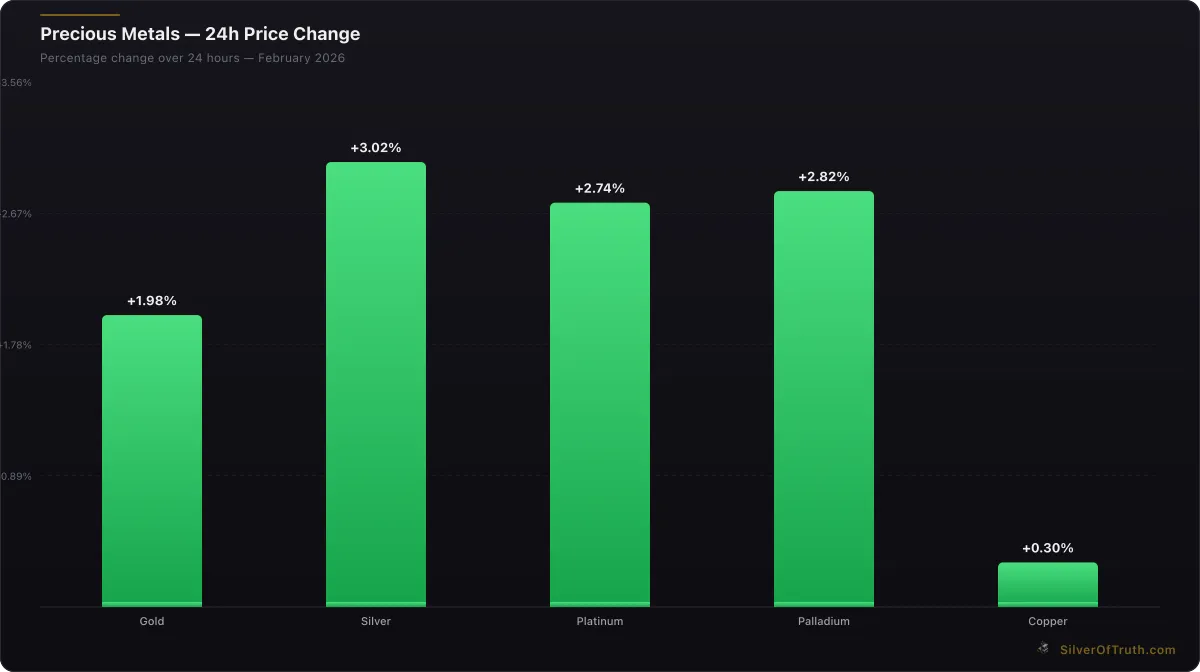
24-hour precious metals price changes. Source: SilverOfTruth, February 2026
Supply constraints from South Africa and Russia appear structural rather than temporary, suggesting limited near-term relief from production increases. New mine development typically requires years to decades, making supply responses to higher prices relatively slow.
The hydrogen economy's development could provide a significant new demand source for platinum over the medium term. Government infrastructure investments in hydrogen production and fuel cell technology represent potential catalysts for sustained platinum demand growth.
However, the long-term electric vehicle transition remains a headwind for traditional automotive PGM demand. Investors must weigh current supply-demand tightness against this secular trend when considering portfolio allocations.
Understanding how global market shifts affect palladium provides insight into potential volatility sources and investment considerations.
FAQ: Platinum and Palladium Price Dynamics
What drives platinum and palladium prices differently from gold and silver?
Platinum and palladium are primarily industrial metals with over 80% of demand coming from automotive catalytic converters and other industrial applications. Unlike gold and silver, which serve as monetary metals and stores of value, PGM prices depend heavily on automotive production cycles, emission standards, and specific industrial demand. This industrial focus makes them more sensitive to economic growth and manufacturing activity.
Why are geopolitical factors particularly important for PGM markets?
Russia and South Africa collectively dominate global PGM production, controlling approximately 80% of palladium and platinum supply, respectively. This geographic concentration makes these markets extremely vulnerable to geopolitical tensions, sanctions, and supply disruptions. Unlike gold and silver with more diversified global production, PGMs face concentrated supply risks that create price volatility during international conflicts or trade disputes.
How does the electric vehicle transition affect platinum and palladium demand?
The shift to electric vehicles represents a long-term headwind for traditional automotive PGM demand since EVs don't require catalytic converters. However, this transition is gradual and varies by region. Meanwhile, platinum is finding new applications in hydrogen fuel cells and industrial processes, potentially offsetting declining diesel vehicle demand. The timeline for significant EV adoption allows current supply constraints to support prices over the medium term.
What role does industrial recycling play in PGM supply?
Catalytic converter recycling typically provides 20-30% of annual PGM supply, making it a crucial supply source. However, supply chain disruptions and processing constraints have reduced recycled supply availability. The high value concentration in catalytic converters makes them attractive for recycling, but theft issues and processing bottlenecks can affect this secondary supply stream.
How should investors approach PGM exposure in precious metals portfolios?
PGM exposure typically serves as a diversification tool within broader precious metals allocations rather than a core holding. Their industrial applications provide different risk characteristics compared to monetary metals like gold and silver. Investors should consider automotive sector cycles, emission regulations, and emerging technology adoption when evaluating PGM investments, as these factors drive demand independently of traditional precious metals dynamics.
Today's surge in platinum and palladium prices reflects fundamental shifts in supply-demand dynamics that extend beyond typical precious metals market drivers. The combination of automotive sector recovery, geopolitical supply constraints, and emerging industrial applications creates a unique investment landscape for these metals.
Track real-time PGM price movements and industrial demand indicators with the SilverOfTruth app — available on the App Store for comprehensive precious metals market intelligence.
Disclaimer: This article is for informational and educational purposes only and does not constitute financial, investment, or trading advice. Past performance is not indicative of future results. Always conduct your own research and consult with a qualified financial advisor before making investment decisions. SilverOfTruth provides market data and analysis tools — it does not provide personalized financial advice.