
Platinum surged 3.13% to $2,085/oz today, outpacing gold's 2.18% gain as geopolitical tensions reshape precious metals demand patterns. While central banks have focused overwhelmingly on gold accumulation—with 2026 purchases on track to exceed 800 tonnes—emerging strategic considerations may be creating spillover demand for platinum as monetary authorities seek portfolio diversification beyond traditional reserve assets. This analysis explores our comprehensive gold investing strategies and examines whether platinum could benefit from the same geopolitical forces driving unprecedented central bank gold buying.
Quick Answer: Central banks bought over 800 tonnes of gold in 2025 amid rising geopolitical tensions, but platinum remains largely absent from official reserves despite its strategic industrial importance and lower correlation to dollar-denominated assets. Platinum's recent 3.13% surge suggests potential spillover demand, though structural challenges in auto demand continue to weigh on fundamentals.
What Drives Central Bank Precious Metals Demand?
Central bank gold purchases reached historic levels in 2025, with global monetary authorities acquiring 1,037 tonnes according to the World Gold Council's latest data. This marked the second-highest annual total since 1967, driven by several converging factors that could theoretically extend to platinum.
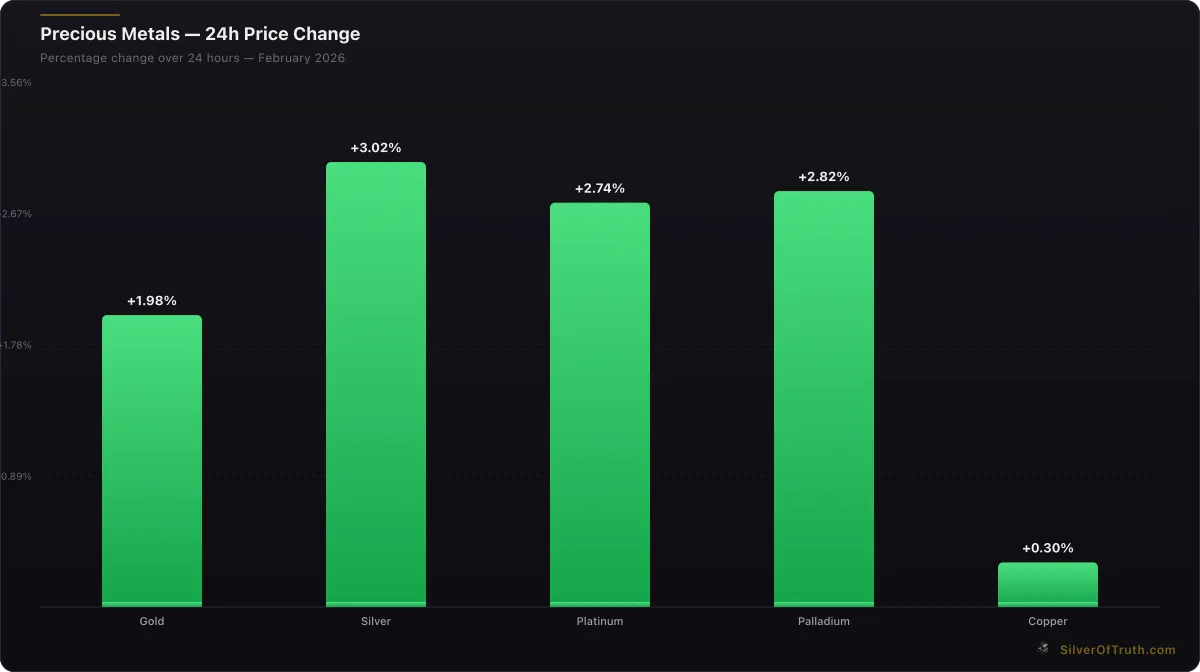
24-hour precious metals price changes. Source: SilverOfTruth, February 2026
The primary motivations for central bank precious metals accumulation include:
De-dollarization strategies have accelerated since 2022, with BRICS nations leading the charge. Russia's Central Bank increased gold reserves by 31 tonnes in Q4 2025 despite sanctions, while China's People's Bank added 225 tonnes throughout 2025. These purchases represent strategic diversification away from dollar-denominated assets, creating demand that traditional price models struggle to capture.
Inflation hedging requirements have become critical as global inflation expectations remain elevated. The Federal Reserve's recent signals about potential rate cuts in 2026 have weakened real interest rates, making non-yielding precious metals more attractive relative to bonds. February's CPI data showing 3.2% core inflation reinforces central banks' need for inflation-resistant reserves.
Geopolitical insurance considerations have intensified following ongoing tensions in Eastern Europe and the Middle East. Central banks view precious metals as the ultimate insurance policy—assets that maintain value regardless of which currency or government prevails in global conflicts.
How Do Geopolitical Tensions Shape Metals Allocation?
Current geopolitical dynamics are fundamentally altering how monetary authorities view precious metals portfolios. Unlike previous decades when gold served as the sole precious metals reserve asset, today's multipolar world may require more diverse metallic reserves.
Supply chain vulnerability assessments now factor prominently in central bank decision-making. Platinum's concentrated production in South Africa (70% of global supply) and Russia (11%) creates both opportunity and risk for strategic buyers. While geographic concentration poses supply disruption risks, it also means platinum supplies could be more easily controlled by aligned nations.
Industrial strategic importance gives platinum unique characteristics among precious metals. Unlike gold, which serves primarily monetary functions, platinum is critical for hydrogen fuel cells, medical devices, and industrial catalysts. Central banks increasingly recognize that controlling strategically important industrial metals provides geopolitical leverage beyond traditional monetary tools.
Currency correlation analysis reveals platinum's lower correlation to dollar movements compared to gold. Over the past five years, platinum-USD correlation averaged 0.32 versus gold-USD correlation of 0.68, according to CME Group data. This lower correlation could appeal to central banks seeking true diversification from dollar-dominated financial systems.
What Role Could BRICS Nations Play in Platinum Demand?
The BRICS bloc's 2025 expansion to include UAE, Saudi Arabia, Egypt, Ethiopia, and Iran has created the world's largest economic alliance, controlling over 40% of global GDP. These nations' coordinated approach to reserve diversification could significantly impact platinum demand patterns.
Russia's platinum production dominance positions Moscow to offer platinum-for-reserves arrangements with BRICS partners. Similar to grain-for-gold deals pioneered in 2024, Russia could exchange platinum for local currencies or other strategic commodities, creating artificial demand outside traditional market mechanisms.
China's industrial platinum needs continue growing despite automotive sector challenges. The nation's hydrogen economy initiatives require massive platinum imports for fuel cell production. Combining industrial demand with potential reserve diversification could create sustained buying pressure that overwhelms automotive sector weakness.
India's jewelry market evolution shows increasing platinum acceptance, with 2025 platinum jewelry demand rising 15% according to Platinum Guild International data. While not central bank activity, this cultural shift creates additional demand that could support higher prices, making platinum more attractive as a reserve asset.
Why Hasn't Platinum Entered Central Bank Reserves?
Despite theoretical advantages, platinum remains largely absent from official central bank holdings. Understanding these barriers is crucial for assessing future adoption potential.
Liquidity constraints represent the primary obstacle. Gold's $13 trillion market capitalization dwarfs platinum's $65 billion, making large-scale central bank transactions potentially disruptive. A 100-tonne platinum purchase—modest by gold standards—would represent roughly 3% of annual global platinum supply, likely triggering severe price volatility.
Storage and custody infrastructure for platinum lags far behind gold's established systems. Central banks rely on institutions like the Bank of England and Federal Reserve Bank of New York for precious metals storage, but these facilities primarily accommodate gold and silver. Expanding platinum storage would require significant infrastructure investment.
Accounting and valuation challenges complicate platinum adoption. Unlike gold, which enjoys special accounting treatment under IMF guidelines, platinum would be subject to mark-to-market volatility in central bank balance sheets. This creates unwanted earnings volatility for institutions prioritizing stability.
Historical precedent limitations work against platinum adoption. Central banking culture moves slowly, with gold's 5,000-year monetary history providing institutional comfort that platinum's 200-year industrial history cannot match. Central bankers prefer assets with established precedent during crisis periods.
How Could Industrial Demand Support Monetary Adoption?
Platinum's industrial applications could paradoxically support its monetary adoption by providing fundamental demand floors that pure monetary metals lack.
Hydrogen economy expansion represents platinum's strongest long-term demand driver. The International Energy Agency projects hydrogen demand will increase 500% by 2050, requiring massive platinum supplies for electrolyzers and fuel cells. This industrial demand could create scarcity that attracts monetary buyers seeking asymmetric return potential.
Medical and defense applications provide recession-resistant demand that gold lacks. Platinum's use in cancer treatments, pacemakers, and military equipment creates inelastic demand regardless of economic conditions. Central banks increasingly value assets with multiple demand sources during uncertain times.
Automotive sector stabilization may finally be emerging after years of decline. Electric vehicle growth has reduced traditional catalytic converter demand, but hybrid vehicle adoption and stricter emissions standards in developing markets could stabilize automotive platinum consumption around current 3-million-ounce levels.
Jewelry demand resilience in Asia provides another demand pillar. Unlike gold jewelry, which competes directly with investment demand, platinum jewelry serves distinct luxury market segments less sensitive to monetary policy changes.
What Does Current Market Action Suggest?
Today's 3.13% platinum surge to $2,085/oz, outpacing gold's 2.18% gain, may signal growing institutional interest in platinum as portfolio diversification intensifies.
Relative performance analysis shows platinum gaining against gold for the first time in months. The platinum-to-gold ratio improved from 0.395 to 0.412 today, still historically depressed but showing signs of mean reversion. If central bank buying spreads beyond gold, platinum's oversold condition versus gold could drive outsized gains.
Volume patterns in platinum futures suggest institutional accumulation. COMEX platinum open interest has increased 15% over the past month, with much of the buying occurring during Asian trading hours—consistent with sovereign or sovereign wealth fund activity.
Options market signals reveal increasing call buying in longer-dated platinum options. March 2027 calls with strikes above $2,500 have seen unusual volume, suggesting some institutions are positioning for potential supply shocks or monetary adoption scenarios.
Track these evolving dynamics with our precious metals converter tool to monitor relative value changes across the metals complex.
What Are the Key Risk Factors?
Several significant risks could prevent geopolitical tensions from translating into sustained platinum demand growth.
Auto sector headwinds remain platinum's primary challenge. Electric vehicle adoption continues accelerating, with 2026 EV sales projected to reach 20% of global auto sales. Each ICE vehicle replaced by an EV eliminates roughly 2-4 grams of platinum demand, creating long-term structural pressure.
Mining supply responses could quickly neutralize any demand increases. South African platinum mines have significant idle capacity that could restart if prices sustain above $2,200/oz. Anglo American Platinum has indicated willingness to increase production by 15% within 18 months if market conditions warrant.
Central bank coordination challenges may prevent meaningful adoption. Unlike gold, where individual central bank purchases create positive network effects, platinum's industrial applications mean that central bank buying could conflict with industrial supply needs, potentially creating political complications.
Economic recession risks could undermine both industrial and potential monetary demand. Platinum's high industrial exposure makes it more economically sensitive than gold, potentially offsetting any safe-haven buying during global downturns.
How Should Investors Position for This Dynamic?
Investors seeking exposure to potential platinum demand from central bank diversification face unique challenges compared to traditional precious metals investing strategies detailed in our gold investing hub.
Physical platinum allocation remains difficult for retail investors. Unlike gold and silver, platinum lacks established coin programs and dealer networks. The few available options include American Platinum Eagles and Canadian Platinum Maple Leafs, but premiums often exceed 10% over spot prices due to limited supply.
ETF exposure considerations provide easier access but carry storage risks. The Aberdeen Standard Physical Platinum Shares ETF (PPLT) holds physical platinum in London vaults, but investors should understand counterparty risks and potential difficulty accessing physical metal during crisis periods.
Mining stock alternatives offer leveraged exposure but add operational risks. Major platinum producers like Sibanye-Stillwater and Impala Platinum Holdings provide exposure to potential price increases while generating dividends, but South African political and operational risks require careful evaluation.
Ratio trading opportunities may offer the most attractive risk-adjusted returns. The platinum-to-gold ratio at 0.412 remains near historic lows, suggesting mean reversion potential if central bank buying diversifies beyond gold.
What Does the Data Reveal About Future Trends?
Recent market data supports the thesis that geopolitical tensions are reshaping precious metals demand patterns, though platinum adoption remains speculative.
Central bank gold purchases accelerated in January 2026, with preliminary data suggesting 65 tonnes of net buying—the strongest start to a year since 2018. This continued accumulation indicates geopolitical tensions remain supportive of precious metals demand generally.
Shanghai Premium dynamics show interesting divergences. While gold premiums in Shanghai average $15/oz above London spot, platinum premiums have compressed to just $5/oz, suggesting limited Eastern buying interest despite China's growing industrial needs.
Futures curve analysis reveals platinum backwardation through December 2027, indicating tight near-term supply relative to expected demand. This market structure often precedes sustained price rallies when demand shocks materialize.
Monitor these trends and more with our comprehensive precious metals price tracking tools, which provide real-time data across the entire metals complex.
Frequently Asked Questions
Q: Are central banks actually buying platinum for reserves? A: Currently, no major central bank reports significant platinum holdings. However, some sovereign wealth funds and government agencies may hold platinum through industrial investment vehicles, making official data incomplete.
Q: How much platinum would central banks need to buy to move prices significantly? A: Given platinum's small market size, just 50-100 tonnes of coordinated central bank buying could increase prices by 20-30%. This represents less than 2% of current central bank gold reserves by value.
Q: Could platinum become part of a new international monetary system? A: While theoretically possible, platinum's industrial importance makes it more likely to serve as a strategic reserve rather than monetary standard. Its role would more closely resemble copper or uranium than gold.
Q: What geopolitical events would most likely trigger platinum demand? A: Supply disruptions in South Africa, expanded BRICS coordination on strategic metals, or Western sanctions limiting Russian platinum exports could all catalyze monetary demand for platinum.
Q: How correlated is platinum to other precious metals during crisis periods? A: Platinum correlation with gold increases during financial stress but remains lower than gold-silver correlation. This makes platinum potentially attractive for true portfolio diversification during geopolitical crises.
Sources
- World Gold Council Global Central Bank Gold Reserves - https://www.gold.org/goldhub/data
- CME Group Metals Market Data - https://www.cmegroup.com/markets/metals.html
- CFTC Commitments of Traders Reports - https://www.cftc.gov/dea/futures/other_lf.htm
- U.S. Bureau of Labor Statistics CPI Data - https://www.bls.gov/cpi/
- London Bullion Market Association Statistics - https://www.lbma.org.uk/prices-and-data
Disclaimer: This article is for informational and educational purposes only and does not constitute financial, investment, or trading advice. Past performance is not indicative of future results. Always conduct your own research and consult with a qualified financial advisor before making investment decisions. SilverOfTruth provides market data and analysis tools — it does not provide personalized financial advice.