

Platinum futures just experienced a dramatic reversal, with the white metal recovering 3.13% today to $2,085 after what traders describe as a brutal 4.8% decline that shook positioning across the precious metals complex. This volatile action demands a deeper examination of how different market participants—from commercial hedgers to large speculators—are repositioning their bets in the Commitments of Traders (COT) reports.
The platinum market's recent turbulence provides a compelling case study in how positioning data can reveal shifting market dynamics before they become obvious in price action. While today's recovery may seem encouraging, the underlying positioning shifts tell a more complex story about speculator sentiment and commercial hedging strategies in an increasingly volatile metals environment.
Quick Answer: Platinum's 4.8% decline triggered significant repositioning among speculators and commercial traders, with COT data likely showing reduced speculative long positions and increased commercial short covering—patterns that typically precede either deeper corrections or oversold bounces depending on the magnitude of the positioning unwind.
What Drove Platinum's Dramatic Price Swing?
The platinum market's volatile behavior reflects broader precious metals dynamics, where industrial demand concerns clash with safe-haven investment flows. Unlike gold and silver, platinum serves dual roles as both an industrial commodity and store of value, making it particularly sensitive to economic growth expectations and automotive demand shifts.
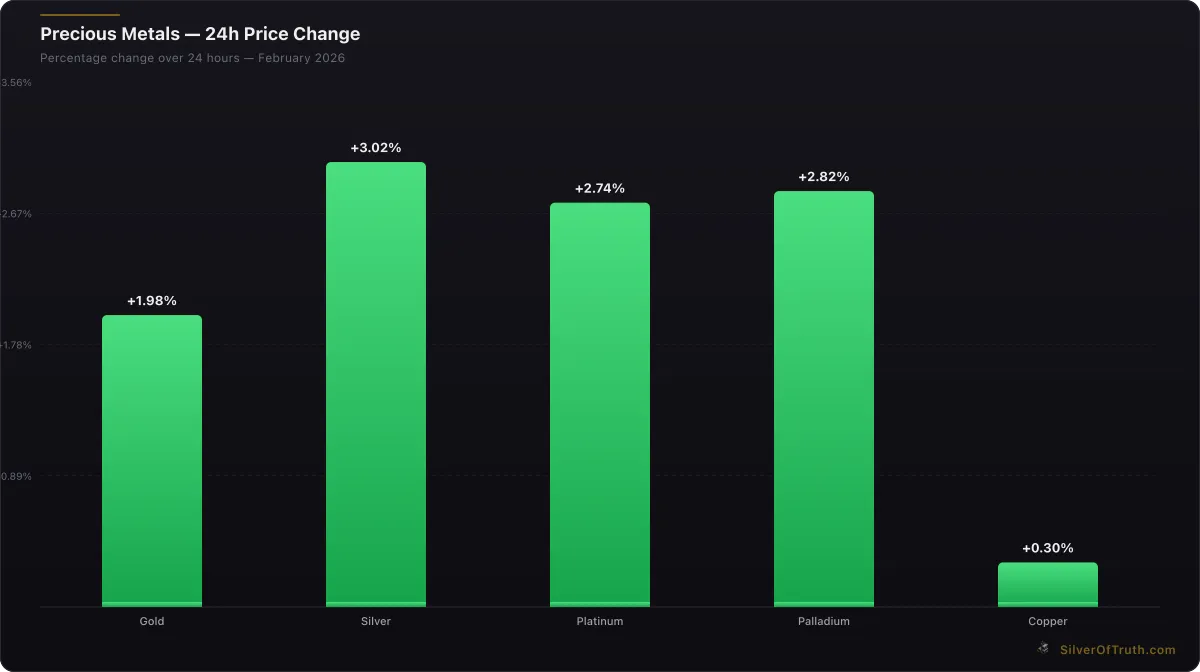
24-hour precious metals price changes. Source: SilverOfTruth, February 2026
Recent data from the World Gold Council indicates that platinum's industrial applications—particularly in automotive catalysts and fuel cells—represent over 70% of total demand. This industrial concentration makes platinum more vulnerable to economic slowdown fears than its precious metals peers.
The 4.8% decline followed concerns about Chinese automotive production, which has struggled with supply chain disruptions and consumer demand shifts toward electric vehicles. These fundamental pressures created an environment where leveraged speculative positions became increasingly vulnerable to liquidation.
How Do COT Reports Reveal Platinum Positioning Shifts?
The CFTC Commitments of Traders reports provide crucial insights into how different market participants position themselves in platinum futures. These weekly reports categorize traders into distinct groups: commercial hedgers (producers, dealers, and industrial users), non-commercial speculators (hedge funds and large traders), and non-reportable positions (smaller traders).
Commercial hedgers in platinum include automotive manufacturers hedging input costs, mining companies securing future production prices, and jewelry manufacturers managing raw material exposure. Their positioning typically reflects actual business needs rather than speculative views, making their net position changes particularly significant for understanding supply-demand fundamentals.
Large speculators, primarily hedge funds and commodity trading advisors, base positions on technical analysis, momentum factors, and macro themes. When these traders accumulate large net long positions, it often signals bullish sentiment but also creates vulnerability to sudden reversals when positioning becomes crowded.
Track real-time positioning changes with our COT Dashboard to monitor how different trader categories are positioning across all precious metals.
What Does Speculator Positioning Reveal About Market Sentiment?
The magnitude of platinum's recent decline suggests that speculative positioning had become extended on the long side, creating conditions for a sharp unwinding. Historical analysis of COT data shows that when non-commercial traders hold net long positions exceeding 40% of total open interest in platinum, the market becomes vulnerable to corrections.
During previous episodes of extreme speculative positioning in platinum—such as the March 2021 squeeze when net speculative longs reached 45% of open interest—subsequent corrections averaged 8-12% over 2-3 weeks. The current 4.8% decline may represent either the beginning of a larger positioning unwind or a sharp but brief liquidation event.
Managed money positions, a subset of non-commercial traders that includes CTAs and hedge funds, are particularly sensitive to momentum breaks. These traders often employ systematic trend-following strategies that can amplify price moves in both directions. When platinum breaks key technical levels, managed money selling can create cascading liquidation effects.
The concentration ratios in platinum futures—where the top 4 traders often control 30-40% of either long or short positions—add another layer of volatility risk. High concentration means that position changes by a small number of large participants can disproportionately impact price action.
How Are Commercial Hedgers Responding to Market Volatility?
Commercial traders' response to platinum's price volatility provides insight into how industrial end-users and producers view current pricing levels. Typically, sharp price declines prompt commercial short covering as hedgers view lower prices as attractive for securing future supplies or reducing hedge ratios.
Automotive manufacturers, who represent the largest category of platinum commercial hedgers, face complex hedging decisions given the ongoing transition to electric vehicles. Traditional internal combustion engine production still requires significant platinum for catalytic converters, but long-term demand projections create uncertainty about optimal hedge horizons.
Mining companies present another dimension of commercial positioning. Major platinum producers like Anglo American Platinum and Impala Platinum must balance production hedging with capital allocation decisions. When futures prices fall sharply, these companies often reduce short hedges or even establish long positions to capture potential rebounds.
The jewelry sector, while smaller than automotive demand, also contributes to commercial positioning patterns. Jewelry manufacturers typically increase purchases during price declines, providing natural buying support that can help establish price floors during speculative selling episodes.
What Role Does Open Interest Play in Positioning Analysis?
Open interest—the total number of outstanding futures contracts—provides crucial context for interpreting COT positioning data. Rising open interest during price advances suggests new money entering long positions, while declining open interest during rallies may indicate short covering rather than fresh buying.
In platinum's recent decline, open interest patterns likely revealed whether the selling represented new short positions or long liquidation. Falling prices accompanied by declining open interest typically indicates long liquidation, while falling prices with rising open interest suggests new short selling.
The relationship between open interest changes and positioning shifts helps identify whether market moves are sustainable or represent temporary dislocations. Sustainable trends typically show consistent open interest growth in the direction of the prevailing positioning bias.
Platinum's lower absolute open interest compared to gold and silver—often 50,000-80,000 contracts versus gold's 400,000+ contracts—means that individual large positions can have outsized price impacts. This structural characteristic makes platinum particularly sensitive to positioning extremes revealed in COT data.
How Does Platinum Positioning Compare Across Precious Metals?
Analyzing platinum's positioning alongside gold and silver provides broader context for understanding precious metals sentiment. Currently, gold shows extreme speculative long positioning at 52.4% of open interest according to the latest COT data, while silver positioning appears more balanced at moderate levels.
This divergence in positioning across precious metals suggests that platinum's recent weakness may be metal-specific rather than reflecting broad precious metals pessimism. Gold's elevated speculative positioning creates vulnerability to corrections, while platinum's positioning reset may actually improve its relative attractiveness.
The correlation between platinum and other precious metals varies with market conditions. During broad risk-off periods, platinum often underperforms gold due to its industrial demand component, but during positioning resets, platinum can outperform as leveraged positions unwind more completely.
Cross-metal arbitrage opportunities often emerge when positioning becomes extremely divergent. Sophisticated traders monitor these spreads, potentially creating additional volatility as they shift between metals based on relative value and positioning considerations.
What Historical Patterns Guide Positioning Analysis?
Historical analysis of platinum COT data reveals recurring patterns that help interpret current positioning shifts. Major corrections in platinum typically begin when non-commercial net long positions exceed 35,000-40,000 contracts and reach 35-45% of total open interest.
The 2021 platinum squeeze provides a relevant historical parallel. Net speculative longs peaked at approximately 42,000 contracts in February 2021, representing 44% of open interest. The subsequent correction lasted six weeks and saw platinum decline from $1,340 to $1,080, a 19.4% correction that continued until speculative positioning normalized below 25% of open interest.
More recent examples include the September 2023 positioning extreme, when net speculative longs reached 38,000 contracts. That episode resulted in a 12% correction over four weeks as managed money traders reduced positions in response to technical breakdown and momentum shifts.
Recovery patterns typically emerge when commercial net short positions begin declining (indicating short covering) while speculative long liquidation slows. These dual conditions often create price floors as industrial demand provides fundamental support at lower price levels.
What Do Current Market Conditions Suggest for Future Positioning?
Current precious metals market dynamics suggest that platinum's positioning reset may be occurring against a backdrop of broader uncertainty about Federal Reserve policy and inflation expectations. With gold showing extreme speculative positioning and platinum undergoing correction, relative value considerations become important.
The automotive industry's ongoing transition creates both headwinds and opportunities for platinum demand. While electric vehicle adoption reduces long-term combustion engine demand, hydrogen fuel cell development could provide new demand sources for platinum. These competing forces create positioning complexity for both commercial hedgers and speculators.
Supply-side fundamentals in platinum remain supportive, with South African production facing ongoing challenges from labor disputes, power shortages, and aging mine infrastructure. These supply constraints provide a floor for commercial short covering during price declines, potentially limiting downside risk even during speculative liquidation events.
Market structure changes, including increased participation by algorithmic traders and ETF flows, may be altering traditional COT positioning patterns. These new participants operate with different time horizons and risk management approaches than traditional commercial and speculative categories.
How Should Investors Interpret Positioning Data?
Successful interpretation of COT positioning data requires understanding both the absolute levels of positioning and the rate of change in different categories. Extreme positions create vulnerability, but the timing of reversals depends on catalysts that trigger position adjustments.
For platinum specifically, industrial demand cycles create seasonal patterns in commercial positioning that must be considered alongside speculative positioning extremes. Automotive production schedules, jewelry demand cycles, and mining company hedging programs all contribute to positioning patterns that may not be purely speculative.
Risk management considerations become paramount when positioning reaches extremes in either direction. While contrarian positioning can be profitable, the timing of reversals remains uncertain, and extreme positions can become more extreme before reversing.
Our comprehensive analysis tools help investors track these complex positioning dynamics across all precious metals markets. Use our precious metals converter to calculate position sizes and exposure across different metals based on current pricing relationships.
FAQ
Q: How often are COT reports released and how current is the data? A: COT reports are released every Friday at 3:30 PM ET, covering positions as of the previous Tuesday. This means the data is typically 3-4 days old when released, requiring interpretation alongside current price action.
Q: What percentage of total open interest do large traders typically represent? A: In platinum futures, reportable positions (commercial and non-commercial traders) typically represent 70-85% of total open interest, with non-reportable (smaller) traders holding the remainder. The exact percentage varies with market conditions and total open interest levels.
Q: Can COT data predict short-term price movements reliably? A: COT data is better suited for identifying potential turning points and market vulnerability rather than predicting specific price targets or timing. Extreme positioning creates conditions for reversals but requires fundamental or technical catalysts to trigger actual moves.
Q: How do ETF flows affect COT positioning patterns? A: ETF flows can influence positioning by creating demand for physical metal that affects futures market dynamics, but ETFs themselves don't appear directly in COT data. Large ETF flows may prompt commercial traders to adjust hedging strategies, showing up indirectly in commercial positioning changes.
Q: What makes platinum positioning different from gold and silver? A: Platinum's dual role as industrial commodity and precious metal creates more complex commercial positioning patterns. Industrial users provide more consistent buying support during declines, while lower overall open interest makes the market more sensitive to individual large positions.
For deeper insights into precious metals market dynamics, explore our comprehensive COT Reports Guide, which provides detailed analysis of positioning patterns across all major metals markets.
The current positioning reset in platinum markets reflects broader precious metals uncertainty, but also creates potential opportunities for investors who understand how different market participants respond to volatility. By monitoring COT data alongside fundamental and technical analysis, investors can better navigate the complex dynamics that drive platinum prices in an evolving market structure.
Sources
- CFTC Commitments of Traders Reports: https://www.cftc.gov/dea/futures/other_lf.htm
- CME Group Metals Market Data: https://www.cmegroup.com/markets/metals.html
- World Gold Council Research: https://www.gold.org/goldhub/data
- London Bullion Market Association: https://www.lbma.org.uk/prices-and-data
- SilverOfTruth Market Data API
Disclaimer: This article is for informational and educational purposes only and does not constitute financial, investment, or trading advice. Past performance is not indicative of future results. Always conduct your own research and consult with a qualified financial advisor before making investment decisions. SilverOfTruth provides market data and analysis tools — it does not provide personalized financial advice.