Palladium's extraordinary 4.36% surge to $1,729/oz today contradicts earlier market predictions of sustained weakness, highlighting how rapidly geopolitical tensions can reshape precious metals flows through London's bullion market. While the broader metals complex shows strength—with gold up 2.18% and silver gaining 2.81%—palladium's dramatic reversal from recent declines demonstrates the metal's unique vulnerability to supply chain disruptions and trading pattern shifts centered around the London Bullion Market Association (LBMA). Understanding these dynamics is crucial for investors navigating an increasingly complex global metals landscape, as explored in our comprehensive precious metals investing guide.
Quick Answer: Geopolitical tensions drive palladium price volatility by disrupting LBMA flows, affecting London's role as the primary trading hub for this supply-concentrated metal. Current tensions impact Russian supply routes, automotive demand patterns, and investor positioning, creating both risks and opportunities in palladium markets.
What Are LBMA Flows and Why Do They Matter for Palladium?
The London Bullion Market Association serves as the global epicenter for precious metals trading, with palladium flows representing a critical component of the market's daily operations. Unlike gold and silver, which benefit from diverse global supply sources, palladium's concentrated production—primarily from Russia and South Africa—makes LBMA flows particularly sensitive to geopolitical disruptions.
LBMA flows encompass the physical movement of metals through London's vault network, electronic trading volumes, and the clearing and settlement of transactions between market makers. According to LBMA data, palladium trading volumes through London often exceed $2 billion daily, representing roughly 60% of global palladium transactions.
The concentration of palladium trading through London creates unique vulnerabilities. When geopolitical tensions arise—particularly involving Russia, which supplies approximately 40% of global palladium—the LBMA's clearing mechanisms can face significant stress. Banks and traders may restrict flows to comply with sanctions, reduce counterparty exposure, or manage regulatory risks, creating artificial supply constraints that amplify price volatility.
Current market dynamics illustrate this sensitivity. Today's 4.36% surge in palladium prices reflects not just supply concerns, but also the interaction between geopolitical uncertainty and London's clearing infrastructure. As tensions escalate, market participants often preemptively adjust their exposure, leading to flow disruptions that precede actual supply shortages.
How Do Geopolitical Tensions Affect London's Precious Metals Infrastructure?
Geopolitical tensions impact London's precious metals infrastructure through multiple channels, each creating ripple effects throughout the palladium market. The most immediate impact occurs through sanctions and regulatory restrictions that limit which entities can participate in LBMA clearing and settlement processes.
When sanctions target major palladium producers or their financial intermediaries, London's clearing banks face complex compliance challenges. They must verify the origin and ownership chain of every transaction, leading to processing delays and increased costs. These operational frictions can reduce trading volumes and widen bid-ask spreads, contributing to enhanced price volatility.
The LBMA's response to geopolitical tensions often involves implementing enhanced due diligence procedures. For palladium, this can mean requiring additional documentation for trades involving Russian-origin metal, creating bottlenecks in an already complex supply chain. Market makers may reduce their inventory holdings to minimize compliance risks, further tightening available liquidity.
Infrastructure impacts extend beyond regulatory compliance. Insurance costs for precious metals shipments increase during periods of heightened geopolitical tension, particularly for routes involving conflict zones or sanctioned territories. Lloyd's of London, which underwrites much of the precious metals trade, may restrict coverage or increase premiums, adding another cost layer that ultimately affects market pricing.
The psychological impact on market participants cannot be understated. Traders and institutional investors may reduce their exposure to palladium during uncertain periods, not because of fundamental supply concerns, but due to the complexity and potential reputational risks of maintaining positions in a geopolitically sensitive commodity.
What Role Does Russian Palladium Play in LBMA Dynamics?
Russian palladium production fundamentally shapes LBMA flows, given Russia's dominant market position through Norilsk Nickel, the world's largest palladium producer. The company's annual output of approximately 2.6 million ounces represents roughly 40% of global supply, making Russian flows through London's market infrastructure critical for global price discovery.
The routing of Russian palladium through London creates unique dependencies. Much of this metal is processed through LBMA-approved refineries and stored in London's vault network before distribution to end users. When geopolitical tensions escalate, these established flows face disruption through multiple channels: direct sanctions on Russian entities, restrictions on transportation routes, and financial institutions' reluctance to handle transactions.
Current sanctions regimes have already altered traditional flow patterns. Some London-based dealers report difficulty obtaining Russian palladium through conventional channels, forcing them to source material from South African producers or draw down existing inventory. This shift has contributed to the metal's price volatility, as South African supply faces its own challenges including power grid instability and labor disputes.
The impact extends beyond physical flows. Russian palladium futures contracts traded on London markets may face liquidity constraints as banks limit their exposure to Russian counterparties. This can create pricing dislocations between physical metal and paper contracts, generating arbitrage opportunities but also complicating price discovery mechanisms.
Market participants increasingly monitor Russian palladium flows as an early warning system for supply disruptions. Changes in shipment patterns, vault holdings, or clearing bank participation can signal potential price movements before they occur, making LBMA flow data a critical tool for palladium traders and analysts.
How Do Automotive Sector Tensions Influence Palladium Demand Through London?
The automotive sector's relationship with palladium markets operates through London's trading infrastructure in complex ways, particularly during periods of geopolitical uncertainty. As the primary consumer of palladium—accounting for roughly 80% of demand through catalytic converter applications—automotive companies' procurement strategies directly impact LBMA flows.
European automakers, facing supply chain uncertainties due to geopolitical tensions, have altered their palladium sourcing patterns. Many now maintain larger strategic stockpiles sourced through London dealers, contributing to increased physical demand through LBMA channels. This inventory building creates temporary demand spikes that can amplify price volatility during uncertain periods.
The shift toward electric vehicles adds another layer of complexity. While this transition reduces long-term palladium demand, the timeline remains uncertain and varies by region. Geopolitical tensions can accelerate or decelerate EV adoption depending on their impact on fossil fuel prices and government policies, creating unpredictable demand patterns that flow through London's markets.
Chinese automotive demand patterns have particular significance for LBMA flows. As Chinese manufacturers seek to secure palladium supplies independent of Western supply chains, they may bypass London markets in favor of direct arrangements with Russian or South African producers. This shift reduces palladium volumes flowing through the LBMA while potentially creating price differentials between London and Shanghai markets.
Supply chain disruptions in the automotive sector can create sudden demand surges in London markets. When assembly lines face shutdowns due to component shortages, manufacturers may need to rapidly procure palladium to restart production, leading to urgent orders that stress LBMA clearing and settlement systems.
What Investment Flows Are Driving Palladium Price Action?
Investment flows in palladium markets reflect the metal's unique position as both an industrial commodity and a store of value during geopolitical uncertainty. Unlike gold and silver, which benefit from established ETF markets, palladium investment occurs primarily through futures contracts and direct physical holdings managed through London's market infrastructure.
Institutional investment patterns show increased interest in palladium as a portfolio diversifier during periods of heightened geopolitical tension. Hedge funds and commodity trading advisors have increased their palladium allocations, viewing the metal's supply concentration as a potential source of alpha during crisis periods. These flows typically route through London-based prime brokers, adding to LBMA transaction volumes.
The limited availability of palladium investment vehicles amplifies the impact of investment flows. When institutional investors decide to increase their palladium exposure, they must compete with industrial users for limited supplies, often driving prices higher than fundamentals might suggest. This dynamic contributed to palladium's extraordinary price run above $3,000/oz in 2021.
Central bank activity in palladium markets remains limited compared to gold, but some emerging market central banks have begun including palladium in their reserve portfolios as a hedge against automotive sector disruptions. These flows, while modest in absolute terms, can have significant price impacts given the market's relatively small size compared to gold and silver.
Retail investment interest in palladium has grown, driven by concerns about supply security and the metal's industrial applications. However, retail access to palladium investment remains challenging due to limited coin and small bar availability, concentrating most retail flow through ETF-like products that ultimately source their metal through London markets. Track these dynamics with our precious metals converter tool.
How Are Sanction Regimes Reshaping Palladium Trade Routes?
Sanction regimes targeting Russian entities have fundamentally altered global palladium trade routes, forcing market participants to develop alternative supply chains that often bypass traditional London channels. These changes create new price dynamics and risk factors that investors must understand when analyzing palladium markets.
The most significant impact involves the rerouting of Russian palladium through non-Western financial systems. Some flows now move through Dubai, Singapore, and Hong Kong rather than London, creating new price discovery centers that may not always align with LBMA pricing. This fragmentation can create arbitrage opportunities but also increases transaction costs and counterparty risks.
Swiss refineries have become increasingly important in processing Russian palladium for global markets. These facilities can refine Russian material and certify it as Swiss-origin metal, potentially circumventing some sanctions restrictions. However, this process adds time and cost to the supply chain, contributing to price volatility.
Alternative payment mechanisms have emerged to facilitate continued palladium trade. Some transactions now occur through cryptocurrency, barter arrangements, or currency swaps rather than traditional dollar-denominated contracts cleared through London. While these mechanisms maintain some level of trade flow, they operate at higher costs and with increased settlement risks.
The development of parallel trading systems poses long-term challenges for London's market dominance in palladium. If alternative infrastructure proves viable, some portion of global palladium trade may permanently migrate away from LBMA systems, reducing London's influence over price discovery and market liquidity.
What Do Current Market Indicators Suggest About Future Palladium Flows?
Current market indicators present a mixed picture for palladium flows through London markets, with technical signals suggesting both opportunities and risks for investors. Today's 4.36% price surge to $1,729/oz occurs against a backdrop of broader precious metals strength, but palladium's specific dynamics warrant careful analysis.
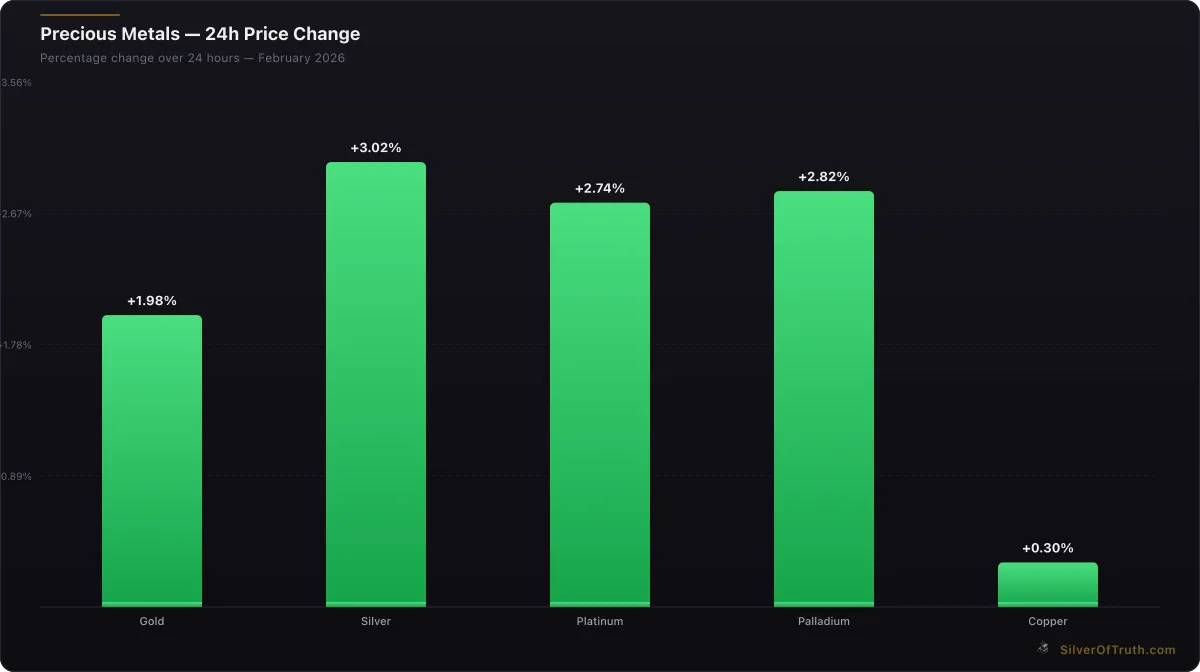
24-hour precious metals price changes. Source: SilverOfTruth, February 2026
The broader precious metals rally—gold up 2.18% to $5,056.40/oz and silver gaining 2.81% to $77.81/oz—suggests improving sentiment toward hard assets amid geopolitical uncertainty. This environment typically benefits palladium, but the metal's industrial applications create different demand drivers compared to monetary metals. For comprehensive analysis of precious metals relationships, explore our Gold/Silver Ratio calculator.
Supply indicators suggest continued tightness in physical palladium markets. South African production continues to face challenges from power grid instability, while Russian supplies remain subject to sanctions-related disruptions. The combination of constrained supply and recovering automotive demand following recent economic uncertainty creates a potentially bullish backdrop for palladium prices.
However, the transition toward electric vehicles creates a long-term headwind for palladium demand that investors must consider. While this transition will unfold over many years, its pace could accelerate if geopolitical tensions lead to sustained high fuel prices or increased government incentives for EV adoption.
Investment demand patterns suggest institutional interest in palladium as a hedge against supply chain disruptions, but this demand remains modest compared to gold and silver. The metal's limited investment infrastructure continues to constrain institutional allocation decisions, potentially limiting upside price momentum even in favorable fundamental environments.
What Strategies Should Investors Consider for Palladium Exposure?
Investors considering palladium exposure must navigate the complex interplay between geopolitical risks, supply constraints, and long-term demand trends. The metal's unique characteristics require specialized strategies that differ from traditional precious metals investments.
Direct physical ownership of palladium presents significant challenges due to limited coin and small bar availability. Most retail investors must rely on ETF products or futures contracts, both of which carry counterparty risks and may not provide the same hedge benefits as physical ownership. Storage costs and insurance requirements for physical palladium also exceed those for gold and silver.
Futures-based strategies can provide palladium exposure with greater liquidity but require active management due to contango and backwardation patterns that can erode returns over time. The palladium futures market's smaller size compared to gold and silver also creates greater price volatility that may not suit all investor risk profiles.
Mining stock exposure offers leveraged plays on palladium prices but introduces additional operational risks related to individual companies and mining jurisdictions. South African platinum group metals miners face particular challenges from power grid instability and labor relations, while Russian miners remain subject to sanctions risks.
Portfolio allocation strategies should consider palladium's correlation patterns with other assets. The metal often moves independently of gold and silver due to its industrial applications, providing diversification benefits but also requiring separate analysis and position sizing decisions. For comprehensive portfolio analysis tools, visit our mining stock screener.
FAQ
How do geopolitical tensions directly impact LBMA palladium flows? Geopolitical tensions affect LBMA flows through sanctions compliance requirements, increased operational costs, and reduced counterparty willingness to trade. Banks may limit clearing services, insurance costs rise, and market participants often reduce exposure preemptively, creating artificial supply constraints that amplify price volatility.
What percentage of global palladium trading occurs through London? According to LBMA data, approximately 60% of global palladium transactions clear through London's market infrastructure, making the LBMA central to global price discovery despite palladium's concentrated production in Russia and South Africa.
How are alternative trade routes affecting palladium pricing? Alternative routes through Dubai, Singapore, and Hong Kong create new price discovery centers that may diverge from LBMA pricing. While these maintain some trade flow, they operate at higher costs and risks, contributing to overall market volatility and price fragmentation.
What role does automotive demand play in London palladium markets? Automotive companies increasingly use London dealers for strategic stockpiling during uncertain periods, creating temporary demand spikes. The EV transition adds uncertainty, while Chinese manufacturers' efforts to bypass Western supply chains may reduce LBMA volumes.
Should investors consider palladium as a portfolio hedge during geopolitical uncertainty? Palladium can provide portfolio diversification due to its unique supply-demand dynamics and limited correlation with monetary metals. However, investors must consider the metal's industrial applications, limited investment infrastructure, and higher volatility compared to gold and silver.
Sources
- London Bullion Market Association (LBMA): https://www.lbma.org.uk/prices-and-data
- CME Group Palladium Futures Data: https://www.cmegroup.com/markets/metals.html
- World Platinum Investment Council: https://platinuminvestment.com/investment-research
- SilverOfTruth Market Data API
Today's palladium surge demonstrates how rapidly geopolitical tensions can reshape precious metals markets through London's trading infrastructure. As global uncertainties persist, investors must understand these complex flow dynamics to navigate palladium's unique risk-reward profile effectively. The metal's concentrated supply chain and industrial applications create both opportunities and vulnerabilities that distinguish it from traditional monetary metals like gold and silver. For investors seeking exposure to this complex but potentially rewarding market, consider tracking these dynamics through the SilverOfTruth app's comprehensive precious metals analysis tools. Learn more about building a diversified precious metals strategy in our comprehensive investing guide.
Disclaimer: This article is for informational and educational purposes only and does not constitute financial, investment, or trading advice. Past performance is not indicative of future results. Always conduct your own research and consult with a qualified financial advisor before making investment decisions. SilverOfTruth provides market data and analysis tools — it does not provide personalized financial advice.