

Platinum's unique position among precious metals stems from its dual role as both an investment asset and critical industrial commodity, making its price movements particularly sensitive to supply disruptions and manufacturing demand shifts. Unlike gold or silver, platinum's limited mining geography and heavy industrial usage create distinct rally patterns that often diverge from broader precious metals trends. Recent price action exemplifies this dynamic, with the metal jumping 2.7% to $2,077.10 per ounce as Chinese industrial demand recovery collided with persistent supply chain bottlenecks, breaking platinum out of its recent $2,020-$2,050 consolidation range.
China Demand Recovery Signals
Chinese platinum imports surged 18% month-over-month in January according to customs data, reflecting renewed industrial activity following the Lunar New Year production ramp-up. This uptick coincides with Beijing's infrastructure stimulus measures targeting green technology manufacturing, where platinum serves critical roles in fuel cells and chemical processing.
The recovery diverges sharply from palladium's mixed signals, as China's influence on palladium prices remains volatile due to automotive sector uncertainty. Platinum benefits from broader industrial applications beyond automotive catalysts, including petroleum refining, electronics, and medical equipment manufacturing.
Shanghai Futures Exchange platinum contracts show consistent backwardation, with near-term contracts trading at premiums to longer-dated futures. This structure typically indicates tight physical supply relative to immediate demand, supporting the current price advance.
Technical Analysis and Resistance Levels
From a technical perspective, platinum's 2.7% advance carries platinum through several key resistance levels that had capped rallies since early February. The metal broke above its 20-day moving average at $2,055 and cleared the psychologically significant $2,075 level that had served as resistance in recent sessions.
Daily momentum indicators support continued upside potential. The Relative Strength Index (RSI) moved to 58, well below overbought territory but showing clear bullish momentum. MACD crossed positive for the first time in two weeks, suggesting the recent consolidation phase may be ending.
Key resistance now sits at $2,100, representing the 61.8% Fibonacci retracement of platinum's decline from December highs to January lows. A clean break above this level would target the $2,150-$2,180 zone, where previous rally attempts stalled in late 2025.
Support remains solid at the $2,050 breakout level, with additional backing at $2,020 where buyers emerged during recent weakness. This technical foundation provides downside protection while the fundamental story develops.
Geopolitical Supply Chain Disruptions
Geopolitical tensions continue reshaping platinum supply chains, particularly affecting South African production that accounts for roughly 70% of global mine output. Labor disputes at key mining operations, combined with infrastructure challenges and energy shortages, have constrained supply elasticity just as demand recovery accelerates.
Russian platinum supplies face ongoing sanctions pressure, removing approximately 12% of global production from Western markets. This supply disruption creates structural tightness that amplifies price responses to demand fluctuations, as evidenced in today's sharp move on modest Chinese import data.
Geopolitical tensions and central bank policies are reviving demand for platinum as investors seek alternatives to traditional safe havens. Unlike gold, which trades primarily on monetary policy expectations, platinum benefits from both industrial demand and store-of-value characteristics during supply disruptions.
The London Platinum and Palladium Market (LPPM) reports declining available inventory, with lease rates rising to 2.5% annually for one-month platinum, up from 1.8% in January. These lending costs reflect tightening physical availability rather than speculative positioning.
Industrial Demand Fundamentals
Beyond automotive catalysts, platinum's industrial applications show robust growth trajectories that support higher price levels. Hydrogen fuel cell development, particularly in commercial transportation and power generation, creates new demand vectors independent of traditional gasoline vehicle production.
Chemical industry consumption remains steady despite broader economic uncertainties, as platinum's catalytic properties prove irreplaceable in many petroleum refining processes. Recent mining sector analysis indicates production costs averaging $1,850-$1,950 per ounce for primary platinum producers, providing fundamental price support well below current levels.
Glass manufacturing demand increased 8% year-over-year, driven by automotive and construction glass production recovery in Asian markets. This industrial consumption proves less cyclical than automotive demand, offering price stability during economic transitions.
Investment demand shows modest but consistent inflows, with platinum ETF holdings increasing 3.2% month-to-date according to precious metals tracking services. While this pales compared to gold ETF flows, it represents steady accumulation by strategic investors recognizing supply-demand fundamentals.
Comparison with Palladium Dynamics
Platinum's advance contrasts sharply with palladium's more volatile performance patterns. Where palladium faces mining sector hurdles and rising production costs, platinum benefits from more diversified supply sources and established recycling infrastructure.
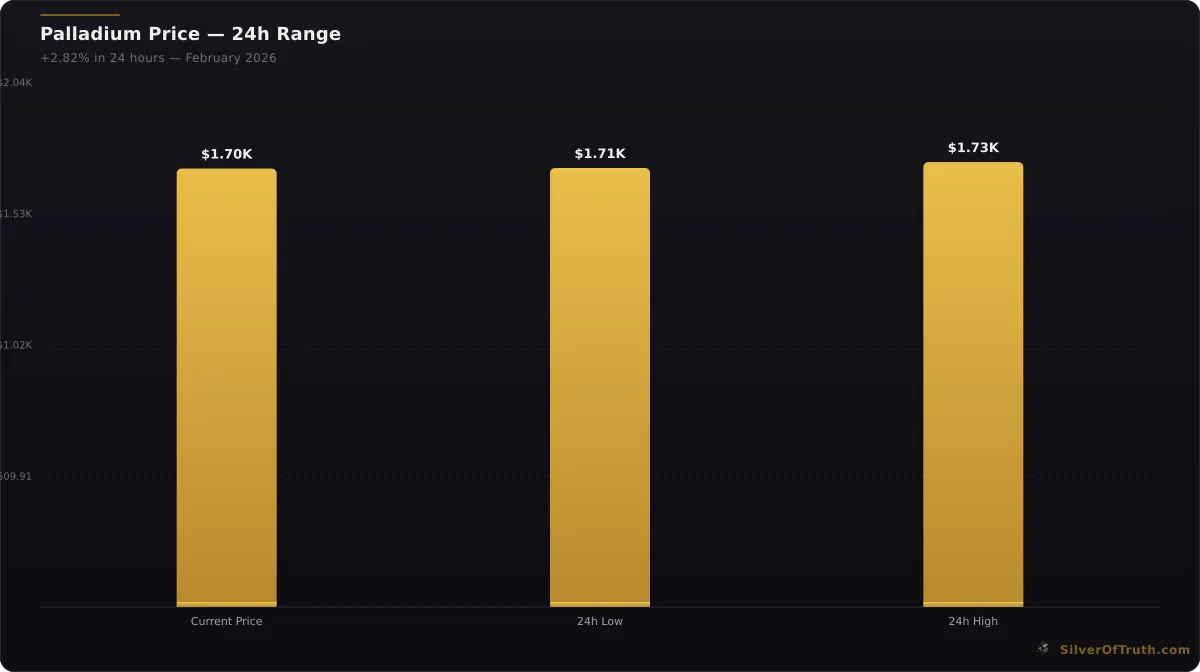
Palladium at $1703.40 — up 2.82% in 24h. Source: SilverOfTruth, February 2026
The platinum-palladium ratio currently sits at 1.22, near the lower end of its five-year range but showing signs of stabilization. Historically, ratios below 1.00 favor platinum substitution in certain automotive applications, creating natural demand support during supply-constrained periods.
Both metals face similar geopolitical supply risks from Russian production disruptions, but platinum's broader industrial application base provides more resilient demand profiles. Global demand patterns continue climbing amid geopolitical shifts, but platinum shows superior technical momentum.
Federal Reserve Policy Implications
Unlike gold and silver, which trade heavily on Federal Reserve policy expectations, platinum shows relatively muted responses to monetary policy shifts. The metal's industrial demand drivers often outweigh financial market considerations, particularly during supply-constrained periods.
Current real interest rate levels, while pressuring some precious metals, have minimal impact on platinum's industrial consumption patterns. Inflation pressures affecting platinum prices primarily operate through input cost channels rather than investment demand fluctuations.
This policy insensitivity proves advantageous during periods of monetary uncertainty, as platinum prices reflect supply-demand fundamentals rather than speculative positioning based on interest rate expectations.
Market Structure and Positioning
COMEX platinum futures show modest open interest at approximately 45,000 contracts, significantly lower than gold's 404,391 contracts or silver's 133,641 contracts. This smaller futures market creates higher volatility but also reduces the impact of speculative positioning on physical market dynamics.
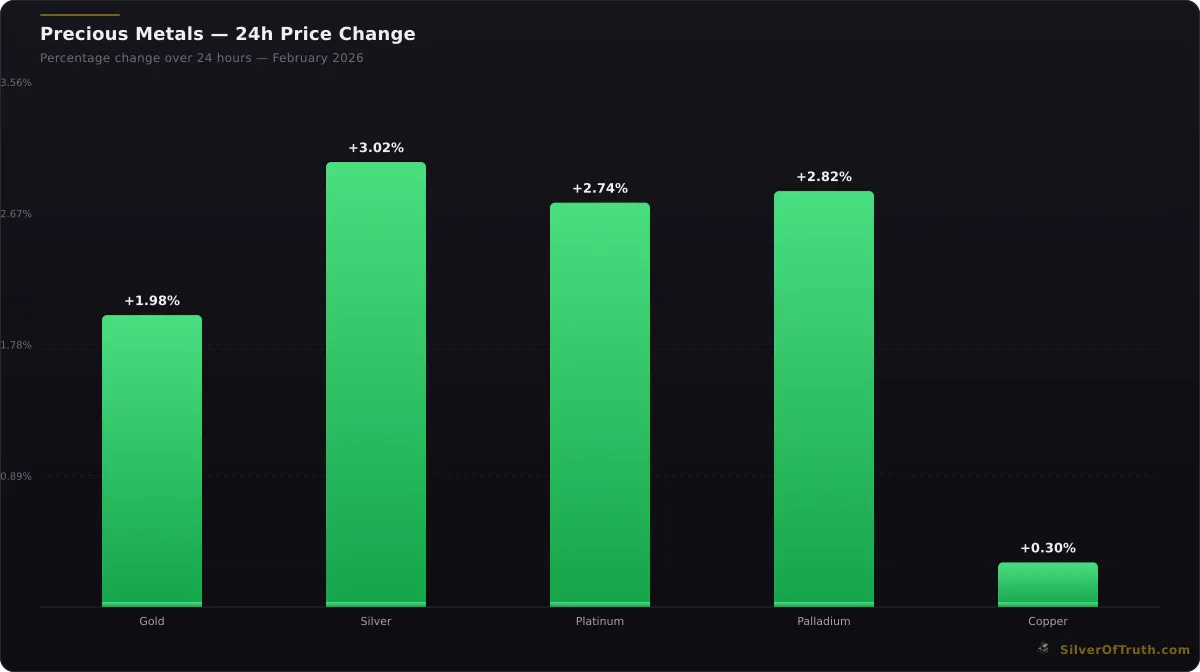
24-hour precious metals price changes. Source: SilverOfTruth, February 2026
Commercial short positions remain elevated but stable, suggesting producers continue hedging operations without excessive pessimism about price direction. Understanding COT reports reveals platinum's positioning dynamics differ substantially from gold and silver, with industrial users playing larger roles relative to financial speculators.
Physical premiums in major trading centers show stability, with London-based dealers quoting premiums of $15-$25 per ounce above spot prices. These levels indicate adequate liquidity without the stressed conditions that sometimes affect palladium markets during supply disruptions.
Looking Ahead: Key Catalysts
Several catalysts could extend platinum's current rally. Chinese industrial production data due next week will provide updated demand signals, while South African mining reports could reveal supply-side developments affecting global availability.
The European Union's ongoing discussions about automotive emission standards may create additional catalyst demand, particularly if regulations favor technologies requiring higher platinum loadings. Similarly, hydrogen infrastructure investments across major economies support long-term demand growth.
Technical traders will watch for sustained trading above $2,075 as confirmation of the breakout, with $2,100 representing the next major test. Failure to hold current gains would likely see platinum retreat to the $2,050 support zone where accumulation previously emerged.
Currency movements also merit attention, as platinum trades primarily in U.S. dollars while major consumption occurs in euro and yuan-denominated markets. Recent dollar strength had pressured platinum prices, but current momentum suggests industrial demand is overcoming currency headwinds.
For precious metals investors seeking exposure beyond traditional gold and silver positions, platinum's current technical setup and fundamental backdrop present compelling opportunities. Best silver stacking app can help track platinum movements alongside other precious metals for portfolio management purposes.
The SilverOfTruth app provides real-time platinum tracking alongside comprehensive precious metals market intelligence, enabling investors to monitor these developing supply-demand dynamics across global markets.
Frequently Asked Questions
Q: How does platinum's 2.7% gain compare to other precious metals? A: Platinum's 2.7% advance outpaced gold (1.98%) and matched palladium's strong performance (2.8%) on Friday, but platinum's move carries more technical significance by breaking key resistance levels that had capped recent rallies.
Q: What role does China play in platinum demand recovery? A: Chinese platinum imports jumped 18% month-over-month in January, driven by industrial activity recovery and infrastructure stimulus targeting green technology manufacturing where platinum serves critical catalytic functions.
Q: Are geopolitical factors affecting platinum supply chains? A: Yes, South African production faces ongoing challenges while Russian sanctions remove approximately 12% of global supply from Western markets, creating structural tightness that amplifies price responses to demand changes.
Q: What technical levels should platinum traders watch? A: Key resistance sits at $2,100 (61.8% Fibonacci retracement), while support holds at the $2,050 breakout level with additional backing at $2,020 where recent buying emerged.
Q: How does platinum differ from palladium in current market conditions? A: Platinum benefits from more diversified industrial applications and established recycling infrastructure, while palladium faces more concentrated automotive demand and higher production cost pressures.
Disclaimer: This article is for informational and educational purposes only and does not constitute financial, investment, or trading advice. Past performance is not indicative of future results. Always conduct your own research and consult with a qualified financial advisor before making investment decisions. SilverOfTruth provides market data and analysis tools. It does not provide personalized financial advice.