

Two exchanges dominate global precious metals trading: COMEX in New York and LBMA in London. Understanding the COMEX vs LBMA difference is crucial for any serious precious metals investor, as these markets operate with fundamentally different structures, purposes, and mechanisms. COMEX primarily serves as a futures exchange for price discovery and hedging, whereas LBMA operates as an over-the-counter physical bullion market. This distinction shapes everything from how contracts are settled to who can participate and how inventory is managed. The differences between these markets directly impact pricing, liquidity, and physical metal flows that affect global precious metals markets.
Market Structure and Organization
COMEX: Centralized Futures Exchange
COMEX (Commodity Exchange Inc.) operates as a centralized derivatives exchange within the CME Group structure. As a regulated futures market, COMEX provides standardized contracts for precious metals trading with specific delivery months, contract sizes, and settlement procedures. The exchange facilitates price discovery through electronic trading on the CME Globex platform, with trading hours extending nearly 24 hours per day.
The exchange maintains strict regulatory oversight under the Commodity Futures Trading Commission (CFTC), requiring daily position reporting for large traders and implementing position limits to prevent market manipulation. Current COMEX inventory data shows 34.4 million ounces of gold and 376.4 million ounces of silver in approved warehouses, with detailed eligible versus registered classifications.
COMEX contracts are standardized: 100 troy ounces for gold and 5,000 troy ounces for silver, with specific delivery procedures and quality requirements. The exchange publishes daily warehouse receipts, showing exactly how much metal enters and leaves approved depositories. This transparency allows traders to monitor physical supply conditions that affect futures pricing.
LBMA: Over-the-Counter Market Network
The London Bullion Market Association (LBMA) operates as a trade association coordinating an over-the-counter (OTC) market rather than a centralized exchange. LBMA facilitates trading through its network of market-making members who quote bid and offer prices for physical bullion transactions. Unlike COMEX's standardized contracts, LBMA deals in various bar sizes and specifications, with the standard being 400-ounce gold bars and 1,000-ounce silver bars.
LBMA pricing occurs through the twice-daily Gold Price auction (formerly the London Gold Fixing), conducted electronically since 2015. Five participating banks submit orders, with the price determined through an iterative auction process until buy and sell orders balance. This mechanism, managed by IBA (ICE Benchmark Administration), provides internationally recognized reference prices used for global bullion transactions.
The association maintains quality standards through its Good Delivery List, certifying approved refiners whose bars meet strict purity and physical specifications. LBMA vault holdings contain approximately 700 million ounces of gold in London vaults, though this figure represents both allocated and unallocated holdings across multiple custodians.
Trading Mechanisms and Participants
COMEX Trading Dynamics
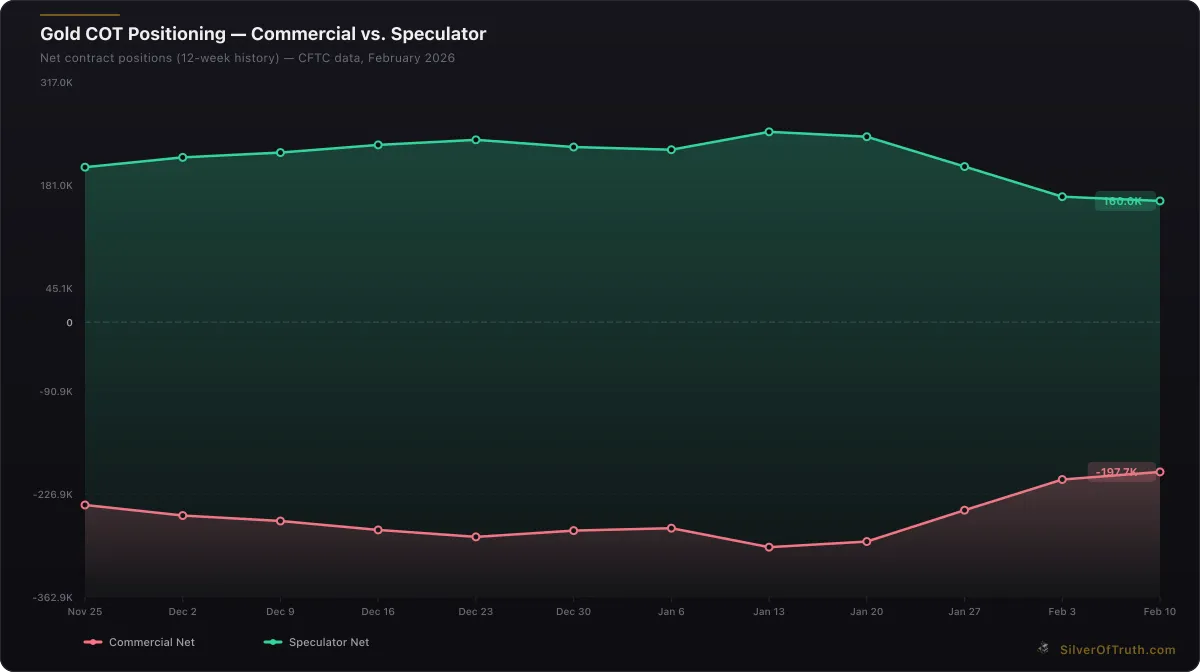
Gold COT positioning: commercial hedgers (red) vs. speculators (green). Source: CFTC via SilverOfTruth, February 2026
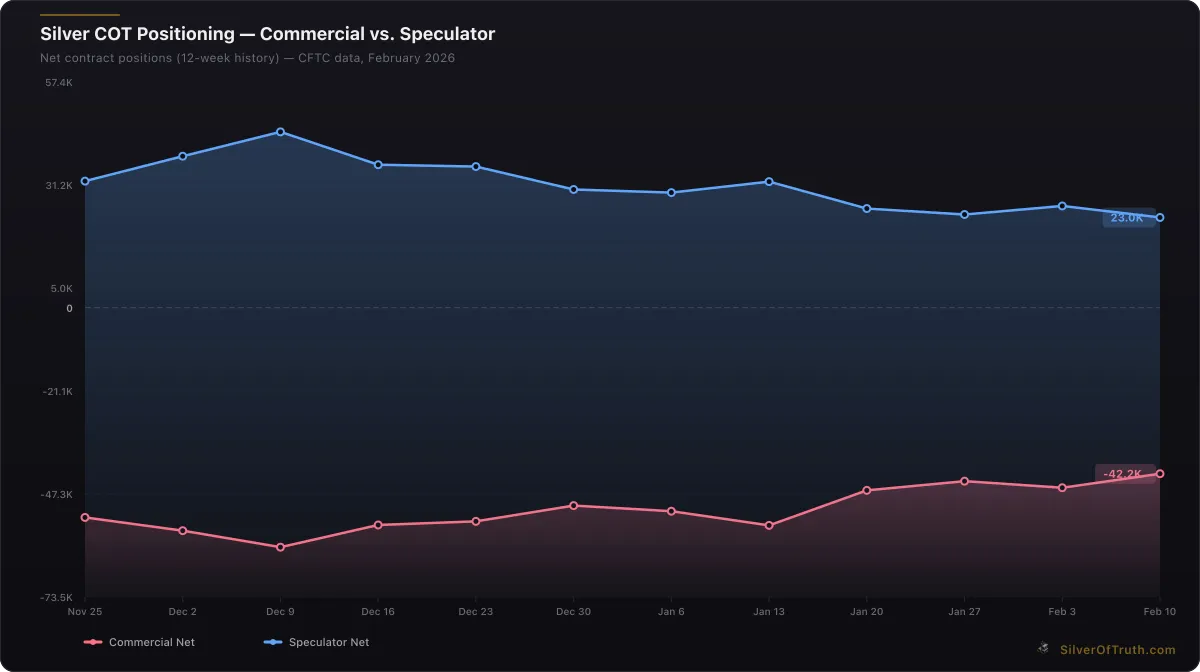
Silver COT positioning: commercial hedgers (red) vs. speculators (blue). Source: CFTC via SilverOfTruth, February 2026
COMEX futures trading attracts diverse participants including commercial hedgers, speculative traders, and arbitrageurs. According to the latest CFTC Commitments of Traders report, commercial traders hold net short positions of 197,738 gold contracts while non-commercial speculators maintain net long positions of 160,012 contracts as of February 10, 2026.
The futures market enables leverage through margin requirements, typically 5-10% of contract value, allowing traders to control large positions with relatively small capital. This leverage amplifies both profits and losses, making COMEX attractive to speculators seeking price exposure without physical ownership. Most contracts are closed before expiration through offsetting trades rather than physical delivery.
Trading occurs nearly continuously, with electronic market hours from Sunday 6:00 PM ET through Friday 5:00 PM ET, pausing only for a daily maintenance window. This extended schedule accommodates global trading patterns and provides liquidity during Asian and European market hours. The exchange's central limit order book ensures transparent price discovery and efficient order matching.
LBMA Market Operations
LBMA operates primarily as a wholesale market serving central banks, mining companies, refiners, and large institutional investors. Minimum transaction sizes typically start at 1,000 ounces for gold and 50,000 ounces for silver, making it unsuitable for retail participants. The market operates through principal trading, where dealers quote firm prices and take positions directly rather than acting purely as intermediaries.
Transactions occur via telephone, electronic platforms like EBS BullionDealer, or increasingly through electronic communication networks (ECNs). Unlike COMEX's transparent order book, LBMA pricing reflects individual negotiations between counterparties, though the twice-daily price fix provides benchmark reference points.
Credit relationships are crucial in LBMA trading, as transactions often involve significant counterparty risk given the large transaction sizes and wholesale nature of the market. Dealers typically maintain credit lines with approved counterparties, limiting participation to financially substantial institutions with established relationships.
Physical Delivery and Settlement
COMEX Warehouse System
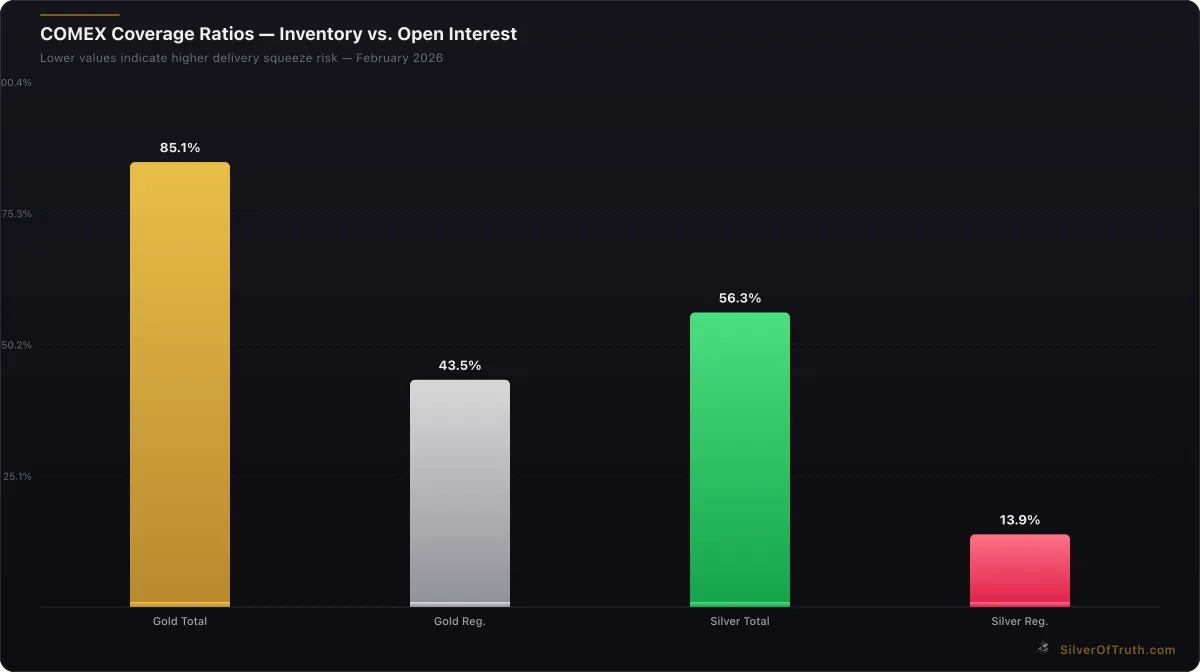
COMEX coverage ratios — lower values indicate higher delivery squeeze risk. Source: SilverOfTruth, February 2026
COMEX maintains a network of approved warehouses in New York, with some facilities also located in Delaware. These depositories hold metal that backs futures contracts, divided into two categories: eligible inventory (metal that meets COMEX specifications but isn't warranted against contracts) and registered inventory (metal warranted against specific contracts and available for delivery).
Current registered gold inventory stands at 17.6 million ounces against open interest of 404,391 contracts (equivalent to 40.4 million ounces), creating a coverage ratio of 43.5%. For silver, registered inventory of 92.9 million ounces faces open interest of 668.2 million ounces, yielding a concerning 13.9% coverage ratio that our COMEX inventory analysis identifies as high-risk territory.
The delivery process follows strict procedures: contract holders wishing to take delivery must maintain positions into the delivery month and submit delivery intentions by specific deadlines. The exchange matches long position holders seeking delivery with short position holders willing to deliver through a structured assignment process. Delivered metal comes with warehouse receipts that can be traded separately from futures contracts.
LBMA Physical Settlement
LBMA transactions typically settle through physical delivery or book transfers between allocated accounts in London vaults. The market specializes in large bar trading, with standard gold bars weighing approximately 400 ounces and silver bars at 1,000 ounces. These Good Delivery bars carry specific hallmarks identifying the refiner, serial numbers, and purity levels.
Settlement usually occurs within two business days (T+2) for spot transactions, though forward settlement dates are common for hedging and financing purposes. Many transactions settle through electronic book entries between vault operators rather than physical bar movement, improving efficiency for wholesale trading.
The unallocated account system allows clients to hold metal claims without specific bar identification, similar to bank account balances. Allocated accounts designate specific identified bars, providing direct ownership but requiring storage fees. This dual system accommodates different client needs while maintaining market liquidity through the fungible unallocated pool.
Price Discovery and Global Influence
COMEX Price Formation
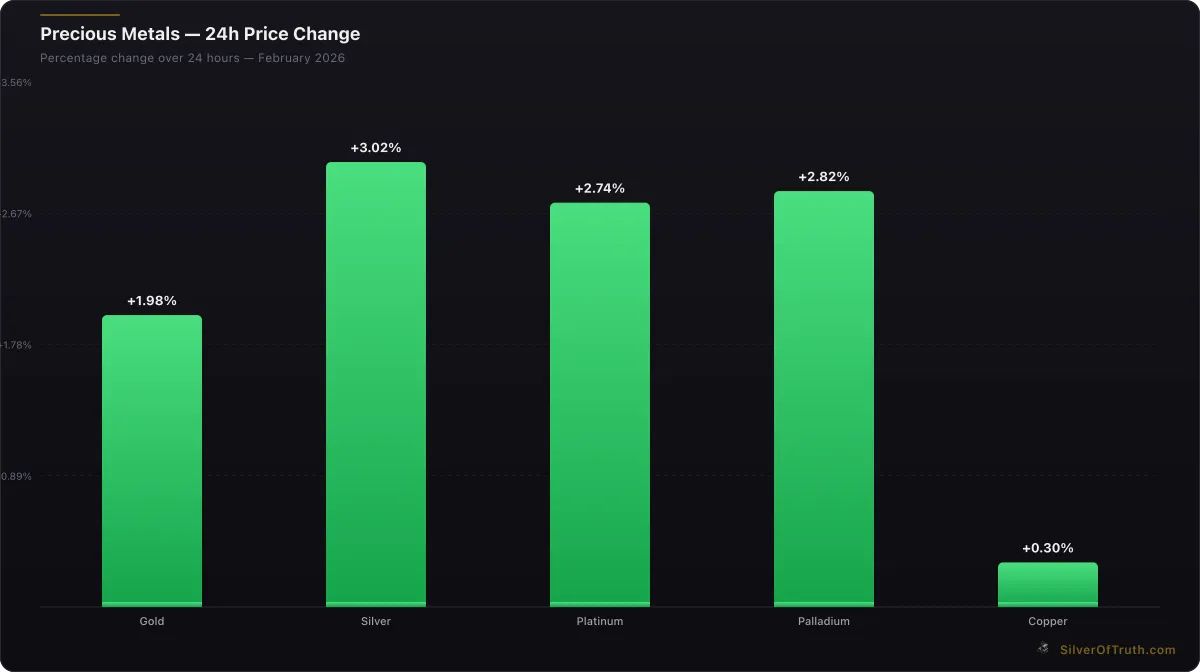
24-hour precious metals price changes. Source: SilverOfTruth, February 2026
COMEX futures contracts serve as primary price discovery mechanisms for global precious metals markets. The active trading in nearby delivery months establishes benchmark prices that influence spot markets worldwide. Electronic trading provides continuous price updates during market hours, with significant price movements often originating from COMEX futures activity.
The exchange's transparent order book reveals buying and selling interest at different price levels, contributing to efficient price discovery. Large speculative positions, currently showing net long exposure of 160,012 gold contracts, can amplify price movements during trend-following periods. Our analysis of COT positioning signals shows how these speculative flows affect price direction.
Settlement prices established at 1:30 PM ET serve as reference points for various industry transactions, from mining company hedging to jewelry manufacturer procurement. The influence extends beyond precious metals, affecting mining stock valuations and related commodity markets through correlation effects.
LBMA Pricing Influence
The LBMA Gold Price, set twice daily at 10:30 AM and 3:00 PM London time, provides internationally recognized benchmark prices. Central banks, mining companies, and institutional investors often reference these fixes for large transactions, lending them significant global influence despite the relatively brief auction periods.
Unlike COMEX's continuous electronic pricing, LBMA fixes represent specific moments when supply and demand balance at prevailing prices. The auction process involves iterative rounds where participants submit orders until clearing prices emerge. This mechanism can produce notable price gaps between fixes, particularly during periods of strong directional pressure.
The London market's role in global gold flows makes its pricing particularly influential for international transactions. Many bilateral central bank transactions, official sector sales, and large corporate hedging programs reference LBMA fixes rather than COMEX futures prices, highlighting the complementary nature of these markets.
Inventory Transparency and Reporting
COMEX Reporting Standards
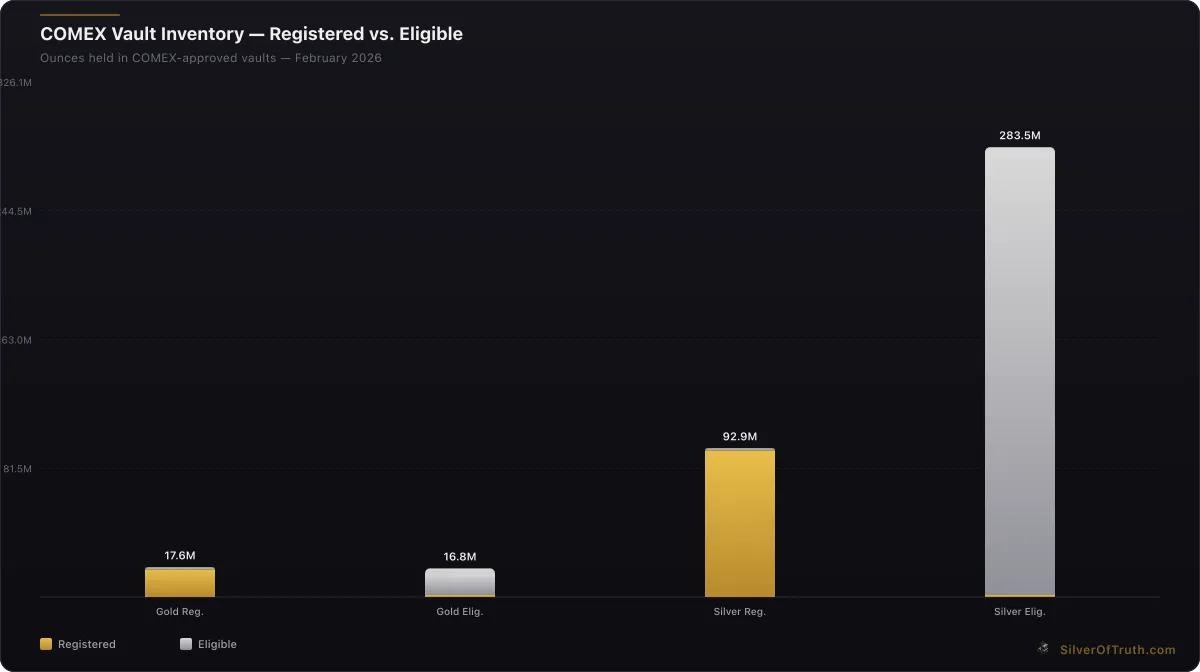
Source: SilverOfTruth COMEX data, February 2026
COMEX provides exceptional transparency in precious metals inventory reporting through daily warehouse stock reports. These reports detail metal movements into and out of approved depositories, showing changes in eligible and registered categories. Market participants can track exactly how much metal is available for delivery against futures contracts.
The current gold inventory of 34.4 million total ounces includes detailed breakdowns by depository location and category. Silver inventory reporting shows 376.4 million total ounces, with recent weekly drops indicating supply pressure. This granular reporting allows investors to assess delivery risk and physical market conditions.
Monthly and yearly historical data enables trend analysis of inventory patterns. Declining registered inventories often signal increasing physical demand or delivery stress, while growing eligible stocks might indicate new metal production or reduced industrial offtake. The transparency facilitates informed trading decisions based on physical supply conditions.
LBMA Vault Reporting
LBMA vault reporting provides less granular detail compared to COMEX, with total holdings reported monthly rather than daily. The association publishes aggregate holdings data showing approximately 700 million ounces of gold across member vaults, though this includes both allocated and unallocated holdings.
Individual vault operators may provide additional reporting, but there's no standardized daily reporting requirement like COMEX. This reduced transparency reflects the OTC market structure where individual institutions maintain proprietary information about client holdings and vault operations.
The lack of detailed inventory reporting makes it more difficult to assess physical supply conditions in London compared to New York. However, the much larger aggregate holdings in LBMA vaults provide substantial buffers against supply disruptions, even without the granular visibility available in COMEX markets.
Regulatory Framework and Oversight
COMEX Regulatory Environment
COMEX operates under comprehensive regulatory oversight from the Commodity Futures Trading Commission, which enforces position limits, reporting requirements, and market conduct rules. Large trader reporting requires daily position disclosures for holders exceeding specific thresholds, currently set at 300 contracts for gold and 1,500 contracts for silver.
The exchange implements position limits to prevent market concentration and potential manipulation. Speculative position limits restrict individual traders from holding excessive contracts relative to market size, while hedge exemptions allow commercial participants to exceed these limits for legitimate business purposes.
Market surveillance systems monitor trading patterns for suspicious activity, unusual price movements, or potential manipulation attempts. Enforcement actions can include fines, trading suspensions, or referral to criminal authorities for serious violations. The regulatory framework aims to maintain orderly markets and protect participants from unfair practices.
LBMA Regulatory Scope
LBMA operates within the UK's financial regulatory framework, with member firms subject to Financial Conduct Authority (FCA) supervision. However, the association itself functions as a trade organization rather than a regulated exchange, creating different oversight dynamics compared to COMEX.
The market's OTC structure means individual transactions occur between consenting parties with negotiated terms, reducing the need for standardized contract regulation. However, market-making members must comply with capital requirements, risk management standards, and conduct regulations applicable to their broader business operations.
Anti-money laundering (AML) and know-your-customer (KYC) requirements apply to LBMA transactions, particularly given the large transaction sizes and international scope. The responsible sourcing standards, including the LBMA Responsible Gold Guidance, add compliance requirements for supply chain verification and due diligence.
Market Size and Liquidity Comparison
Daily Trading Volumes
COMEX gold futures typically trade 300,000-500,000 contracts daily, representing 30-50 million ounces of equivalent metal exposure. Silver futures volume averages 150,000-250,000 contracts, equivalent to 750 million to 1.25 billion ounces. These volumes significantly exceed global mine production, highlighting the market's role in price discovery and hedging rather than physical delivery.
Peak volume days can exceed these averages substantially during periods of high volatility or major economic announcements. Federal Reserve policy decisions, employment reports, and geopolitical developments often trigger volume surges as traders adjust positions rapidly.
LBMA daily trading volumes are more difficult to quantify precisely due to the OTC market structure, but estimates suggest 1,000-1,500 tonnes of gold trade daily in London (approximately 32-48 million ounces). This represents substantial physical metal flows, though much occurs through book transfers rather than physical bar movement.
Liquidity Characteristics
COMEX futures provide excellent liquidity through standardized contracts and centralized matching. Bid-ask spreads typically remain tight, especially in nearby delivery months, allowing large position changes with minimal market impact. The electronic platform ensures continuous liquidity during trading hours.
However, liquidity can deteriorate rapidly during extreme market conditions, as witnessed during the March 2020 pandemic crisis when futures prices briefly diverged significantly from London spot prices. Such episodes highlight how even deep markets can experience temporary liquidity crunches.
LBMA liquidity depends on market-maker willingness to quote prices and maintain inventory positions. During normal conditions, the wholesale market provides substantial liquidity for large transactions that would be difficult to execute efficiently on COMEX. However, credit concerns or extreme volatility can reduce market-maker participation and widen spreads.
Geographic and Currency Considerations
COMEX Dollar-Denominated Focus
COMEX contracts denominate prices exclusively in US dollars, making them natural hedging vehicles for dollar-based investors and companies. The dollar pricing creates currency exposure for international participants, who must consider both precious metals price movements and exchange rate fluctuations.
The New York market primarily serves North American participants during regular business hours, though electronic trading accommodates global participation. Time zone differences can create liquidity variations, with the most active trading typically occurring during New York business hours when both European and American markets overlap.
Physical delivery occurs exclusively in US locations, creating logistical considerations for international participants seeking actual metal. The concentration of COMEX-approved warehouses in the New York area limits delivery options compared to LBMA's more geographically diverse vault network.
LBMA International Scope
LBMA operates with greater currency flexibility, conducting transactions in US dollars, British pounds, euros, and other major currencies depending on participant preferences. This multi-currency capability accommodates diverse international clients without forcing currency conversion.
London's position between Asian and American time zones provides natural advantages for global precious metals trading. The market operates during European business hours while maintaining communication with Asian markets closing and American markets opening.
The extensive London vault network includes facilities operated by major international banks and specialist custodians, providing diverse storage options for global clients. This geographic concentration creates operational efficiencies while maintaining secure storage standards.
Investment Implications and Strategic Considerations
COMEX for Price Exposure
Investors seeking precious metals price exposure without physical ownership often prefer COMEX futures for their leverage capabilities and trading efficiency. Futures contracts provide dollar-for-dollar price movement relative to spot prices while requiring only margin deposits rather than full contract values.
However, futures contracts expire and require periodic rolling to maintain positions, creating transaction costs and potential basis risk. Contango or backwardation in futures curves can result in positive or negative roll yields that affect total returns over time.
Our guide to gold-silver ratio trading strategy demonstrates how COMEX futures facilitate ratio trades between different metals, taking advantage of relative value opportunities.
LBMA for Physical Ownership
Investors prioritizing actual metal ownership typically engage with LBMA market participants for allocated bullion purchases. The large bar specifications require significant minimum investments but provide direct precious metals exposure without counterparty risk associated with unallocated accounts.
Storage costs and insurance requirements add ongoing expenses that futures contracts avoid. However, physical ownership eliminates concerns about contract expiration, leverage risks, or exchange default that theoretical exist with derivatives.
The choice between physical vs paper silver applies equally to gold investments, with physical ownership through LBMA channels providing maximum security at the cost of higher transaction expenses and storage complexity.
Integration and Arbitrage Opportunities
Cross-Market Arbitrage
Price differences between COMEX futures and LBMA spot prices create arbitrage opportunities for sophisticated traders with access to both markets. These spreads typically remain narrow during normal conditions but can widen significantly during market stress.
The March 2020 pandemic created notable arbitrage opportunities when COMEX gold futures traded at substantial premiums to London spot prices, reflecting delivery difficulties and warehouse constraints. Traders able to execute complex strategies involving EFPs (Exchange for Physical) transactions and international metal movements captured these spreads.
Currency hedging adds complexity to cross-market arbitrage, as LBMA transactions in non-dollar currencies create additional exchange rate exposures that must be managed alongside precious metals positions.
Market Integration Effects
Despite their different structures, COMEX and LBMA maintain interconnected pricing relationships through arbitrage activities and cross-market participant flows. Major bullion banks typically maintain operations in both markets, facilitating price convergence through their trading activities.
EFP transactions allow COMEX futures holders to exchange contracts for physical metal, often sourced from London markets. These mechanisms help maintain price relationships and provide flexibility for traders seeking to switch between paper and physical exposure.
Central bank activities often span both markets, with official sector transactions potentially affecting both COMEX positioning and London physical flows simultaneously. Understanding these interconnections helps investors assess how developments in one market might affect the other.
Technology and Trading Infrastructure
COMEX Electronic Systems
COMEX relies heavily on CME Group's Globex electronic trading platform, providing 24-hour access to futures markets with sophisticated order types and risk management tools. The system handles hundreds of thousands of contracts daily with microsecond execution speeds and comprehensive audit trails.
Algorithmic trading represents a significant portion of COMEX volume, with high-frequency traders providing liquidity while potentially increasing short-term volatility. The electronic infrastructure accommodates various trading strategies from simple market orders to complex spread trades and options combinations.
Real-time data feeds provide comprehensive market information including price, volume, and open interest data that enables thorough market analysis. Our COMEX inventory charts utilize this data to provide investors with current market condition assessments.
LBMA Trading Technology
LBMA market modernization includes electronic trading platforms like EBS BullionDealer and increasing adoption of electronic communication networks (ECNs) for price discovery and trade execution. However, much trading still occurs through traditional telephone relationships between market makers and clients.
The twice-daily price fix utilizes electronic auction systems managed by IBA, replacing the historic telephone-based fixing process with more transparent and auditable procedures. Participants submit orders electronically with iterative price discovery until supply and demand balance.
Settlement systems increasingly rely on electronic messaging and automated processing to reduce operational risk and improve efficiency in trade confirmation and settlement. However, the wholesale nature of transactions means many processes remain more manual compared to standardized exchange environments.
Frequently Asked Questions
What is the main difference between COMEX and LBMA?
COMEX operates as a centralized futures exchange focusing on standardized derivatives contracts for price discovery and hedging, while LBMA functions as an over-the-counter physical bullion market facilitating wholesale transactions in large bars. COMEX emphasizes paper trading with occasional physical delivery, whereas LBMA primarily handles actual metal transactions.
Which market has more influence on precious metals prices?
Both markets significantly influence global precious metals pricing through different mechanisms. COMEX futures provide continuous price discovery during extended trading hours and serve as benchmark references for many industry transactions. LBMA's twice-daily price fixes offer internationally recognized benchmark prices used by central banks and institutions for large transactions. Neither dominates completely—they serve complementary price discovery functions.
Can individual investors access both markets?
Individual investors can easily access COMEX through futures brokers offering precious metals contracts, though this involves derivatives exposure rather than physical ownership. LBMA access typically requires substantial minimum investments (often $100,000+) and relationships with participating dealers, making it primarily institutional in nature. Most individual investors interact with LBMA markets indirectly through precious metals dealers who source inventory from London.
How do inventory levels compare between the markets?
COMEX maintains approximately 34.4 million ounces of gold and 376.4 million ounces of silver in approved warehouses, with daily reporting of inventory changes. LBMA vaults hold an estimated 700 million ounces of gold, significantly more than COMEX, though with less frequent and detailed reporting. The larger LBMA holdings reflect London's role as a global bullion storage center serving central banks and institutions worldwide.
Which market is better for hedging precious metals exposure?
The optimal hedging market depends on specific needs and circumstances. COMEX futures excel for standardized hedging with leveraged exposure, flexible position sizing, and liquid entry/exit capabilities. LBMA works better for large-scale physical hedging where actual metal ownership is required, such as mining company production hedging or central bank reserve management. Many sophisticated participants use both markets for different aspects of their hedging strategies.
Disclaimer: This article is for informational and educational purposes only and does not constitute financial, investment, or trading advice. Past performance is not indicative of future results. Always conduct your own research and consult with a qualified financial advisor before making investment decisions. SilverOfTruth provides market data and analysis tools — it does not provide personalized financial advice.