

The London bullion market handles over 75% of global gold trading, yet most investors remain unaware of what happens in the vaults beneath London's streets or how to interpret the data these facilities reveal about true physical demand. London vault gold represents the physical foundation of the global gold market, stored in highly secure facilities operated by LBMA (London Bullion Market Association) members that serve multiple functions: supporting spot trading, providing custody services, and facilitating global gold flows between central banks, refiners, and institutional investors. Unlike COMEX inventory which focuses on futures delivery, London vaults offer unique insights into actual physical gold movement and storage patterns that can inform your precious metals investment strategy.
Understanding the LBMA Vault System
The London Bullion Market Association oversees the world's largest gold trading hub, with eight primary vault operators holding an estimated 6,000-7,000 tonnes of gold. These facilities include major players like JPMorgan Chase, HSBC, ICBC Standard Bank, and Malca-Amit, each maintaining strict security protocols and daily reporting requirements.
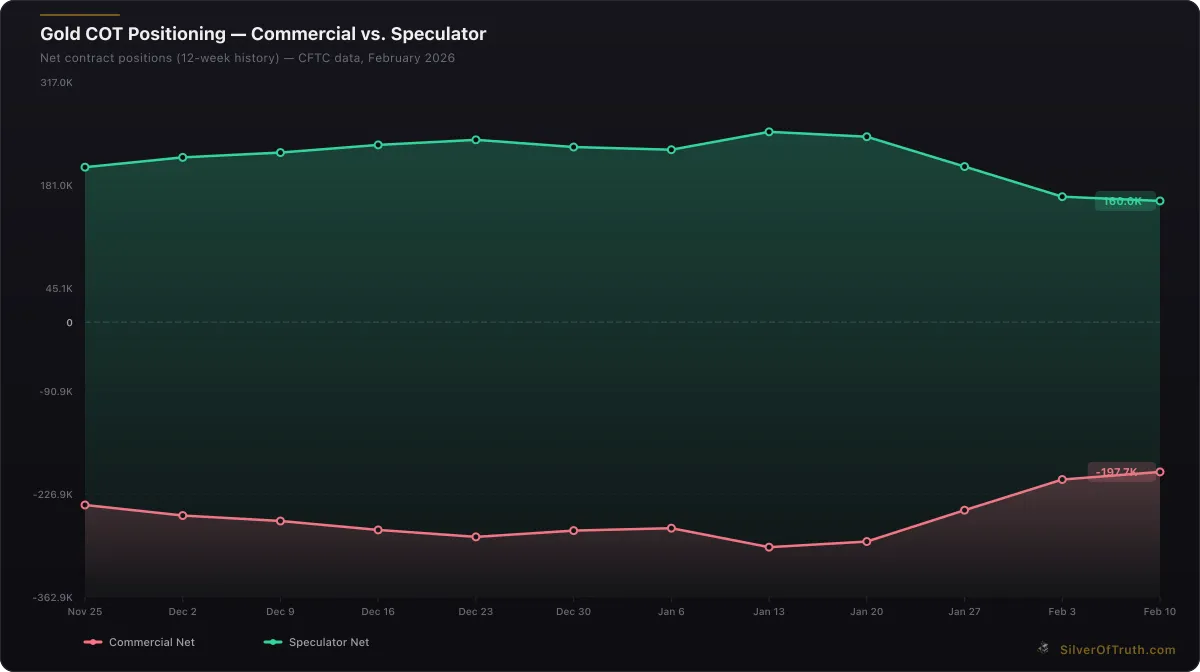
Gold COT positioning: commercial hedgers (red) vs. speculators (green). Source: CFTC via SilverOfTruth, February 2026
London vault gold operates on an allocated basis, meaning specific bars are identified and reserved for individual clients. This contrasts with unallocated gold, where clients hold claims against a general pool of metal. The World Gold Council reports that London's vault system processes approximately 5,000 tonnes of gold annually through refining, transport, and storage operations.
LBMA vault data provides insights unavailable elsewhere in the precious metals market. Monthly vault holdings, published with a three-month delay, show net inflows and outflows that reflect genuine physical demand patterns. When central banks, sovereign wealth funds, or large institutions accumulate physical gold, much of this activity flows through London's vault network.
The system's transparency extends to bar-level tracking. Each London Good Delivery bar carries a unique serial number, weight, and purity certificate. This granular record-keeping enables precise tracking of gold movements between vaults, refiners, and end users. For investors analyzing physical vs paper silver dynamics, London's approach offers a model of how transparent physical markets should operate.
LBMA Vault Data and Market Intelligence
LBMA vault statistics reveal patterns invisible in daily spot prices or futures data. Consider the vault holdings trends from 2020-2025: massive inflows during the pandemic crisis (+1,200 tonnes in 2020) followed by gradual redistribution as central banks and institutions diversified storage locations.
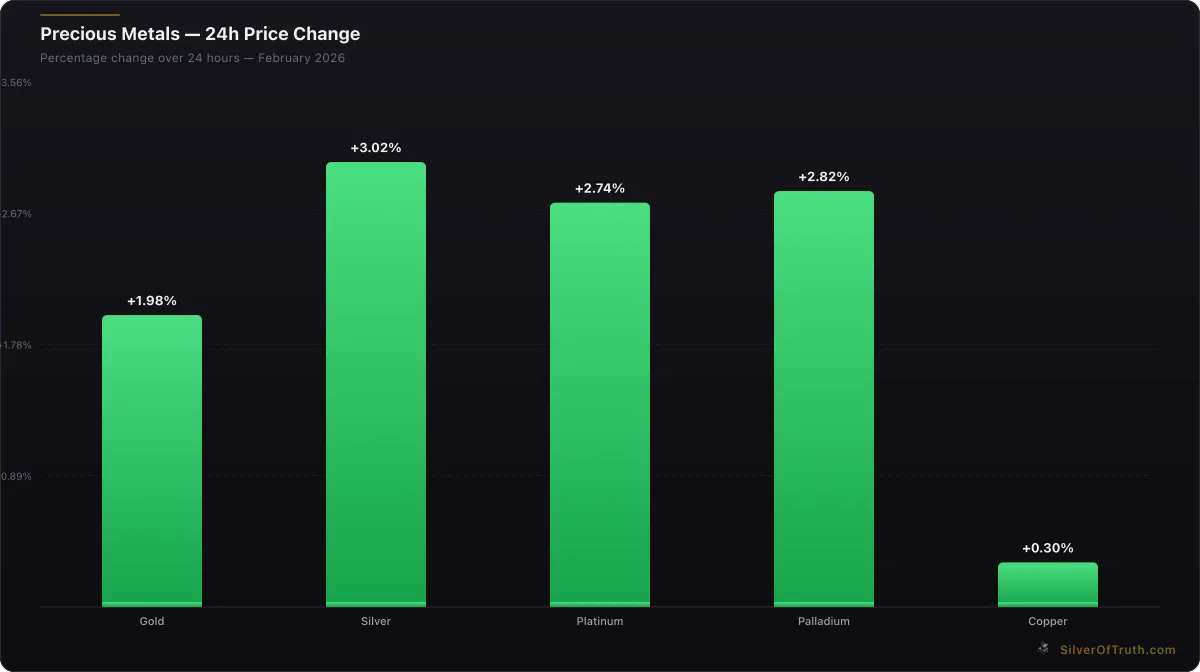
24-hour precious metals price changes. Source: SilverOfTruth, February 2026
The three-month reporting delay, while frustrating for immediate analysis, serves important purposes. It prevents front-running of large institutional moves while providing enough time lag to identify genuine trends versus temporary fluctuations. When vault holdings surge, it typically indicates institutional accumulation driven by currency concerns, geopolitical tensions, or portfolio rebalancing.
Recent LBMA data through November 2025 showed London vault holdings at approximately 6,800 tonnes, down from peak levels of 7,200 tonnes in early 2024. This 400-tonne decline suggests significant physical offtake, potentially supporting current gold price strength above $5,000 per ounce. The outflows align with increased central bank buying activity reported by the LBMA and suggest supply tightness in institutional-grade gold.
The vault data also reveals seasonal patterns. Q4 typically shows increased activity as institutions rebalance portfolios and central banks execute annual gold purchases. Q1 often sees consolidation as new storage arrangements settle. Understanding these rhythms helps investors distinguish between meaningful trend changes and routine market flows.
London vs COMEX: Different Markets, Different Signals
While COMEX registered vs eligible explained focuses on futures delivery mechanics, London vault gold serves broader institutional needs. COMEX inventory, currently at 34.4 million ounces total with a 43.5% registered coverage ratio, reflects futures market dynamics and delivery pressures. London vaults, by contrast, house long-term institutional holdings with less turnover.
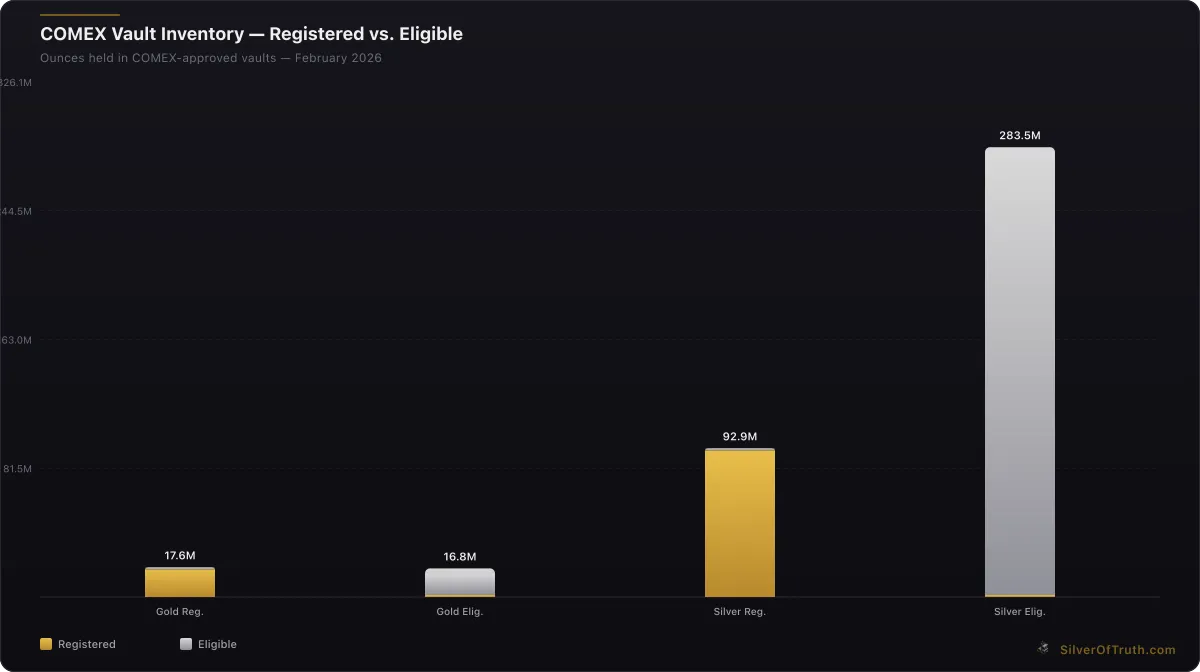
Source: SilverOfTruth COMEX data, February 2026
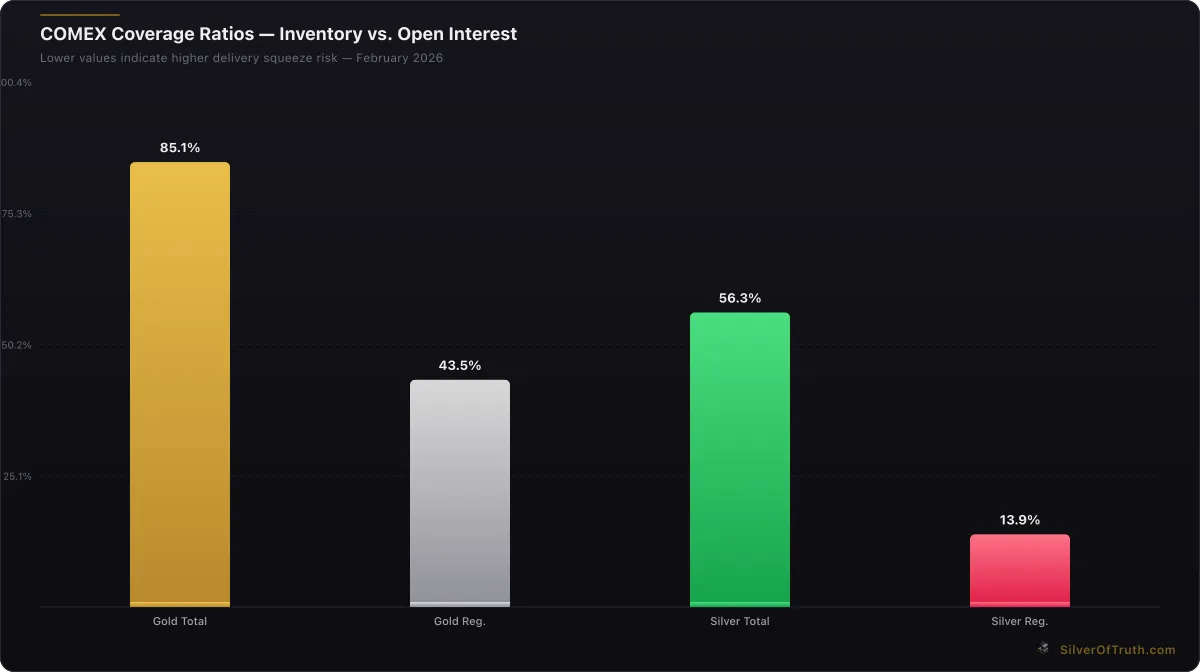
COMEX coverage ratios — lower values indicate higher delivery squeeze risk. Source: SilverOfTruth, February 2026
The relationship between London and COMEX provides arbitrage signals. When COMEX shows delivery stress (coverage ratios below 40%), London vault outflows often accelerate as metal flows to New York for futures delivery. Conversely, when COMEX inventory builds, London may see increased inflows from arbitrageurs storing metal until better delivery opportunities arise.
Current market conditions illustrate this dynamic perfectly. COMEX gold inventory shows moderate depletion (-4.76% monthly) while maintaining medium risk levels. If London vault data (when published) confirms continued outflows, it would validate supply tightness across both major gold markets. This convergence of signals often precedes significant price movements.
The timing differences matter crucially. COMEX data updates daily, providing real-time inventory signals. London vault data, published quarterly with delays, offers strategic trend confirmation. Savvy institutions monitor both: COMEX for tactical positioning, London for strategic validation of longer-term physical supply trends.
Central Bank Gold and London Vaults
Central bank gold purchases reached record levels in 2022-2023, with much of this metal initially flowing through London's vault system before redistribution to home countries. The U.S. Mint and other national mints rely on London refineries for much of their gold supply, creating additional demand flows through the vault network.
LBMA vault data captures these central bank flows better than any other source. When the People's Bank of China or Reserve Bank of India execute large purchases, the metal often temporarily appears in London vaults before shipment. This creates identifiable patterns: sudden inflows followed by organized outflows to specific destinations.
The geopolitical implications run deeper than simple accumulation. Central banks increasingly prefer physical possession over gold held in foreign vaults, driving a "repatriation" trend. Germany's multi-year program to repatriate 674 tonnes from New York and Paris vaults exemplifies this shift. London vault outflows to traditional gold-producing countries often signal this repatriation activity.
Recent central bank buying, concentrated among emerging market economies, creates sustained pressure on London vault supplies. Unlike speculative buying that may reverse quickly, central bank accumulation represents permanent removal from tradeable supply. When vault data confirms this institutional absorption, it provides fundamental support for higher gold prices.
Industrial Demand and London Gold Flows
London's role extends beyond investment demand to industrial supply chains. Electronics manufacturers, jewelry producers, and dental industries source gold through London's refining and distribution network. The Silver Institute notes similar industrial patterns for silver, but gold's industrial applications, while smaller by percentage, generate consistent base-level demand.
Technology sector demand deserves special attention. With gold at $5,063.80 per ounce, high-tech applications become more price-sensitive, but critical applications like semiconductor contacts and medical devices maintain steady consumption. London vault data captures this industrial offtake through regular withdrawals by industrial distributors and manufacturers.
The refining cycle also influences vault flows. When gold jewelry demand surges in India during festival seasons, London refineries increase output, temporarily boosting vault throughput. These seasonal patterns appear in monthly vault statistics, helping investors distinguish between structural demand changes and cyclical fluctuations.
Brexit initially threatened London's dominance in global gold trading, but the market adapted quickly. EU-based institutions established London subsidiaries to maintain vault access, while London clearers expanded European operations. Vault data shows minimal long-term Brexit impact, confirming London's entrenched role in global gold markets.
ETF Dynamics and London Storage
Gold ETFs like SPDR Gold Trust (GLD) and iShares Gold Trust (IAU) store much of their physical backing in London vaults. With over 2,000 tonnes combined, these ETFs represent significant demand for London vault space. ETF inflows and outflows directly impact vault statistics, creating measurable connections between retail investor sentiment and institutional storage demand.
The ETF arbitrage mechanism ensures that large creation/redemption activity appears in vault data. When gold ETFs see massive inflows during crisis periods, authorized participants purchase physical gold in London, temporarily boosting vault holdings. Subsequent redistribution to ETF-specific storage creates measurable vault flows.
Understanding these ETF-driven patterns helps investors separate retail-driven demand from institutional accumulation. ETF-related vault activity tends to be more volatile and trend-following, while central bank and sovereign wealth fund flows show steadier, longer-term patterns. The gold silver ratio trading strategy often incorporates these ETF flow dynamics for tactical allocation decisions.
Vault Security and Insurance Implications
London vault gold benefits from sophisticated security measures that exceed most national reserves. Multi-layered access controls, biometric systems, seismic monitoring, and armed response protocols protect holdings worth hundreds of billions of dollars. These security investments create barriers to entry for competing storage locations, reinforcing London's market dominance.
Insurance coverage through Lloyd's of London syndicates provides additional confidence for institutional clients. All-risks policies cover theft, natural disasters, and operational errors, with coverage limits reaching billions of pounds per facility. This comprehensive protection enables pension funds, sovereign wealth funds, and central banks to store massive gold quantities with confidence.
The security infrastructure creates operational costs that smaller storage centers cannot match. This economic moat protects London's position even as geopolitical pressures encourage storage diversification. Institutions may reduce London exposure for political reasons but rarely eliminate it entirely due to the security advantages.
Physical Gold Investment Strategies Using London Vault Data
Sophisticated gold investors incorporate LBMA vault data into allocation decisions through several approaches. Trend analysis identifies major institutional accumulation or distribution phases, providing early signals for position adjustments. When vault holdings surge beyond normal ranges, it often precedes sustained price rallies driven by institutional demand.
Seasonal pattern recognition helps with tactical timing. Historical vault data reveals Q4 accumulation patterns and Q1 distribution trends that savvy investors can exploit. These patterns become more pronounced during currency crisis periods or heightened geopolitical tensions.
Cross-market analysis combines London vault trends with COMEX inventory patterns for comprehensive supply assessment. When both markets show synchronized inventory declines, it validates broader supply tightness that may not be apparent from price action alone. This convergence analysis proves particularly valuable during consolidation phases when prices trade sideways despite underlying supply constraints.
For investors following how to evaluate mining stocks, London vault data provides demand validation for mining sector investments. Sustained vault outflows indicate strong physical demand that should translate into favorable conditions for gold miners, particularly junior explorers whose valuations correlate closely with gold price trends.
Shanghai Gold Exchange and London Arbitrage
The relationship between London vault gold and Shanghai Gold Exchange (SGE) creates important arbitrage opportunities and demand signals. SGE premiums to London spot prices indicate Chinese demand intensity, while physical gold flows between London and Shanghai reflect global supply distribution patterns.
When SGE premiums expand above $20-30 per ounce, it typically triggers gold flows from London vaults to Asian delivery points. This arbitrage activity appears in London vault statistics as organized outflows to Asian destinations. Current gold prices at $5,063.80 make these arbitrage flows economically significant for large institutional players.
The timing of these flows matters for global price formation. London trading hours overlap partially with Asian markets, creating windows where arbitrage pressures can influence spot prices. Vault data helps investors understand when these flows are building or subsiding, providing insights into potential price pressures before they fully materialize.
Chinese New Year, Indian festival seasons, and other cultural demand drivers create predictable patterns in London-to-Asia gold flows. These seasonal arbitrage opportunities become embedded in vault statistics, helping investors anticipate demand cycles that may not be apparent from Western market analysis alone.
Risk Management and London Gold Storage
For individual investors considering London vault storage, understanding the risk framework becomes essential. Counterparty risk varies significantly among LBMA vault operators, with bank-affiliated facilities offering deposit insurance advantages over independent vault companies. Due diligence on specific vault operators should include financial stability assessment, insurance coverage verification, and operational track record analysis.
Allocated versus unallocated storage represents another critical decision. Allocated gold provides specific bar identification and legal title, but costs more in storage fees. Unallocated gold offers lower costs but creates counterparty risk if the vault operator encounters financial difficulties. The choice depends on individual risk tolerance and investment timeframes.
Currency risk affects non-UK investors storing gold in London. While gold itself provides currency diversification benefits, storage fees, insurance costs, and transaction expenses in British pounds create additional currency exposure. Some investors hedge this exposure, while others accept it as part of their overall currency diversification strategy.
Regulatory Environment and Compliance
London vault gold operates under comprehensive regulatory oversight from the Financial Conduct Authority (FCA) and HM Revenue & Customs (HMRC). Anti-money laundering (AML) requirements mandate detailed customer identification and transaction reporting for all vault activities. These regulations increase operational costs but provide legal protection for legitimate investors.
Brexit created temporary uncertainty about EU investor access to London vaults, but equivalence agreements and subsidiary structures maintained market continuity. Current regulations treat EU institutional investors similarly to domestic clients, preserving London's role in European gold markets.
Tax implications vary significantly by investor jurisdiction and storage structure. UK investors benefit from capital gains tax exemptions on investment gold, while international investors face varying tax treatment in their home countries. Professional tax advice becomes essential for substantial London vault gold positions.
Future Developments in London Vault Gold
Technology adoption in London vaults includes blockchain tracking systems, automated inventory management, and enhanced security protocols. These innovations reduce operational costs while improving transparency and security. The LBMA continues developing digital gold trading platforms that integrate directly with vault operations.
Environmental, social, and governance (ESG) pressures influence vault operations through responsible sourcing requirements and carbon footprint reduction initiatives. London refineries increasingly emphasize recycled gold processing and renewable energy usage to meet institutional investor sustainability requirements.
Central bank digital currencies (CBDCs) may eventually interact with physical gold systems, potentially creating hybrid digital-physical gold products backed by London vault holdings. While still developmental, these innovations could expand demand for professionally stored physical gold.
Frequently Asked Questions
How much gold is stored in London vaults?
Current estimates suggest London vaults hold approximately 6,000-7,000 tonnes of gold, worth over $400 billion at current prices. The exact amount varies as the LBMA publishes official statistics quarterly with a three-month delay.
Can individual investors access London vault storage?
Yes, several LBMA members offer vault services to high-net-worth individuals and smaller institutions. Minimum quantities typically start at 100 ounces (about $500,000 at current prices) with annual storage fees of 0.5-1.0% of gold value.
How does London vault data differ from COMEX inventory?
London vault data reflects long-term institutional holdings and global gold distribution patterns, while COMEX inventory focuses on futures market delivery mechanics. London data updates monthly with delays, while COMEX reports daily in real-time.
What security measures protect London vault gold?
London vaults employ military-grade security including biometric access controls, seismic monitoring, 24/7 armed guards, reinforced construction, and comprehensive insurance coverage through Lloyd's of London syndicates.
How do central bank purchases affect London vault holdings?
Central bank gold purchases often flow initially through London vaults before redistribution to home countries. This creates temporary inflow spikes followed by organized outflows, creating identifiable patterns in LBMA vault statistics.
London vault gold represents the physical foundation of global precious metals markets, with LBMA data providing unique insights into institutional demand patterns invisible in daily price movements. As gold trades above $5,000 per ounce and supply constraints emerge across multiple markets, understanding these vault dynamics becomes increasingly valuable for serious precious metals investors.
Whether you're analyzing central bank accumulation trends, evaluating industrial demand patterns, or timing strategic allocation decisions, London vault data offers institutional-grade intelligence for informed investment decisions. Track these critical supply indicators with the SilverOfTruth app — available on the App Store.
Disclaimer: This article is for informational and educational purposes only and does not constitute financial, investment, or trading advice. Past performance is not indicative of future results. Always conduct your own research and consult with a qualified financial advisor before making investment decisions. SilverOfTruth provides market data and analysis tools — it does not provide personalized financial advice.