

What if you could control 100 ounces of gold with just a fraction of its value? COMEX futures contracts make this possible, but understanding how paper gold and silver work is crucial before diving in. With gold futures representing over 40.4 million ounces in open interest as of February 2026, these derivative contracts drive precious metals pricing worldwide.
COMEX (Commodity Exchange) futures are standardized contracts that allow investors to buy or sell specific amounts of precious metals at predetermined prices and dates. Unlike physical ownership, futures contracts are primarily financial instruments used for speculation, hedging, and price discovery. This comprehensive guide will explain exactly how these powerful tools work.
What Are COMEX Futures Contracts?
COMEX futures are standardized agreements traded on the CME Group exchange that obligate buyers and sellers to exchange specific quantities of precious metals at future dates. Each contract represents a fixed amount of metal with standardized quality specifications, delivery locations, and settlement procedures.
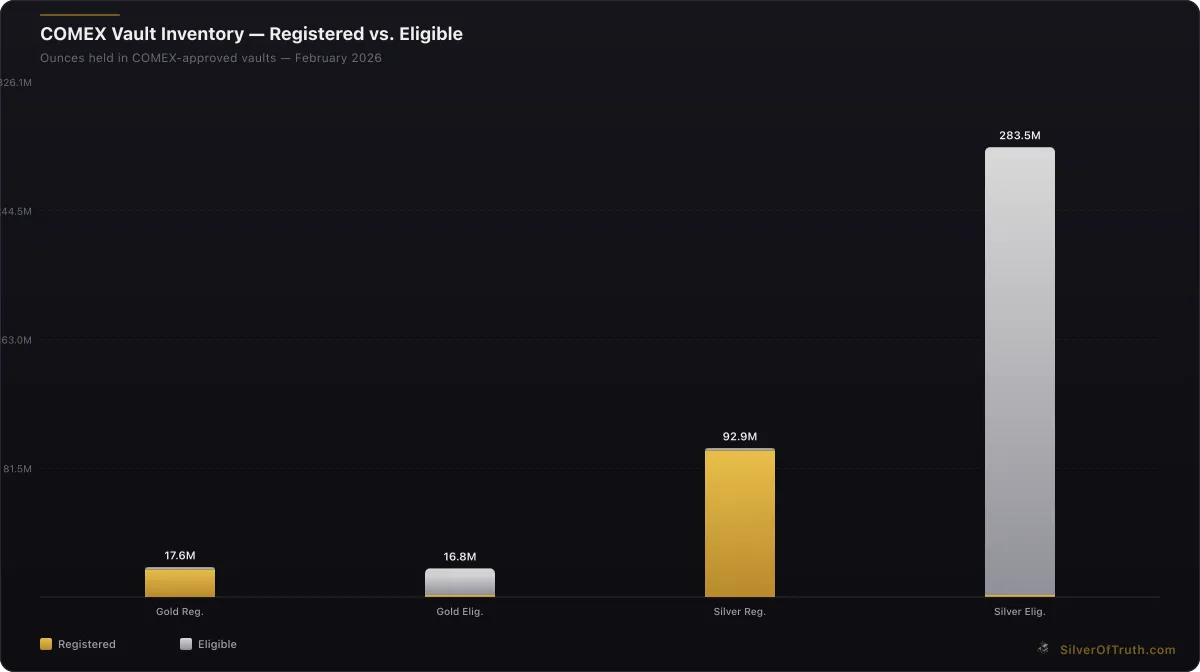
Source: SilverOfTruth COMEX data, February 2026
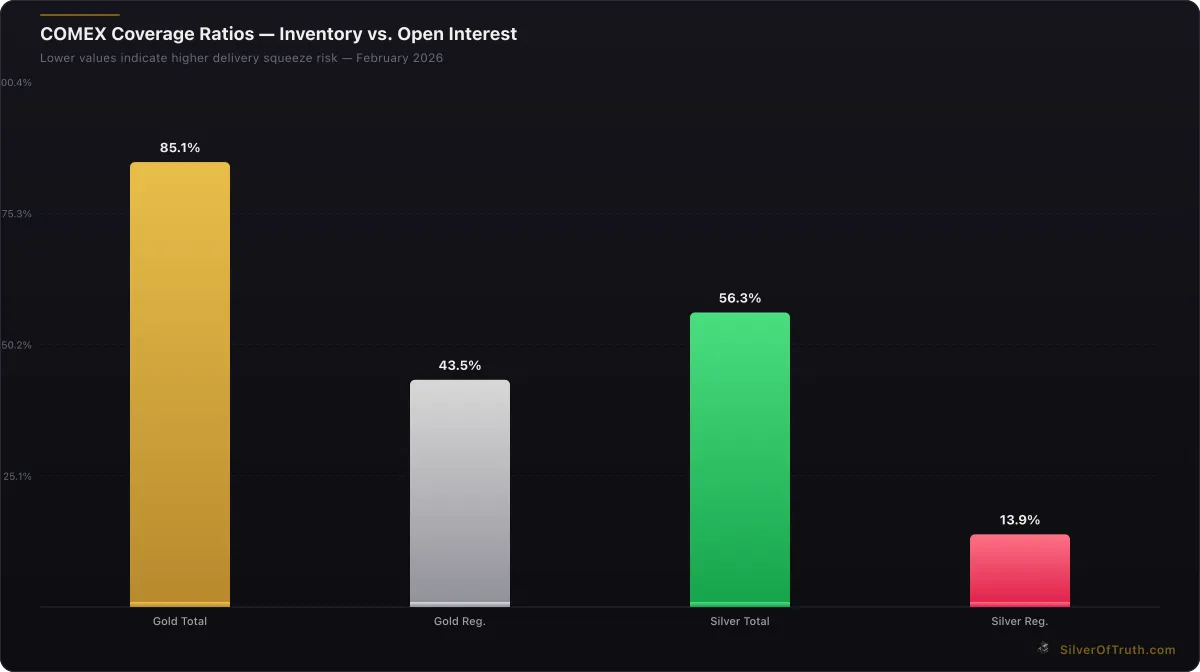
COMEX coverage ratios — lower values indicate higher delivery squeeze risk. Source: SilverOfTruth, February 2026
The key distinction between COMEX futures and physical metals lies in their purpose and mechanics. While physical gold and silver provide direct ownership, futures contracts are derivative instruments whose value derives from the underlying metal's spot price. Most futures contracts—approximately 98%—never result in physical delivery, instead settling in cash or being rolled to later months.
Contract standardization ensures market liquidity and transparent pricing. Gold futures (GC) represent 100 troy ounces, while silver futures (SI) control 5,000 troy ounces. This standardization allows efficient trading between participants worldwide, from mining companies hedging production to speculators betting on price movements.
The COMEX delivery system operates through a network of approved warehouses storing both eligible and registered inventory. Registered inventory can be delivered against futures contracts, while eligible inventory cannot be delivered until converted to registered status. This warehouse system underpins the entire futures market's credibility.
COMEX Futures Contract Specifications
Understanding contract specifications is essential for anyone considering COMEX futures trading. Each metal has distinct characteristics that affect trading strategies and risk management.
Gold Futures (GC) Specifications
| Specification | Details | |---|---| | Contract Size | 100 troy ounces | | Tick Size | $0.10 per ounce ($10 per contract) | | Trading Months | February, April, June, August, October, December | | Last Trading Day | Third business day prior to delivery month end | | Delivery Location | CME-approved depositories | | Margin Requirements | ~$4,000-8,000 initial (varies with volatility) |
Silver Futures (SI) Specifications
| Specification | Details | |---|---| | Contract Size | 5,000 troy ounces | | Tick Size | $0.005 per ounce ($25 per contract) | | Trading Months | March, May, July, September, December | | Last Trading Day | Third business day prior to delivery month end | | Delivery Location | CME-approved depositories | | Margin Requirements | ~$8,000-15,000 initial (varies with volatility) |
With gold trading at $5,063.80 and silver at $77.27 per ounce according to current CME Group COMEX data, a single gold contract controls approximately $506,380 worth of metal, while a silver contract represents about $386,350 in value. The leverage potential is enormous—controlling hundreds of thousands of dollars in metal with margins of just a few thousand dollars.
Platinum (PL) and palladium (PA) futures follow similar structures but with different contract sizes and trading patterns. Our complete guide to COMEX inventory explores how these specifications interact with physical delivery mechanics.
How COMEX Futures Pricing Works
COMEX futures prices reflect multiple factors beyond simple supply and demand for physical metals. Understanding these price drivers helps explain why futures sometimes diverge from spot prices and how arbitrage opportunities emerge.
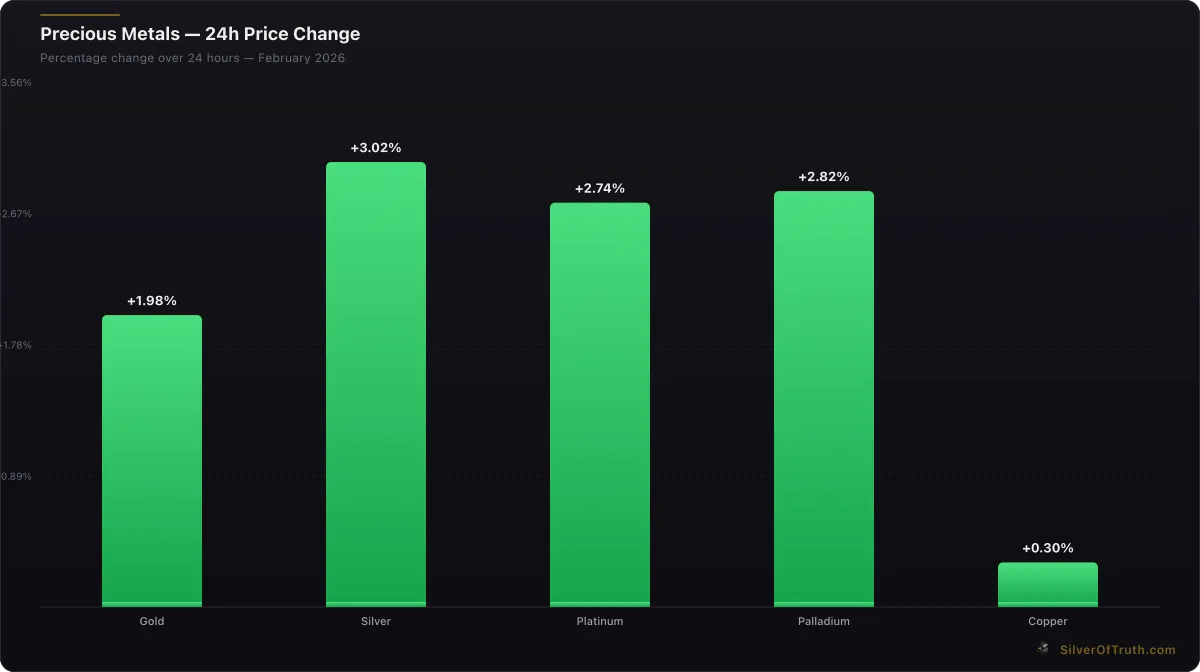
24-hour precious metals price changes. Source: SilverOfTruth, February 2026
Price Discovery Mechanisms
The futures market serves as the primary price discovery venue for precious metals globally. Trading volume often exceeds physical market transactions by 100:1, meaning paper trading dominates price formation. This occurs because futures markets offer superior liquidity, transparency, and continuous trading compared to fragmented physical markets.
Futures prices incorporate storage costs, interest rates, and convenience yields into their premiums or discounts to spot prices. When futures trade above spot (contango), it typically reflects carrying costs exceeding convenience yields. When futures trade below spot (backwardation), it often signals supply tightness or strong physical demand.
Current market conditions show interesting dynamics. With COMEX gold inventory at 34.4 million ounces and open interest representing 40.4 million ounces, the coverage ratio stands at 85.1%—a medium-risk level that influences futures pricing through delivery concerns.
The Gold/Silver Ratio at 65.53 also affects relative futures pricing between metals. When the ratio reaches extreme levels, traders often use futures to execute ratio trades, buying undervalued metals and selling overvalued ones.
Margin and Leverage Mechanics
COMEX futures require only initial margins—typically 5-15% of contract value—to establish positions. This creates substantial leverage but also magnifies both profits and losses. If gold moves $50 per ounce, a single futures contract gains or loses $5,000, potentially doubling or halving a trader's margin deposit.
Variation margin requirements ensure accounts remain adequately funded as prices move. If positions move against traders, they must post additional funds or face liquidation. This margin system enables efficient price discovery while managing counterparty risk through daily settlement.
Understanding Open Interest and Volume
Open interest and trading volume provide crucial insights into futures market dynamics and help predict price movements. These metrics reveal market participation levels, liquidity conditions, and whether trends are likely to continue or reverse.
Interpreting Open Interest Data
Open interest represents the total number of outstanding futures contracts that haven't been closed or delivered. As of February 13, 2026, gold futures show open interest of 404,391 contracts (equivalent to 40.4 million ounces), while silver futures have 133,641 contracts outstanding (668.2 million ounces).
Rising open interest alongside rising prices typically indicates new money entering long positions—a bullish sign. Conversely, rising prices with falling open interest suggests short covering rather than fresh buying, often marking trend exhaustion. The recent decline in gold open interest (-5,303 contracts) despite price gains suggests profit-taking rather than conviction buying.
Our analysis of COT positioning signals shows how open interest interacts with trader positioning. Commercial hedgers hold net short positions of -197,738 gold contracts, while speculators maintain net longs of +160,012 contracts—positioning that influences price direction as these groups adjust their holdings.
Understanding the relationship between open interest and COMEX registered vs eligible inventory helps assess delivery squeeze potential. With registered gold inventory at 17.6 million ounces covering 43.5% of open interest, supply constraints could emerge if delivery demand increases unexpectedly.
Volume Patterns and Liquidity
Trading volume measures daily contract transactions and indicates market liquidity and interest levels. High volume validates price moves, while low volume suggests potential reversals or lack of conviction. Electronic trading allows near-24-hour futures access, though peak liquidity occurs during U.S. market hours.
Volume spikes often coincide with economic data releases, Federal Reserve announcements, or geopolitical events. The CFTC COT reports published weekly also influence trading volume as market participants adjust positions based on large trader positioning data.
The Delivery Process and Physical Settlement
While most COMEX futures settle financially, understanding the delivery process is crucial because delivery potential keeps futures prices tethered to physical market values. The threat of delivery forces convergence between paper and physical prices as contracts approach expiration.
How Physical Delivery Works
Delivery begins with the short position holder (seller) issuing a delivery notice to the exchange clearing house, typically during the first notice period starting three business days before the delivery month. The clearing house randomly assigns these notices to long position holders, who must accept delivery and payment.
Delivered metals must meet strict quality specifications and come from CME-approved depositories. For gold, contracts call for 100 troy ounces of 995 minimum fineness. Silver requires 5,000 troy ounces of 999 minimum fineness. These standards ensure uniformity and market confidence.
The delivery process involves several steps: notice issuance, clearing house assignment, warehouse receipt transfer, and payment completion. Title to the metal transfers with the warehouse receipt, making delivery a book entry rather than physical movement in most cases. Buyers can subsequently withdraw metal from warehouses or leave it stored for future transactions.
Recent delivery statistics show balanced activity with 35,850 gold contracts issued and stopped month-to-date according to our COMEX inventory analysis. This equilibrium suggests neither acute shortage nor surplus in the physical market.
Delivery Squeeze Mechanics
Delivery squeezes occur when limited registered inventory cannot satisfy potential delivery demand from open interest. These events can cause futures prices to spike dramatically as shorts scramble to cover positions rather than face delivery obligations they cannot fulfill.
Current conditions show moderate squeeze potential. Gold's registered coverage ratio at 43.5% provides adequate but not ample supply buffer. Silver faces higher risk with total inventory covering just 56.3% of open interest, though much of this represents eligible rather than deliverable registered metal.
The relationship between inventory and open interest determines squeeze probability. Historical analysis shows coverage ratios below 30% often trigger delivery stress, while ratios above 60% typically provide comfortable supply cushions.
COMEX Futures vs Physical Metals Investment
Choosing between COMEX futures and physical metals depends on investment objectives, risk tolerance, and market outlook. Each approach offers distinct advantages and disadvantages that suit different investor profiles and strategies.
Advantages of COMEX Futures
Futures contracts provide several benefits over physical ownership:
Leverage and Capital Efficiency: Control large metal positions with small initial investments. A $5,000 margin deposit can control $500,000+ worth of gold, amplifying both profits and risks.
Liquidity and Trading Flexibility: Execute trades instantly during market hours without dealer spreads or shipping delays. Position sizes can be adjusted quickly based on changing market conditions.
No Storage Costs: Avoid physical storage, insurance, and security expenses associated with owning actual metals. These carrying costs can significantly erode returns over time.
Portfolio Hedging: Use futures to hedge existing physical positions or other investments exposed to precious metals price risk. Miners frequently use futures to lock in selling prices for future production.
Tax Advantages: In some jurisdictions, futures receive more favorable tax treatment than physical metals, particularly regarding capital gains timing and rates.
Disadvantages and Risks
Futures trading involves substantial risks that physical metals avoid:
Counterparty Risk: Futures depend on clearing house and broker solvency. While CME clearing is robust, systemic risks exist that don't affect physical ownership.
Margin Calls and Forced Liquidation: Adverse price movements trigger margin calls. Inability to meet these calls results in forced position liquidation, potentially at unfavorable prices.
Time Decay and Rollover Costs: Futures contracts expire, requiring position rolls to maintain exposure. Contango markets make rolling expensive, eroding returns over time.
No Physical Possession: Cannot take delivery for personal holdings, emergency preparedness, or preference for tangible assets. Futures are purely financial instruments.
Complexity and Learning Curve: Require understanding of margin, expiration dates, contract specifications, and market mechanics. Mistakes can be costly for inexperienced traders.
Our guide to physical vs paper silver explores these tradeoffs in greater detail, helping investors choose appropriate allocation strategies.
Who Uses COMEX Futures and Why
COMEX futures serve diverse market participants with varying objectives and strategies. Understanding these different players helps explain market behavior and provides context for price movements and positioning changes.
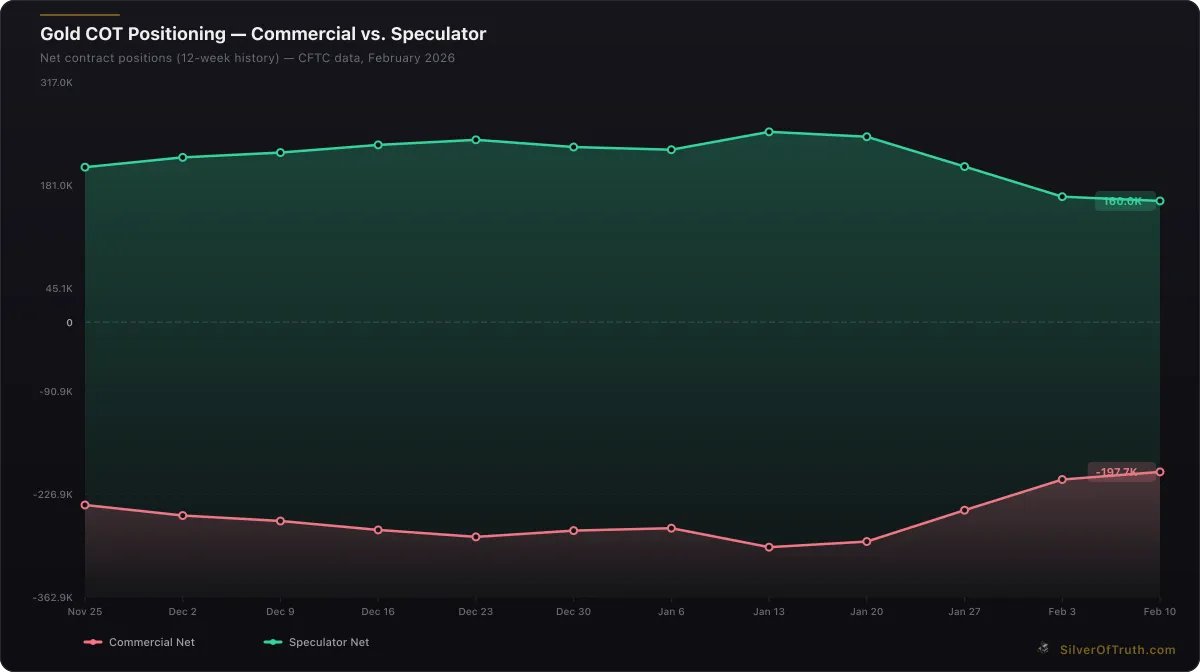
Gold COT positioning: commercial hedgers (red) vs. speculators (green). Source: CFTC via SilverOfTruth, February 2026
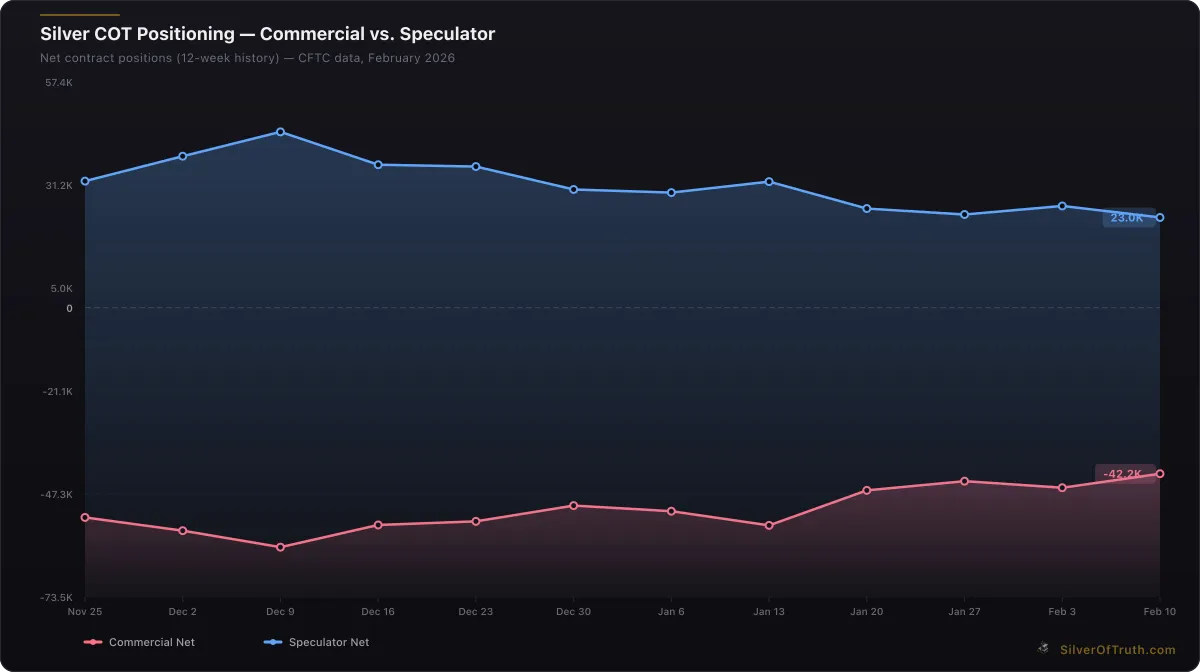
Silver COT positioning: commercial hedgers (red) vs. speculators (blue). Source: CFTC via SilverOfTruth, February 2026
Commercial Hedgers
Mining companies, refiners, and jewelry manufacturers use futures primarily for risk management rather than speculation. Miners sell futures contracts against future production to lock in selling prices and ensure profitability regardless of price fluctuations. This hedging removes price risk but sacrifices upside participation.
Jewelry manufacturers and industrial users buy futures to secure metal supplies at known costs, enabling accurate product pricing and inventory management. These hedges protect against supply disruptions and price spikes that could damage their businesses.
According to the latest CFTC COT report data, commercial traders hold net short positions of -197,738 gold contracts and -42,163 silver contracts, reflecting their typical role as natural sellers hedging production and inventories.
Speculative Traders
Hedge funds, commodity trading advisors (CTAs), and individual traders use futures for profit-seeking speculation based on price direction predictions. These traders provide market liquidity and help with price discovery but can also increase volatility during trend changes.
Managed money positioning in gold shows how large speculators influence market dynamics. Currently holding net long positions of +92,022 gold contracts, these traders have reduced exposure recently (-50 contracts weekly), suggesting cautious sentiment despite rising prices.
Technical analysis often drives speculative trading decisions, with traders using chart patterns, momentum indicators, and trend-following systems to time entries and exits. Our COT report analysis explains how tracking speculative positioning helps predict potential market turning points.
Arbitrageurs and Market Makers
Sophisticated traders exploit price discrepancies between futures and physical markets, different contract months, or related metals. These arbitrage activities help maintain market efficiency and price relationships.
Exchange market makers provide continuous bid-offer spreads, facilitating smooth trading for all participants. Their activities ensure adequate liquidity and narrow spreads that benefit everyone using the markets.
Key Risks and Considerations
COMEX futures trading involves multiple risk categories that investors must understand and manage appropriately. Proper risk assessment and management are essential for successful futures participation.
Market Risk and Volatility
Precious metals prices can move dramatically based on economic data, monetary policy changes, geopolitical events, and technical factors. Gold and silver often experience 2-5% daily moves during volatile periods, translating to significant gains or losses on leveraged futures positions.
Current market conditions show elevated volatility with gold up 2.33% and silver gaining 2.10% in the latest session. Such moves represent $2,330 gains or losses per gold contract and $1,050 per silver contract—amounts that can quickly exceed initial margin requirements.
Interest rate changes particularly affect precious metals futures. Rising real interest rates reduce metals' appeal as non-yielding assets, while falling rates enhance their attractiveness. Federal Reserve policy shifts can trigger substantial futures price movements within hours.
Operational and Execution Risks
Trading mechanics introduce risks beyond pure price exposure. System failures, communication problems, or execution delays can prevent timely position adjustments during critical market periods. Ensuring reliable trading systems and backup procedures helps mitigate these operational risks.
Margin requirements can change rapidly during volatile periods, potentially requiring additional funds when markets are most stressful. Maintaining adequate account equity beyond minimum requirements provides safety buffers for unexpected margin increases.
Regulatory and Tax Implications
Futures trading faces extensive regulation by the CFTC and exchanges. Position limits restrict how many contracts individual traders can hold, preventing excessive concentration. Large trader reporting requirements provide market transparency but may affect trading strategies.
Tax treatment varies by jurisdiction and trader classification. Futures may qualify for favorable 60/40 capital gains treatment in the U.S., but rules are complex and subject to change. Consulting qualified tax professionals is essential for proper compliance and planning.
Frequently Asked Questions
What's the minimum amount needed to trade COMEX futures?
Most brokers require $10,000-25,000 minimum account sizes for futures trading, though initial margins for individual contracts are much lower. Gold futures typically require $4,000-8,000 initial margin, while silver needs $8,000-15,000. However, prudent risk management suggests maintaining 3-5 times minimum margins to handle adverse price movements without forced liquidation.
How do COMEX futures prices relate to physical gold and silver prices?
Futures prices closely track spot prices but include carrying costs, storage fees, and interest rate effects. The difference between futures and spot prices (basis) reflects these factors plus supply/demand imbalances. Delivery potential keeps futures anchored to physical values, preventing excessive divergence.
Can individual investors take delivery of physical metals from COMEX contracts?
Yes, but it's complex and expensive for most individuals. Delivery requires accepting full contract sizes (100 oz gold or 5,000 oz silver) and involves warehouse fees, insurance, and logistics. Most individual investors find direct bullion purchases more practical for physical ownership goals. Our silver stacking guide offers better options for personal physical holdings.
What happens if I can't meet a margin call?
Failure to meet margin calls results in forced position liquidation by your broker, potentially at unfavorable prices during volatile markets. This liquidation can create losses exceeding your initial investment. Maintaining adequate account equity and understanding margin requirements before trading helps prevent forced liquidations.
How do COMEX futures affect physical metal prices worldwide?
COMEX futures serve as the global benchmark for precious metals pricing. Physical dealers, miners, refiners, and other market participants reference COMEX prices when setting their buy/sell spreads. This price discovery function means COMEX futures influence physical markets far beyond direct trading participation.
COMEX futures represent powerful financial tools that can enhance precious metals investment strategies when properly understood and carefully managed. Whether you're seeking portfolio hedging, speculative opportunities, or deeper market understanding, futures knowledge is essential in today's interconnected metals markets.
Track live COMEX inventory data, futures positioning, and delivery activity with the SilverOfTruth app — available on the App Store for comprehensive precious metals market intelligence.
Disclaimer: This article is for informational and educational purposes only and does not constitute financial, investment, or trading advice. Past performance is not indicative of future results. Always conduct your own research and consult with a qualified financial advisor before making investment decisions. SilverOfTruth provides market data and analysis tools — it does not provide personalized financial advice.