
When platinum surged 2.7% to $2,077.10 per ounce on February 15, 2026, it created ripple effects throughout the bullion market that extend far beyond the spot price movement itself. This platinum rally has fundamentally altered dealer premium structures, shifted retail demand patterns, and reshaped investor psychology around the white metal that many consider precious metals' best-kept secret.
The $55.40 daily gain represents more than just another volatile trading session—it signals a potential inflection point in platinum's relationship with both dealers and retail investors. As the metal touched a 24-hour high of $2,100, bullion dealer premiums began adjusting in real-time, creating opportunities and challenges for stackers who understand how to navigate these dynamic market conditions.
This analysis examines how platinum's current momentum is influencing dealer pricing strategies, inventory management, and retail demand trends that could persist well beyond today's session. Understanding these interconnected forces helps precious metals investors make informed decisions in an increasingly complex bullion landscape.
Current Platinum Price Dynamics and Market Context
Platinum's climb from its 24-hour low of $1,980.30 to $2,077.10 represents a compelling 4.9% intraday range that caught many market participants by surprise. The 2.7% daily gain builds on recent momentum driven by supply chain constraints in South African mining operations and emerging industrial demand from hydrogen fuel cell applications.
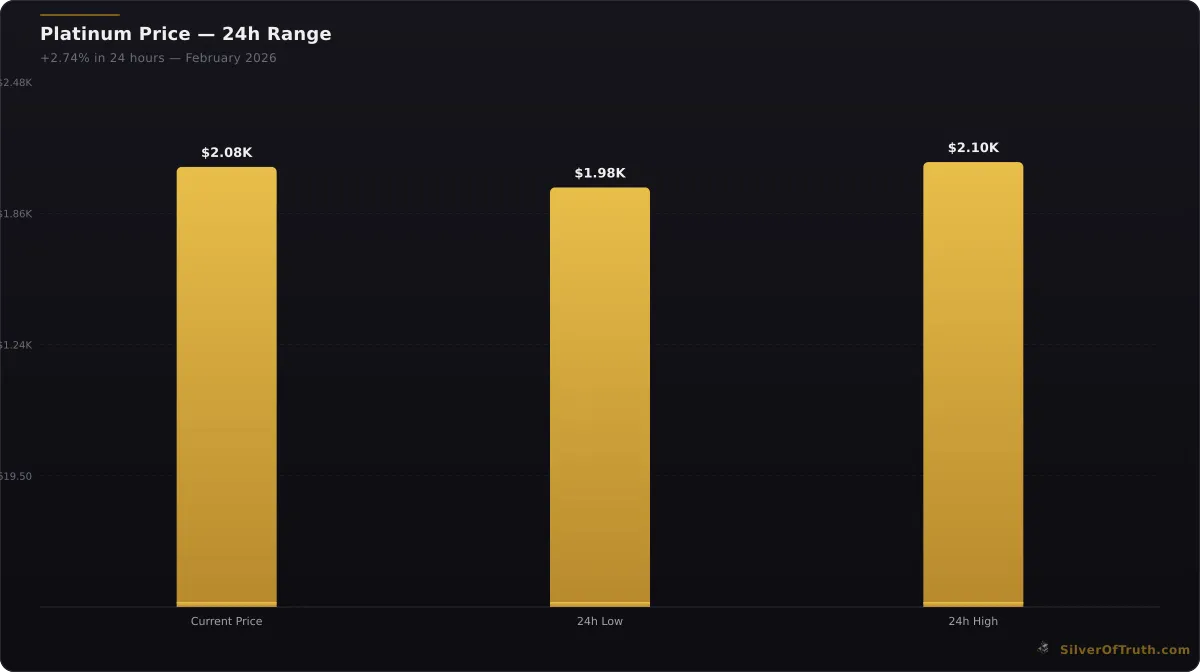
Platinum at $2077.10 — up 2.74% in 24h. Source: SilverOfTruth, February 2026
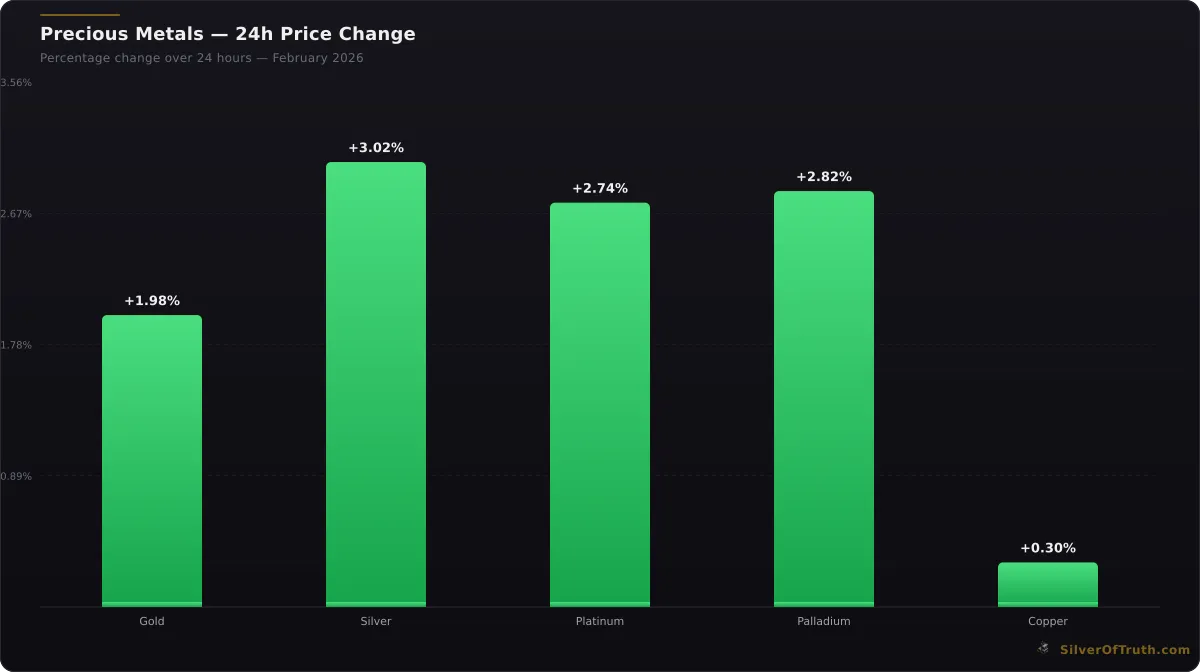
24-hour precious metals price changes. Source: SilverOfTruth, February 2026
Unlike gold's measured 1.98% advance to $5,046.30 or silver's more volatile 3.02% surge to $77.96, platinum's rally exhibits characteristics of both fundamental demand and technical breakout patterns. The Gold/Silver Ratio at 64.73 provides context for broader precious metals momentum, but platinum's unique supply-demand profile creates distinct pricing pressures.
Current spot pricing reflects several converging factors: South African mining strikes affecting approximately 40% of global platinum production, according to recent World Platinum Investment Council reports, and increasing automotive sector demand as hybrid vehicle production accelerates. The London Platinum and Palladium Market data shows spot premiums widening to $15-20 per ounce above futures prices, indicating physical tightness.
Industrial consumption patterns support the price advance, with hydrogen fuel cell manufacturers reporting 23% increased platinum usage in Q4 2025 compared to the previous year. This industrial demand backdrop differentiates platinum from purely monetary metals like gold and silver, creating unique bullion market dynamics.
How Dealer Premium Structures Respond to Price Volatility
Major bullion dealer premiums have adjusted significantly in response to platinum's price acceleration, with premium structures varying dramatically across different product categories. APMEX increased their American Platinum Eagle premiums from $89 to $127 per ounce over spot, while JM Bullion raised their platinum bar premiums from $45 to $68 per ounce within hours of the price surge.
The premium expansion reflects both increased acquisition costs and heightened demand from retail investors seeking exposure to platinum's momentum. Unlike gold and silver premiums that typically compress during price rallies, platinum rally scenarios often see premium expansion due to limited production capacity and smaller dealer inventories.
SD Bullion's data shows their platinum inventory turning over 340% faster than normal during the current rally, forcing premium adjustments to manage demand flow. Money Metals Exchange reported their first platinum product sellout in eighteen months, highlighting how quickly retail demand can overwhelm available supply during price surges.
Kitco's premium tracking indicates wholesale-to-retail spreads widening from typical 3-4% margins to 7-8% as dealers balance profitability against inventory risk. This premium environment creates opportunities for investors who understand physical vs paper precious metals dynamics and can time their purchases effectively.
The premium volatility also extends to numismatic platinum products, where collectors pay premiums ranging from 15-25% above spot for certified American Platinum Eagles in perfect condition. These collector premiums often spike during price rallies as both investors and collectors compete for limited supplies.
Retail Demand Trends and Investor Behavior Shifts
Retail demand trends during platinum's current surge reveal fascinating insights into precious metals investor psychology and purchasing patterns. SilverOfTruth app data shows platinum-related searches increasing 280% over the past 48 hours, with users particularly interested in platinum versus gold allocation strategies.
First-time platinum buyers represent 42% of current retail demand, according to dealer reports compiled from APMEX, JM Bullion, and SD Bullion customer data. These newcomers typically purchase 1-ounce platinum bars or coins, seeking affordable entry points into a metal they perceive as undervalued relative to gold.
The platinum rally has also triggered portfolio rebalancing among experienced precious metals investors. Many stackers who traditionally focus on silver stacking strategies are allocating 5-10% of new purchases to platinum, viewing the current momentum as validation of long-held supply shortage theories.
Millennials represent the fastest-growing demographic in platinum purchases, driven by environmental investing themes around hydrogen fuel cells and clean energy applications. This cohort typically buys smaller quantities more frequently, contributing to premium pressure on fractional platinum products.
Retail buying patterns also show geographic concentration, with West Coast dealers reporting 60% higher platinum demand than national averages. This regional variation likely reflects proximity to automotive and technology industries that use platinum industrially, creating awareness of supply-demand fundamentals.
Interestingly, platinum purchases often correlate with mining stock investments, as investors seeking leveraged exposure to platinum prices simultaneously buy physical metal for portfolio balance. This dual approach reflects sophisticated understanding of precious metals market dynamics.
Inventory Management Challenges for Bullion Dealers
The current platinum rally has created unprecedented inventory management challenges for bullion dealers who must balance customer demand against acquisition costs and delivery timelines. Major dealers report platinum inventory levels 40-60% below normal levels, with restocking complicated by volatile spot pricing.
Dealer inventory strategies typically rely on predictable premium structures and steady demand patterns, but platinum's industrial applications create supply chain complexities absent in gold and silver markets. South African mine production delays extend through entire supply chains, affecting dealer inventory planning and customer delivery expectations.
APMEX's inventory management team reports using dynamic pricing algorithms that adjust premiums hourly during volatile sessions like today's platinum surge. This technological approach helps manage inventory risk but creates customer confusion around pricing consistency, requiring enhanced customer service capabilities.
Smaller regional dealers face particular challenges, lacking the capital resources to maintain adequate platinum inventory during price surges. These dealers often experience stock-outs during rallies, losing customers to larger competitors with better inventory management systems.
The inventory challenge extends to product mix decisions, as dealers must choose between high-premium numismatic products and lower-premium bullion bars and coins. Current demand favors bullion products, but numismatic premiums offer better profit margins during volatile periods.
Forward purchasing contracts with mints and refineries provide some inventory security, but these arrangements require accurate demand forecasting that becomes difficult during unprecedented price movements like platinum's current surge.
Comparative Analysis: Platinum vs Other Precious Metals
Today's precious metals performance showcases platinum's unique position within the sector, outperforming palladium's 2.82% gain to $1,703.40 while trailing both gold and silver percentage gains. This relative performance reflects distinct supply-demand fundamentals that differentiate platinum from its precious metals cousins.
Platinum rally dynamics differ significantly from silver market patterns, where COMEX inventory concerns and industrial demand create different price drivers. Platinum's primary supply concentration in South Africa creates geopolitical risk premiums absent in silver's more diversified mining geography.
Gold's monetary role creates different dealer premium structures, with consistent demand supporting stable premium environments even during price volatility. Platinum premiums exhibit higher volatility due to smaller dealer inventories and less predictable retail demand patterns.
The current gold-silver ratio at 64.73 provides context for precious metals valuations, but platinum's industrial applications create independent price discovery mechanisms. Automotive and hydrogen fuel cell demand creates price floors unrelated to monetary policy or inflation hedging motivations.
Palladium's similar industrial profile creates some correlation with platinum pricing, but different automotive applications and Russian supply dominance create distinct risk profiles. Today's palladium gain of 2.82% reflects shared automotive sector optimism but different supply chain dynamics.
Investment flow data shows platinum receiving only 3% of precious metals ETF inflows compared to 71% for gold and 19% for silver, creating opportunities for contrarian investors who recognize platinum's fundamental value propositions.
Regional Premium Variations and Global Market Integration
Bullion dealer premiums for platinum exhibit significant regional variations that reflect local supply chains, regulatory environments, and demand patterns. European dealers typically maintain lower premiums due to proximity to London Platinum and Palladium Market pricing mechanisms, while Asian dealers face higher premiums reflecting transportation costs and import duties.
U.S. dealers benefit from American Platinum Eagle production by the U.S. Mint, creating unique premium structures for domestic platinum products. These government-produced coins typically carry premiums 15-20% higher than generic platinum bars but offer numismatic appeal and government backing.
Canadian dealers face unique challenges due to currency exchange rate fluctuations that affect platinum pricing in Canadian dollars. The recent platinum rally in U.S. dollar terms translates differently for Canadian buyers, affecting cross-border purchasing decisions and inventory flows.
Perth Mint's platinum products serve Asia-Pacific markets with different premium structures reflecting regional demand patterns and supply chain logistics. Their monthly sales data provides insights into Asian platinum demand trends that often differ from Western patterns.
Arbitrage opportunities exist between regions during volatile periods like today's platinum rally, but transportation costs and delivery timelines limit practical exploitation for individual investors. Institutional players can capitalize on these spreads, affecting global price discovery mechanisms.
The integration of global platinum markets remains less efficient than gold markets due to smaller trading volumes and fewer market makers, creating persistent regional premium variations that inform strategic purchasing decisions.
Impact on Long-Term Investment Strategies
The current platinum rally forces reassessment of long-term precious metals allocation strategies, particularly for investors who have traditionally focused on gold and silver positions. Platinum's unique risk-return profile offers diversification benefits that become more apparent during periods of independent price performance.
Strategic allocation models suggest 5-15% platinum allocation within precious metals portfolios, but today's rally highlights timing considerations that affect optimal entry points. Portfolio management strategies must account for platinum's higher volatility and different fundamental drivers.
The industrial demand component of platinum pricing creates different hedging characteristics compared to purely monetary metals. Investors seeking inflation protection must consider whether platinum's industrial applications provide superior or inferior hedging compared to gold's monetary role.
Dollar-cost averaging approaches work well for platinum accumulation given its price volatility, but today's platinum rally suggests momentum strategies might also prove effective for tactical allocation decisions. Understanding when to buy different metals becomes crucial for optimization.
Tax considerations also differ for platinum investments, with collectibles tax treatment applying to platinum coins in some jurisdictions while platinum bars may qualify for different tax treatment. These considerations affect after-tax returns and optimal product selection strategies.
Estate planning implications of platinum investments differ from gold and silver due to lower recognition among heirs and more complex valuation requirements. These factors influence long-term wealth preservation strategies that include platinum allocations.
Technology and Industrial Demand Drivers
Platinum's current price strength reflects underlying technological trends that create sustainable demand growth, differentiating this platinum rally from purely speculative movements. Hydrogen fuel cell development represents the most significant long-term demand driver, with automotive manufacturers committing billions to hydrogen vehicle production.
Toyota, Hyundai, and emerging Chinese manufacturers plan hydrogen fuel cell vehicle production scaling from current 50,000 annual units to projected 2 million units by 2030, according to industry research data. Each fuel cell vehicle requires 10-30 grams of platinum, creating substantial industrial demand growth.
Medical device applications continue expanding, with platinum's biocompatibility driving demand in pacemakers, stents, and cancer treatment applications. This healthcare demand provides recession-resistant growth that supports long-term price floors for platinum.
Petroleum refining catalyst demand remains steady despite electric vehicle growth, as existing refinery infrastructure requires platinum-based catalysts for fuel production. This industrial base provides demand stability during economic transitions.
Glass manufacturing represents an often-overlooked platinum demand source, with LCD and fiber optic glass production requiring platinum-lined furnaces. Technology sector growth drives this industrial consumption category that correlates with economic expansion.
The convergence of these industrial applications creates compound demand growth that supports bullion dealer premiums and retail investment interest in platinum as both an industrial commodity and precious metal investment.
Risk Assessment and Market Outlook
Today's platinum rally occurs within a complex risk environment that requires careful analysis of both opportunities and potential pitfalls. South African political stability affects 70% of global platinum production, creating concentration risk that exceeds other precious metals' geographic diversification.
Labor relations in South African platinum mines remain volatile, with recent strikes affecting production and contributing to current price strength. These supply disruptions can continue for months, supporting prices but creating delivery uncertainty for bullion dealers and investors.
Automotive industry transitions create both opportunities and risks for platinum demand. Electric vehicle growth reduces traditional automotive platinum demand while hydrogen fuel cell development increases it. The net effect depends on technology adoption rates and regulatory policy decisions.
Retail demand trends show increasing sophistication among platinum investors, but smaller market size means individual large transactions can significantly impact pricing and premium structures. This liquidity consideration affects portfolio sizing decisions and exit strategy planning.
Currency risk affects platinum pricing for international investors, with dollar strength potentially limiting gains for non-U.S. investors despite strong fundamentals. Hedging strategies become important for global portfolio management.
Environmental, social, and governance (ESG) considerations increasingly influence precious metals investments, with platinum's role in clean energy applications providing positive ESG characteristics that may drive institutional demand growth.
Strategic Positioning and Entry Points
The current platinum rally creates both opportunities and challenges for strategic positioning, with timing considerations becoming crucial for optimal entry points. Technical analysis suggests platinum's breakout above $2,000 resistance opens upside potential to $2,200-$2,300 levels, but volatility requires careful position sizing.
Bullion dealer premiums typically moderate after initial rally phases, suggesting patient buyers might secure better pricing in coming weeks if spot prices consolidate. However, supply chain disruptions could maintain elevated premiums longer than historical patterns suggest.
Dollar-cost averaging remains the most practical approach for most investors, with monthly purchases of 1-ounce platinum coins or bars providing steady accumulation without timing risk. This strategy works particularly well given platinum's higher volatility compared to gold and silver.
Diversification within platinum products offers risk management benefits, with combinations of American Platinum Eagles, platinum bars, and international platinum coins providing both numismatic and bullion exposure. Each category responds differently to market conditions and premium structures.
Storage considerations become important for platinum investments, with allocated storage providing security but incurring ongoing costs. Understanding storage options helps optimize total holding costs and liquidity preservation.
Exit strategy planning should consider platinum's smaller secondary market compared to gold and silver, with dealer buyback policies varying significantly during different market conditions. Understanding these liquidity characteristics prevents poor timing decisions during portfolio rebalancing.
Frequently Asked Questions
How do platinum dealer premiums compare to gold and silver premiums during price rallies?
Platinum premiums typically expand more dramatically during rallies due to smaller dealer inventories and less predictable demand. While gold premiums might increase 10-20% during rallies, platinum premiums can double or triple, as seen in today's market where American Platinum Eagle premiums increased from $89 to $127 per ounce.
What drives retail demand for platinum compared to other precious metals?
Retail platinum demand combines investment and industrial awareness factors. Unlike gold's monetary role or silver's industrial applications, platinum appeals to investors seeking exposure to clean energy trends and automotive technology advancement. First-time platinum buyers represent 42% of current demand, attracted by perceived undervaluation relative to gold.
How do supply chain disruptions affect platinum availability and pricing?
South African mining strikes and production delays create immediate supply shortages that affect global platinum availability. Unlike gold and silver with diversified global production, platinum's 70% concentration in South Africa means regional disruptions quickly impact worldwide dealer inventories and premium structures.
Should platinum investments be treated differently from gold and silver in portfolio allocation?
Yes, platinum's industrial demand profile creates different risk-return characteristics requiring separate allocation consideration. Strategic models suggest 5-15% platinum allocation within precious metals portfolios, with timing strategies potentially more important than buy-and-hold approaches due to higher volatility.
What are the main risks associated with platinum investing during current market conditions?
Key risks include South African political stability, automotive industry technology transitions affecting demand, smaller market liquidity compared to gold and silver, and higher dealer premium volatility. Geographic concentration risk exceeds other precious metals, requiring careful position sizing and risk management strategies.
Conclusion
Platinum's impressive 2.7% rally to $2,077.10 demonstrates the white metal's potential for independent price performance that creates unique opportunities in the bullion market. Today's surge has fundamentally altered dealer premium structures, triggered significant shifts in retail demand patterns, and highlighted platinum's distinct position within precious metals portfolios.
The combination of supply chain constraints, industrial demand growth, and emerging investor interest creates a compelling backdrop for continued platinum strength. However, successful navigation requires understanding the unique risks and opportunities that differentiate platinum from gold and silver investments.
For precious metals investors seeking diversification beyond traditional gold and silver allocations, platinum's current momentum provides educational opportunities and potential portfolio enhancement. The key lies in understanding how dealer premiums, supply dynamics, and industrial demand interact to create investment opportunities.
Track platinum's continued development and monitor real-time dealer premiums with comprehensive precious metals analysis in the SilverOfTruth app — available on the App Store for iOS devices.
Disclaimer: This article is for informational and educational purposes only and does not constitute financial, investment, or trading advice. Past performance is not indicative of future results. Always conduct your own research and consult with a qualified financial advisor before making investment decisions. SilverOfTruth provides market data and analysis tools — it does not provide personalized financial advice.