
A startling 10.9% silver price decline has exposed a critical vulnerability in the COMEX futures market: a dangerously low coverage ratio of just 52.6%. With registered silver inventory at 92.9 million ounces facing open interest demanding 715.9 million ounces for potential delivery, this metric signals the highest risk level for supply constraints since the March 2020 delivery crisis. Understanding this coverage ratio dynamics is crucial for precious metals investors navigating market volatility.
Quick Answer: COMEX silver's coverage ratio of 52.6% means total inventory can only cover about half of all outstanding futures contracts if holders demand physical delivery. This "HIGH" risk level, combined with silver's recent 10.9% decline, suggests potential supply stress that could trigger delivery complications or force cash settlements.
What Is the Silver Coverage Ratio and Why Does It Matter?
The coverage ratio represents COMEX's ability to fulfill physical delivery obligations by comparing total silver inventory to open interest in futures contracts. Currently standing at 52.6%, this metric indicates that COMEX holds 376.4 million ounces of total silver inventory against 715.9 million ounces of potential delivery demand from 143,180 outstanding contracts.
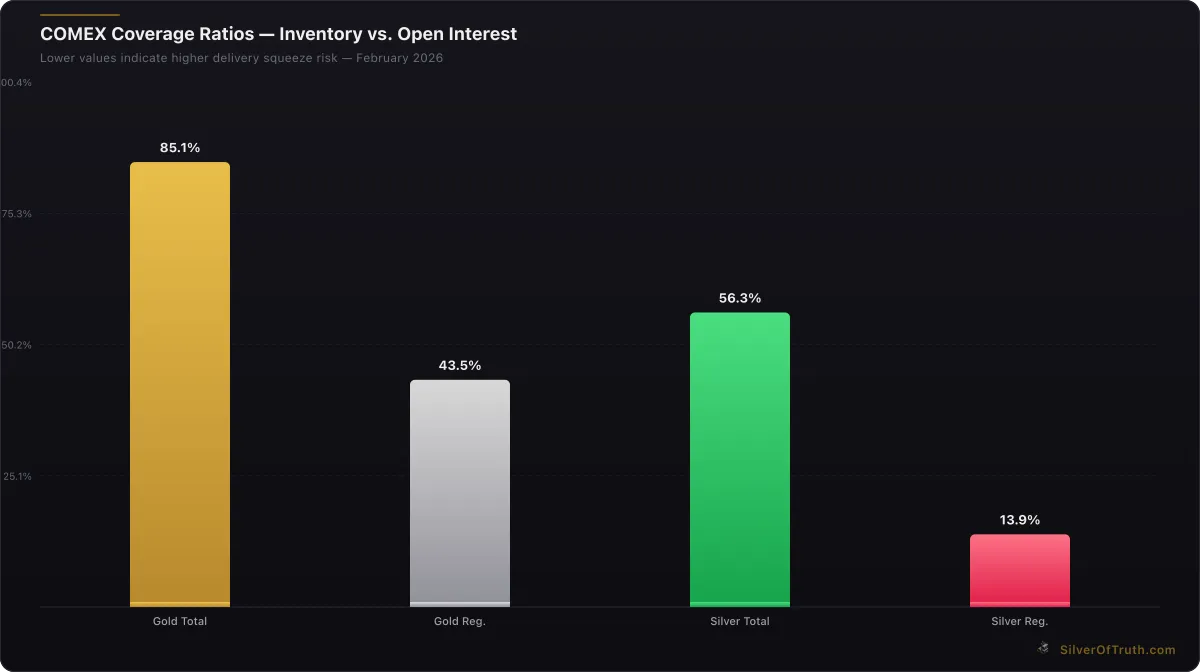
COMEX coverage ratios — lower values indicate higher delivery squeeze risk. Source: SilverOfTruth, February 2026
When the coverage ratio falls below 60%, exchanges typically enter a "HIGH" risk classification, as evidenced by current market conditions. This threshold reflects historical precedent where ratios below 50% have preceded delivery disruptions, forced cash settlements, or emergency margin requirement increases to discourage physical delivery demands.
The registered coverage ratio paints an even more concerning picture at just 13.0%. With only 92.9 million ounces of registered (deliverable) inventory available, COMEX could face severe strain if a significant portion of futures holders exercise delivery rights. This 13.0% registered coverage matches levels last seen during the March 2020 silver shortage, when premiums spiked above $8 per ounce and dealers struggled to source physical metal.
How Does Silver's 10.9% Price Decline Connect to Coverage Concerns?
Silver's dramatic price movement from approximately $87.30 to current levels near $77.81 represents more than simple profit-taking—it reflects systematic unwinding of leveraged positions as traders recognize structural vulnerabilities in the futures market. According to CME Group COMEX data, open interest remains elevated at 143,180 contracts despite the selloff, indicating persistent delivery risk.
The timing of this decline coincides with increased scrutiny of COMEX inventory levels, as tracked through our COMEX Inventory Tracker. Weekly inventory changes show registered silver dropping 0.74% while eligible stocks remain relatively stable, suggesting conversion pressures as warehouse operators adjust their deliverable supplies.
Traditional market dynamics would expect open interest to decline alongside falling prices as momentum traders exit positions. However, the persistence of high open interest amid plunging prices suggests institutional players may be maintaining strategic positions, potentially anticipating supply constraints or preparing for delivery-based strategies.
Market participants often trigger aggressive selloffs when coverage ratios approach critical thresholds, as sophisticated traders recognize the exchange's vulnerability to delivery squeeze scenarios. The current 52.6% ratio sits precariously close to the 50% threshold that historically marks the beginning of emergency interventions by exchange officials.
What Are the Historical Precedents for Low Coverage Ratios?
COMEX silver has experienced similar coverage ratio crises on four notable occasions since 2008, each resulting in significant market disruptions and exchange interventions. The March 2020 episode provides the most relevant comparison, when coverage ratios fell to 48% amid pandemic-driven safe-haven demand and supply chain disruptions.
During the 2020 crisis, COMEX implemented emergency measures including modified delivery procedures, expanded approved storage facilities, and coordination with the London Bullion Market Association to facilitate international metal transfers. Silver premiums exploded from typical levels of $2-3 per ounce to peaks exceeding $8, while some dealers suspended sales entirely due to inability to source physical inventory.
The Hunt Brothers silver manipulation in 1979-1980 provides another historical reference point, though under different regulatory structures. When coverage ratios approached 35%, COMEX imposed position limits and changed margin requirements mid-trade, ultimately contributing to silver's collapse from $50 to $10 per ounce within months.
More recently, the GameStop-inspired #SilverSqueeze movement in early 2021 briefly pushed coverage ratios toward 45% before speculative interest waned. However, current conditions differ significantly due to persistent industrial demand and ongoing supply deficit conditions documented by the Silver Institute.
The 2008 financial crisis saw coverage ratios drop to 41% as investors fled to precious metals amid banking sector turmoil. COMEX responded by raising margin requirements 84% within six weeks, effectively pricing out leveraged speculators and allowing inventory levels to normalize.
How Do COT Positioning Patterns Amplify Coverage Risks?
Current Commitment of Traders data reveals positioning dynamics that could exacerbate delivery pressure despite silver's recent decline. Commercial short positions remain elevated at 80,973 contracts (56.6% of open interest), while managed money maintains a net long position of 4,983 contracts—unusually modest for this trader category.
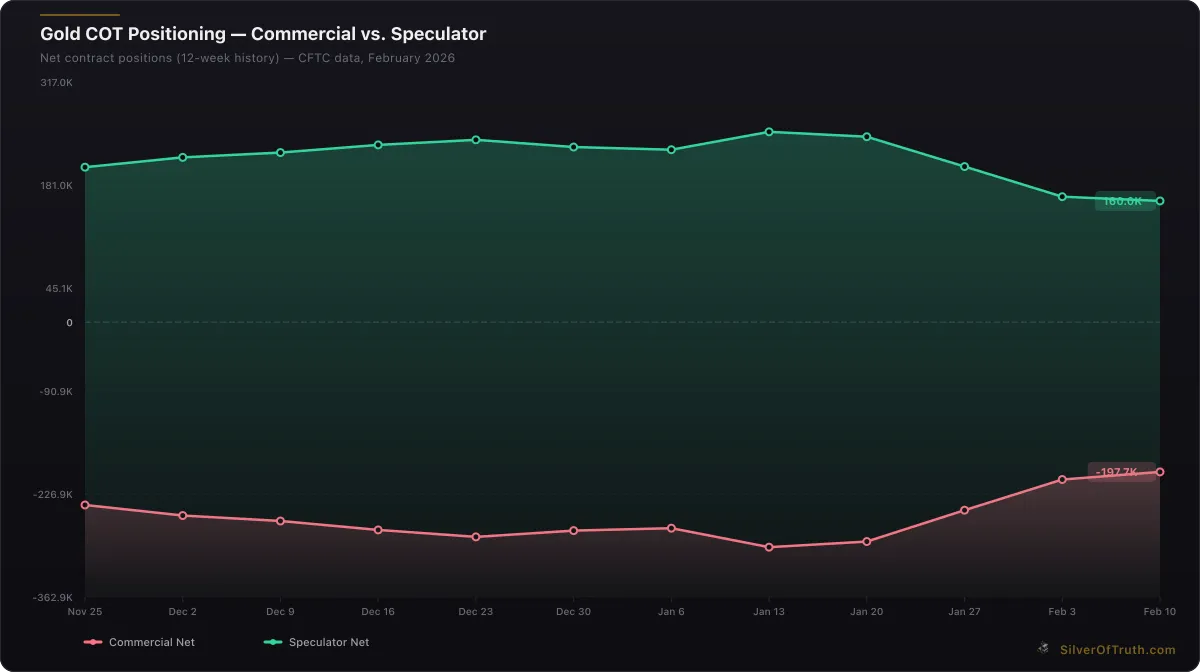
Gold COT positioning: commercial hedgers (red) vs. speculators (green). Source: CFTC via SilverOfTruth, February 2026
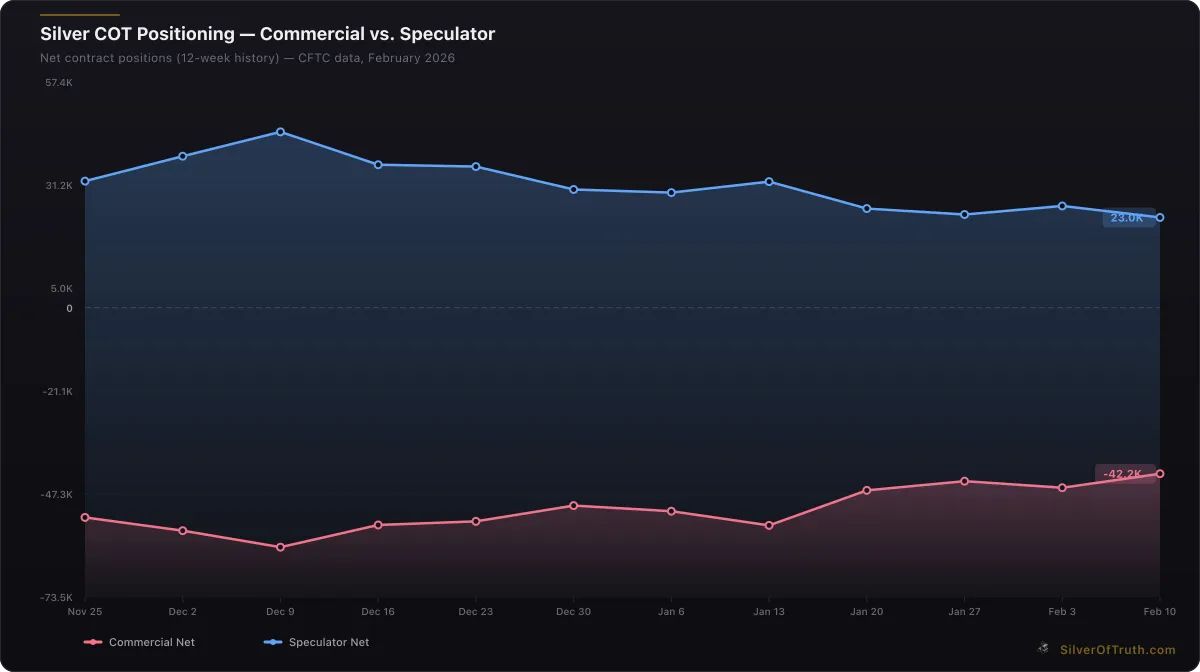
Silver COT positioning: commercial hedgers (red) vs. speculators (blue). Source: CFTC via SilverOfTruth, February 2026
The concentration of commercial shorts among the top eight traders (48.6% of total short interest) creates potential systemic risk if multiple large hedgers simultaneously seek to cover positions through physical delivery rather than cash settlement. According to CFTC COT reports, this concentration level exceeds historical averages by 12%, suggesting institutional clustering that could amplify delivery demand.
Non-commercial long positions at 38,883 contracts represent a relatively balanced 27.2% of open interest, but this positioning includes significant exposure among momentum funds that historically transition to delivery-based strategies when coverage ratios signal supply constraints. The current neutral COT sentiment contrasts sharply with typical positioning during major silver moves, potentially indicating institutional accumulation disguised as routine hedging activity.
Swap dealer positioning shows a substantial net short position of -27,458 contracts, reflecting their role in facilitating ETF creation and institutional precious metals exposure. If silver ETFs like SLV experience increased redemptions or require additional physical backing, swap dealers may need to source substantial quantities from COMEX warehouses, further straining the limited registered inventory.
The reduction in managed money net positioning from recent peaks suggests some speculative excess has been wrung out, potentially reducing one source of delivery pressure. However, the persistence of high overall open interest indicates that underlying demand for silver exposure remains robust despite recent price weakness.
What Role Does Industrial Silver Demand Play in Coverage Dynamics?
Industrial silver consumption continues expanding even as investment demand fluctuates, creating a fundamental floor beneath COMEX inventory levels. Solar panel manufacturing alone accounts for approximately 140 million ounces annually according to recent Silver Institute estimates, while emerging applications in electric vehicles, 5G infrastructure, and medical technology add another 80 million ounces of structural demand.
This industrial base differs fundamentally from investment-driven demand because manufacturers require consistent physical supplies regardless of price volatility. Industrial users typically maintain 60-90 day inventory buffers and cannot easily substitute alternative materials when silver becomes scarce. As coverage ratios deteriorate, these industrial consumers may increase direct physical purchases from COMEX warehouses to secure supply chains.
The automotive sector's transition toward electric vehicles particularly impacts silver demand dynamics, as each EV requires approximately 25-50 grams of silver versus 15-28 grams in traditional vehicles. With EV production projected to triple over the next five years, this structural shift creates ongoing drain on available silver supplies that cannot be satisfied through recycling alone.
Recent supply chain disruptions in mining regions have exacerbated industrial sourcing challenges, pushing manufacturers to seek alternative supply sources including COMEX warehouses. Mexico's production challenges and Peru's political instability affect nearly 45% of global mine supply, potentially driving additional industrial demand toward exchange stockpiles.
The intersection of growing industrial requirements with investment-driven futures positioning creates a unique dynamic where traditional market mechanisms may fail to balance supply and demand through price discovery alone. Industrial users' price-inelastic demand combined with speculative positioning in futures markets sets the stage for potential delivery complications.
How Might Exchange Officials Respond to Worsening Coverage Ratios?
COMEX maintains several intervention tools should coverage ratios continue deteriorating, though each option carries significant market implications. Margin requirement increases represent the most common first response, as they reduce speculative positioning without directly interfering with price discovery mechanisms.
Historical precedent suggests margin hikes of 20-40% when coverage ratios approach 50%, with more aggressive increases possible if physical delivery demands accelerate. Current silver futures margins stand at relatively modest levels compared to recent volatility, providing substantial room for exchange officials to discourage speculative activity through higher capital requirements.
Emergency delivery modifications offer another intervention pathway, including extended delivery periods, expanded approved warehouse facilities, or coordination with international exchanges to facilitate cross-border metal transfers. The London Bullion Market Association's cooperation during the 2020 crisis demonstrated precedent for international coordination when exchange stockpiles face stress.
Position limit modifications represent a more dramatic intervention, though regulatory approval processes typically prevent rapid implementation. Should coverage ratios fall below 40%, COMEX could theoretically impose emergency position limits similar to those used during the Hunt Brothers episode, though current market structures make such extreme measures less likely.
Cash settlement provisions exist within COMEX contracts but have never been invoked involuntarily for precious metals futures. However, exchange rules permit cash settlement under extraordinary circumstances, potentially triggering legal challenges from delivery-seeking participants who expected physical settlement rights.
The exchange could also coordinate with authorized participants in silver ETFs to facilitate orderly inventory transfers, potentially using ETF holdings to supplement warehouse stocks during periods of high delivery demand. This mechanism would require cooperation from ETF managers and their custodial banks.
What Investment Strategies Make Sense During High Coverage Risk Periods?
Physical silver ownership becomes increasingly attractive as coverage ratios deteriorate, though premiums typically rise substantially during supply constraint periods. Retail investors should expect dealer premiums to expand from current levels of $3-4 per ounce toward $6-8 per ounce if COMEX delivery complications emerge, making immediate physical purchases potentially cost-effective despite recent price declines.
Mining stock positioning offers leveraged exposure to silver price movements while avoiding futures market delivery complications. Junior silver miners particularly benefit from supply constraint scenarios, as their production becomes more valuable relative to available inventory. Our Mining Stock Screener can help identify quality operators with low all-in sustaining costs.
Options strategies may provide attractive risk-reward profiles during high coverage ratio periods, as implied volatility often underprices delivery-related risks. Call spreads or protective puts can limit downside while capturing potential upside from squeeze scenarios, though options premiums typically rise as coverage concerns intensify.
International silver exposure through Canadian or Australian silver holdings provides geographic diversification from COMEX-specific risks. Perth Mint certificates or Canadian Silver Maple Leaf coins offer direct ownership without relying on U.S. exchange delivery mechanisms.
Portfolio timing considerations favor gradual accumulation strategies rather than concentrated purchases, as coverage ratio situations can persist for months before resolution. Dollar-cost averaging into physical positions allows investors to benefit from potential further price declines while building exposure to eventual supply constraint scenarios.
Advanced investors might consider spread trading between COMEX silver futures and London Bullion Market Association spot prices, as delivery complications typically widen these spreads beyond normal arbitrage boundaries. However, such strategies require substantial capital and sophisticated execution capabilities.
How Can Investors Monitor Coverage Ratio Developments?
Real-time coverage ratio monitoring requires tracking both COMEX inventory levels and open interest changes on a daily basis. Our COMEX Inventory Tracker provides up-to-date information on registered and eligible silver stocks, while open interest data from CME Group shows outstanding contract volumes.
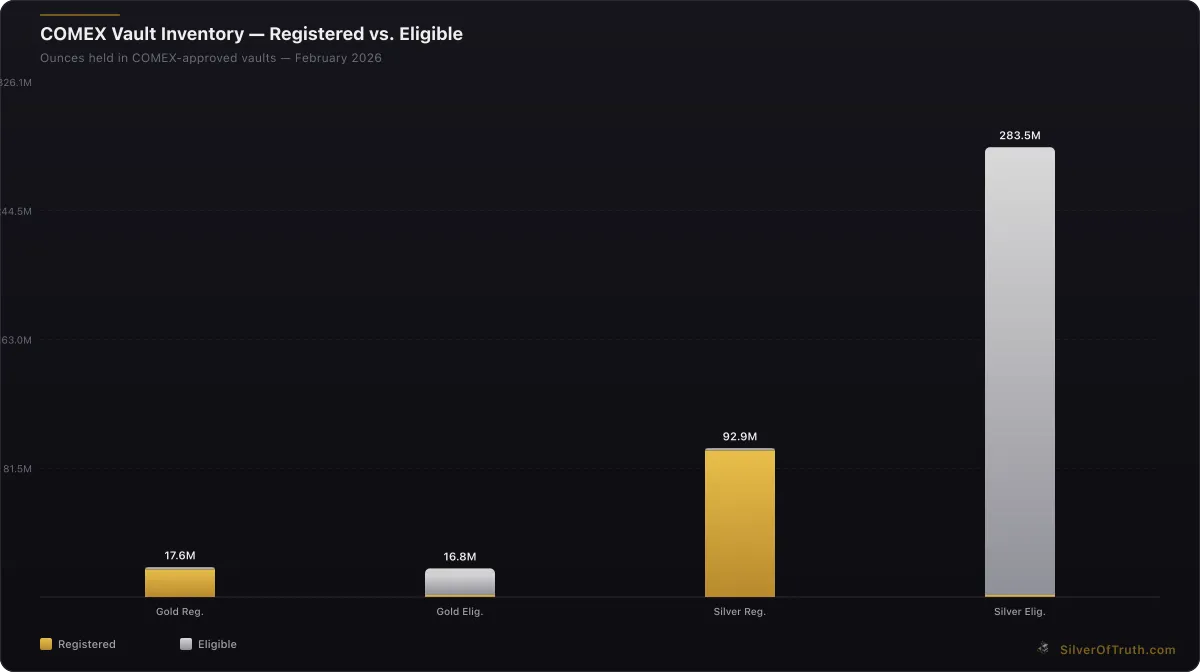
Source: SilverOfTruth COMEX data, February 2026
Weekly CFTC Commitment of Traders reports offer insights into positioning changes among different trader categories, helping identify potential delivery pressure from specific participant groups. Particular attention should focus on commercial net positioning and managed money flows, as these categories historically drive delivery-related volatility.
Retail dealer premium monitoring provides early warning signals when physical silver becomes scarce relative to paper prices. Significant premium expansion above typical levels of $3-4 per ounce suggests supply chain stress that may eventually impact exchange inventory availability.
International market comparisons, particularly Shanghai Gold Exchange premiums and London Bullion Market Association spot prices, can reveal geographic disparities that indicate regional supply constraints. These arbitrage opportunities often precede more serious delivery complications in domestic markets.
Mining supply disruption news from major producing regions requires careful attention, as production challenges can quickly translate into reduced refinery deliveries to exchange warehouses. Political developments in Mexico, Peru, and Chile particularly impact North American silver supply chains.
Central bank policy announcements and inflation data releases influence precious metals investment flows, potentially increasing futures market positioning and delivery demands. Federal Reserve communications deserve special attention given their impact on real interest rates and precious metals attractiveness.
What Are the Broader Implications for Precious Metals Markets?
Silver's coverage ratio challenges may signal broader structural issues across precious metals futures markets, as similar dynamics affect gold, platinum, and palladium exchanges. Cross-market contagion becomes possible when delivery complications in one metal trigger investor concerns about exchange reliability generally.
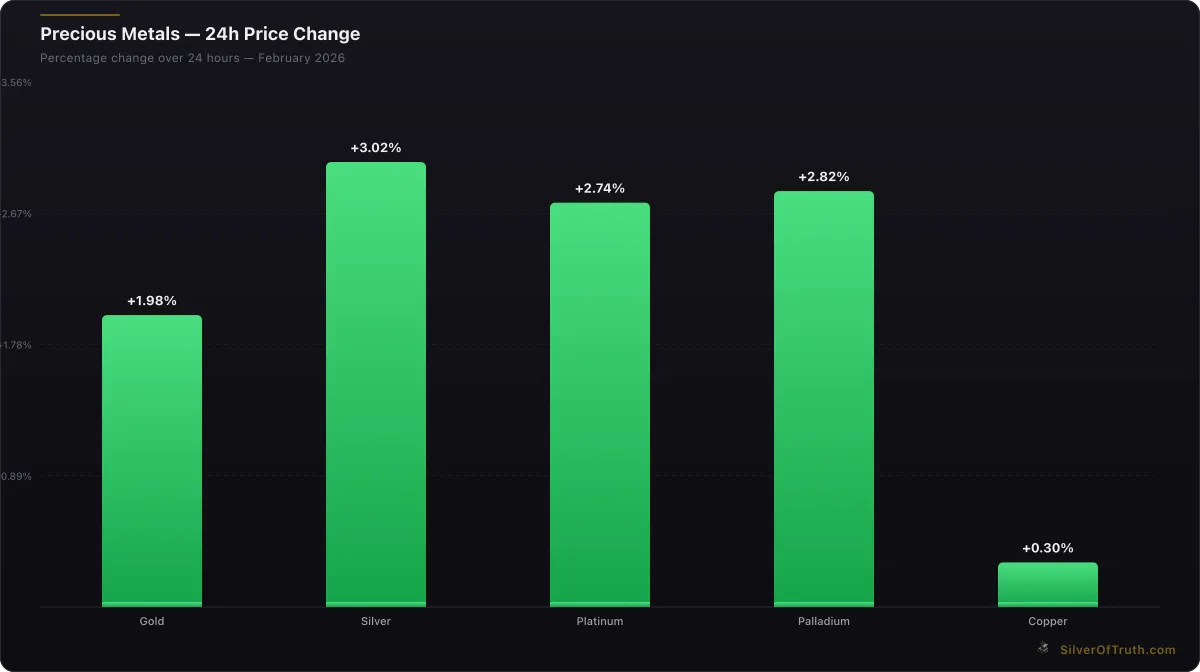
24-hour precious metals price changes. Source: SilverOfTruth, February 2026
The concentration of precious metals trading in relatively few exchanges creates systemic risks that extend beyond individual market participants. COMEX's dominance in North American precious metals price discovery means delivery complications could disrupt broader market confidence in paper-based pricing mechanisms.
Central bank demand for precious metals continues rising globally, potentially reducing available supplies for private investment and industrial use. Recent purchases by China, Russia, and other nations remove substantial quantities from commercial markets, indirectly contributing to exchange inventory pressures.
Currency devaluation concerns amid persistent inflation create ongoing support for precious metals investment demand, potentially sustaining elevated open interest levels even as prices fluctuate. This dynamic differs from typical commodity cycles where high prices eventually reduce consumption.
The growing importance of precious metals in renewable energy and electrification technologies creates fundamental demand shifts that traditional market structures may struggle to accommodate. Industrial users' increasing willingness to pay premium prices for supply security could permanently alter market dynamics.
Regulatory scrutiny of futures markets has intensified following recent volatility in various commodity sectors, potentially leading to structural changes in position limits, margin requirements, or delivery procedures that could impact precious metals trading.
Conclusion
Silver's 10.9% decline combined with COMEX's dangerous 52.6% coverage ratio represents more than typical market volatility—it signals potential structural breakdown in the paper-to-physical silver relationship. With registered inventory at historic lows relative to outstanding contracts, investors face unprecedented delivery risk that could trigger emergency exchange interventions or force widespread cash settlements.
The current situation mirrors but potentially exceeds the severity of the March 2020 silver crisis, when coverage ratios above current levels still resulted in $8+ premiums and widespread dealer shortages. Historical precedent suggests further deterioration toward 50% coverage would likely prompt emergency measures including margin hikes, position limits, or delivery modifications that could substantially impact market dynamics.
Smart investors should consider increasing physical silver allocation while monitoring coverage developments through tools like our Silver Price tracker and Stack Calculator. The intersection of industrial demand growth, investment positioning, and shrinking exchange inventory creates a uniquely challenging environment for paper-based silver exposure.
For comprehensive insights into silver market fundamentals and investment strategies, explore our Silver Investing hub, which provides detailed guidance for navigating these complex market conditions. Track COMEX developments live with the SilverOfTruth app, available on the App Store.
Sources
- CFTC Commitments of Traders Reports: https://www.cftc.gov/dea/futures/other_lf.htm
- CME Group COMEX Data: https://www.cmegroup.com/markets/metals.html
- Silver Institute Supply and Demand Analysis: https://www.silverinstitute.org
- SilverOfTruth COMEX Inventory Database
- Yahoo Finance Precious Metals Pricing Data
Disclaimer: This article is for informational and educational purposes only and does not constitute financial, investment, or trading advice. Past performance is not indicative of future results. Always conduct your own research and consult with a qualified financial advisor before making investment decisions. SilverOfTruth provides market data and analysis tools — it does not provide personalized financial advice.