
Silver markets present a fascinating contradiction as of February 13, 2026: while speculator positioning appears relatively balanced according to the latest CFTC Commitment of Traders data, COMEX inventory dynamics are flashing high-risk warning signals with a coverage ratio of just 52.6%. This divergence between futures positioning and physical market stress creates a unique analytical puzzle that demands deeper examination. Our comprehensive COT Reports guide provides essential background for understanding these positioning dynamics.
Quick Answer: Silver speculator positioning remains neutral at 18% of open interest while the COMEX coverage ratio sits at a high-risk 52.6%, creating a disconnect between futures sentiment and physical delivery stress that could trigger significant price volatility.
What Does Current Speculator Positioning Reveal About Silver Sentiment?
The latest CFTC COT report dated February 3, 2026, reveals a surprisingly balanced speculator stance in silver futures. Non-commercial traders (speculators) hold a net long position of +25,877 contracts, representing just 18.1% of total open interest of 143,180 contracts. This positioning sits well below the extreme levels that typically signal crowded trades and potential reversals.
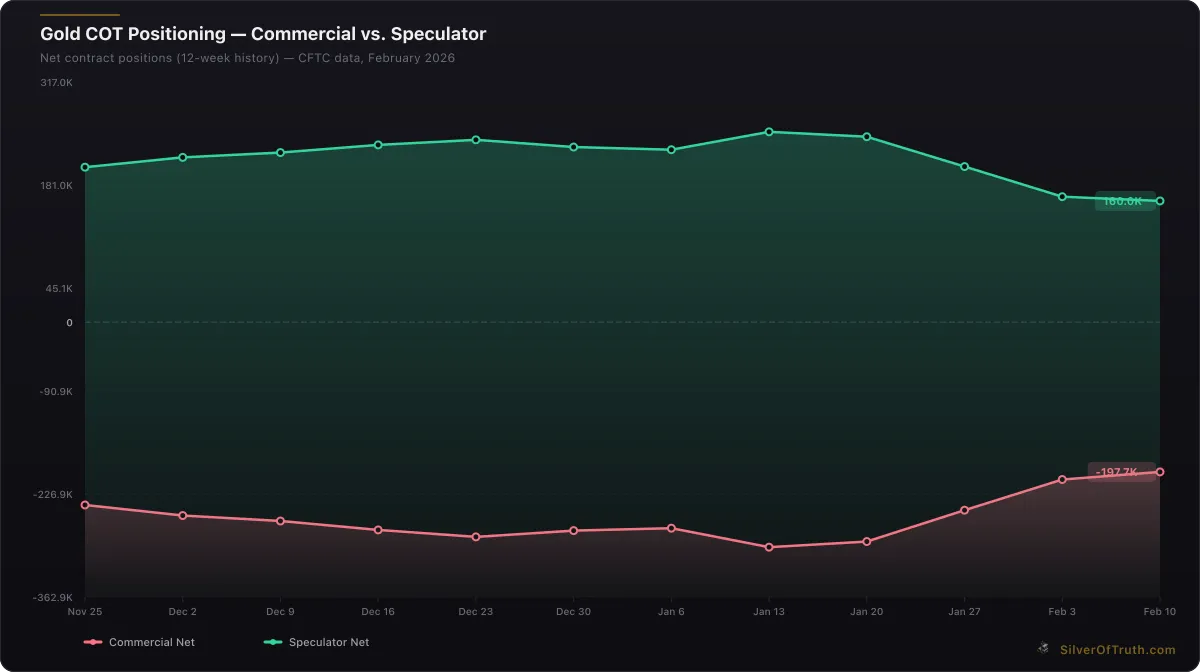
Gold COT positioning: commercial hedgers (red) vs. speculators (green). Source: CFTC via SilverOfTruth, February 2026
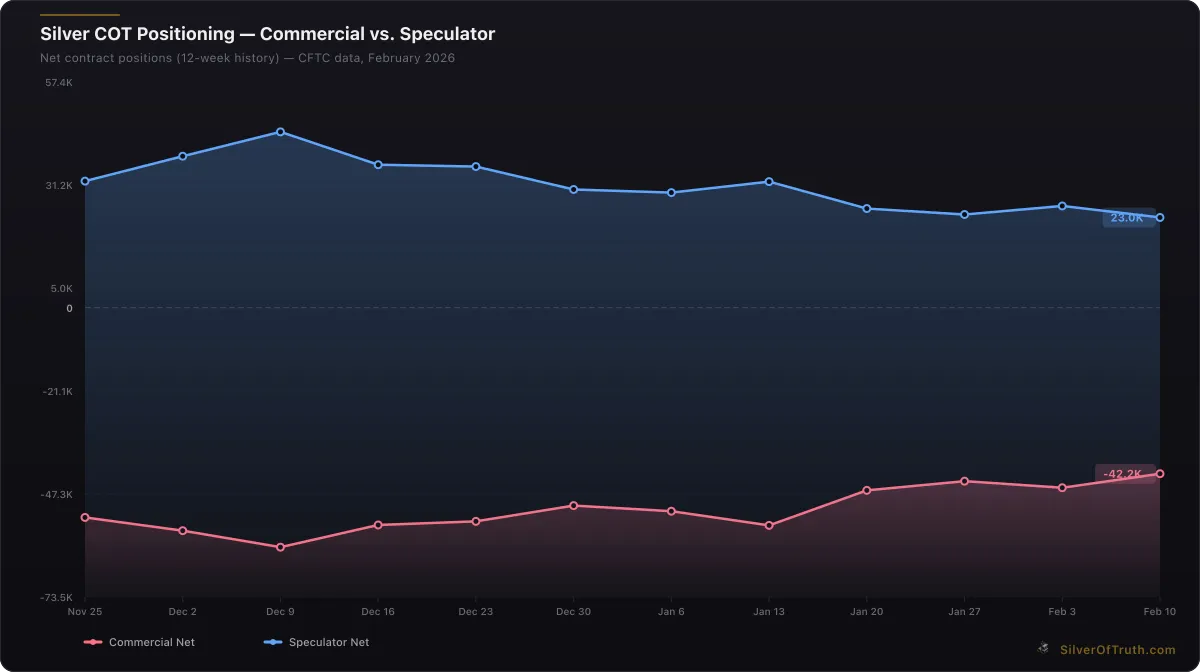
Silver COT positioning: commercial hedgers (red) vs. speculators (blue). Source: CFTC via SilverOfTruth, February 2026
Managed money funds, a subset of speculators closely watched for trend-following behavior, maintain a modest net long position of +4,983 contracts (13,189 long vs 8,206 short). The weekly change shows managed money reducing their net long exposure by 2,716 contracts, suggesting profit-taking rather than aggressive accumulation. According to CFTC COT report data, this represents a significant shift from more bullish positioning seen in previous months.
The concentration data provides additional insight into positioning dynamics. The top 4 long traders control 22.6% of total long positions, while the top 4 short traders hold 35.6% of short positions. This asymmetry suggests more concentrated short selling among large traders, potentially commercial hedgers managing physical silver exposure.
How Do Commercial Hedgers View Current Silver Market Conditions?
Commercial traders, representing miners, refiners, and industrial users with actual silver business operations, maintain their characteristic net short position at -45,725 contracts. This represents 35,248 long contracts against 80,973 short contracts, giving commercials a 56.6% share of total short interest in the market.
The weekly change in commercial positioning shows modest adjustments: long positions decreased by 9,540 contracts while shorts fell by 7,871 contracts, resulting in a net change of -1,669 contracts. This relatively stable positioning suggests commercial hedgers aren't rushing to adjust their risk management strategies despite recent price volatility.
Swap dealers, another category within the commercial classification, hold a substantial net short position of -27,458 contracts. Their weekly change of -4,615 contracts indicates these financial intermediaries reduced their short exposure, possibly reflecting client flow patterns or internal risk management decisions. The CME Group COMEX data confirms these positioning trends align with broader precious metals futures activity.
Why Is the 52.6% Coverage Ratio Creating Delivery Stress Concerns?
While futures positioning appears balanced, the physical silver market tells a different story entirely. COMEX silver inventory totals 376.4 million ounces, with 283.5 million ounces eligible and 92.9 million ounces registered for delivery. Against current open interest of 143,180 contracts (715.9 million ounces equivalent), this creates a coverage ratio of just 52.6%.
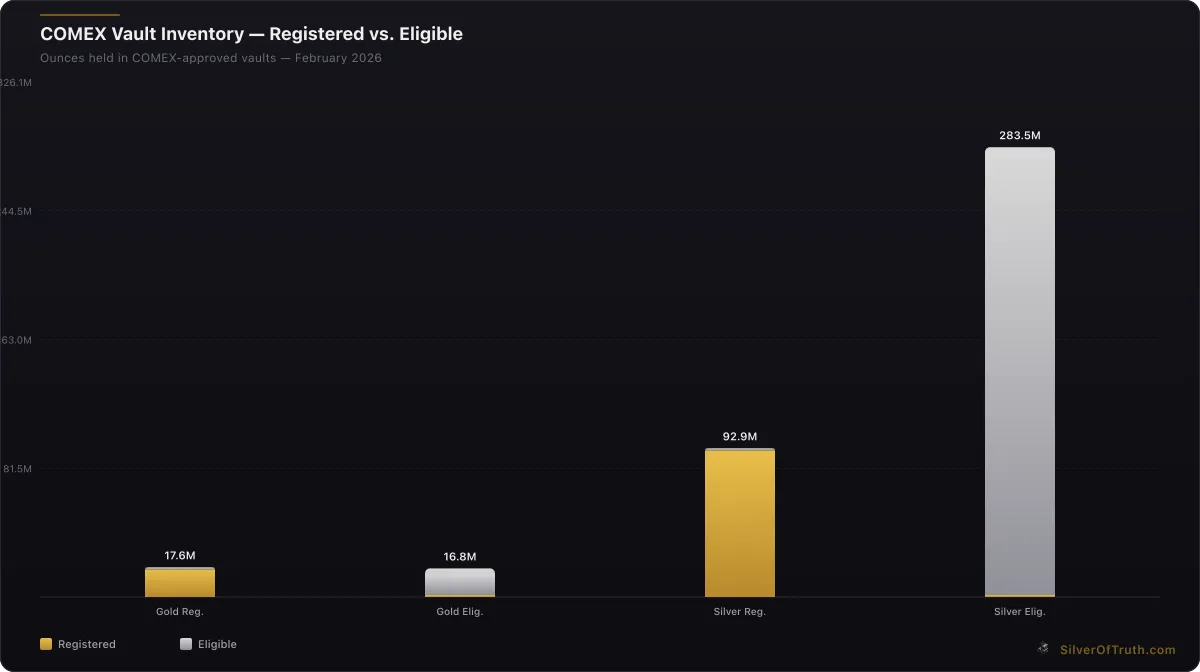
Source: SilverOfTruth COMEX data, February 2026
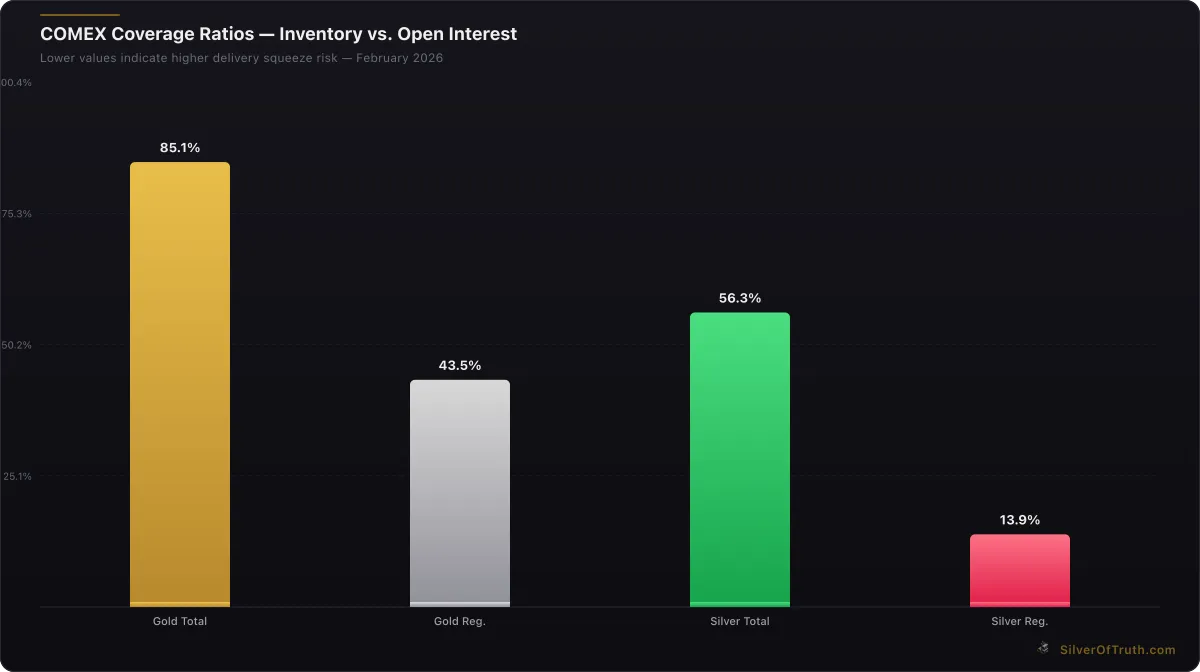
COMEX coverage ratios — lower values indicate higher delivery squeeze risk. Source: SilverOfTruth, February 2026
This coverage ratio falls into the "HIGH" risk category, indicating insufficient physical inventory to satisfy potential delivery demands if speculators choose to stand for delivery. The registered silver, which can immediately satisfy delivery notices, covers only 13% of open interest — an extremely tight situation by historical standards.
The inventory trend compounds these concerns. Total COMEX silver stocks declined 0.74% in the most recent period, continuing a pattern of steady drawdowns that has persisted for months. This ongoing depletion occurs while silver prices trade at $77.81 per ounce, up 2.81% in the latest session, suggesting strong underlying demand for physical metal.
Track these critical inventory levels in real-time using our COMEX Inventory Tracker, which monitors both eligible and registered stocks across all precious metals depositories.
What Historical Patterns Emerge When Coverage Ratios Reach These Levels?
Historical analysis reveals that coverage ratios below 60% often coincide with periods of significant price volatility in silver markets. During the March 2020 market disruption, silver coverage ratios fell below 40%, triggering delivery delays and forcing COMEX to adjust settlement procedures. The current 52.6% ratio approaches that threshold, creating similar structural risks.
The 2008 financial crisis provides another relevant comparison. Silver coverage ratios remained elevated above 80% throughout most of that period, allowing the market to function smoothly despite extreme volatility in other asset classes. Today's much tighter inventory situation suggests silver markets may be more vulnerable to delivery squeezes than during previous crisis periods.
More recently, coverage ratios in the 50-60% range during 2022-2023 coincided with periods where silver prices exhibited higher volatility relative to gold. The current ratio of 52.6% places today's market in similar territory, suggesting increased sensitivity to both speculative positioning changes and physical demand shifts.
Understanding these patterns becomes crucial for investors monitoring the relationship between paper and physical silver markets. Our guide to the Gold/Silver Ratio explores how these dynamics affect relative precious metals performance.
How Do Open Interest Changes Signal Shifting Market Dynamics?
Total open interest in COMEX silver futures declined by 13,457 contracts in the latest reporting period, bringing the total to 143,180 contracts. This reduction in overall market participation occurs alongside balanced speculator positioning, creating mixed signals about future direction.
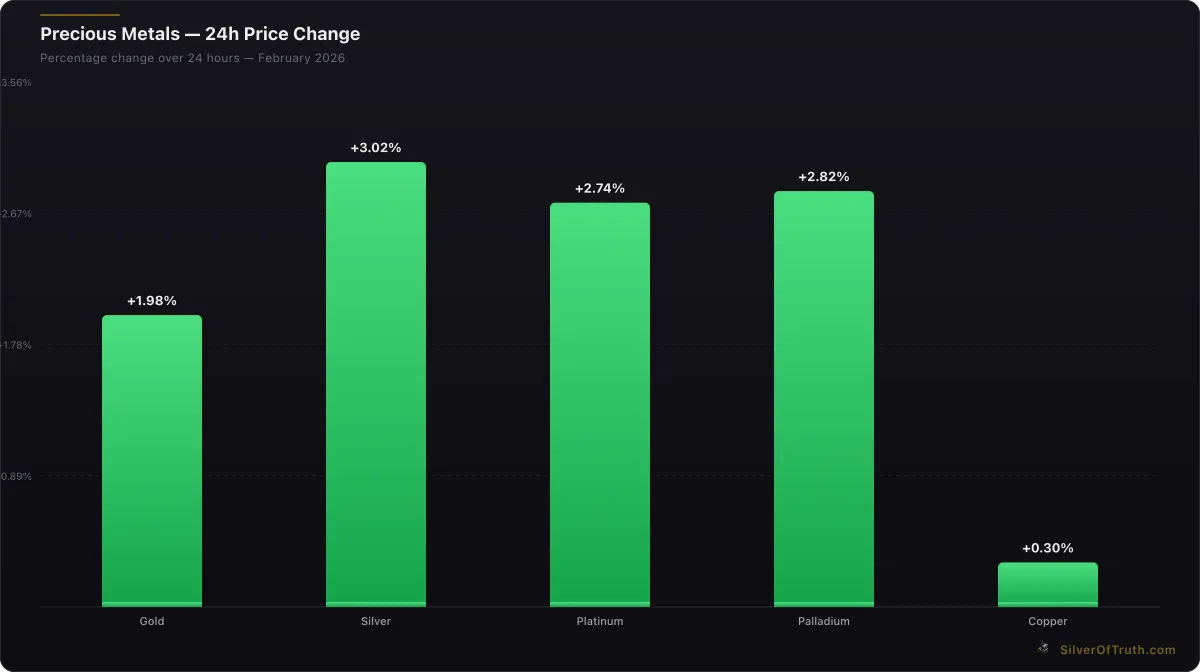
24-hour precious metals price changes. Source: SilverOfTruth, February 2026
Declining open interest typically indicates position liquidation rather than new money entering the market. When combined with neutral speculator positioning, this pattern suggests consolidation rather than trending behavior. However, the high-risk coverage ratio adds complexity to this interpretation.
The relationship between open interest and inventory coverage creates a critical feedback loop. Lower open interest theoretically reduces delivery pressure, but the mathematics of the coverage ratio means even modest increases in speculative long positions could quickly ratchet up delivery stress.
Non-reportable positions (smaller traders below CFTC reporting thresholds) hold a net long position of +19,848 contracts, representing 22.7% of long interest. These smaller participants often provide market liquidity but may be more sensitive to volatility if coverage ratio concerns trigger rapid price movements.
What Do Concentration Metrics Reveal About Market Control?
The concentration analysis within COT data provides insight into how market control distributes among large participants. In silver, the top 8 long traders control 33.3% of all long positions, while the top 8 short traders hold 48.6% of short positions. This concentration on the short side suggests a relatively small number of entities are providing significant short interest.
This asymmetric concentration pattern often emerges when commercial hedgers dominate short positioning while speculative longs remain more distributed. The concentration of shorts could create rapid covering pressure if delivery concerns intensify, potentially amplifying price volatility.
Comparing these concentration levels to other precious metals, silver shows higher short-side concentration than typically seen in gold markets. This structural difference may explain why silver often exhibits greater volatility during periods of physical market stress.
The World Gold Council research on precious metals market structure highlights how concentration patterns can influence price discovery efficiency and volatility characteristics across different metals.
How Are Global Silver Supply Dynamics Affecting COMEX Positioning?
Beyond COMEX-specific data, global silver supply conditions contribute to positioning dynamics. Industrial silver demand continues growing, driven by solar panel installations and electric vehicle production. The Silver Institute reports ongoing structural supply deficits that strain available above-ground stocks.
Mine production constraints add another layer of complexity. Several major silver producers have reported lower output due to permitting delays and operational challenges. These supply-side pressures help explain why COMEX inventory levels struggle to rebuild despite relatively balanced futures positioning.
Recycling supply, historically a buffer during tight market conditions, remains constrained by high processing costs and limited scrap availability. This creates additional reliance on mine production and above-ground stocks held in exchanges like COMEX.
The interaction between global supply constraints and COMEX inventory dynamics creates a situation where even modest increases in speculative demand could trigger significant delivery stress. This backdrop makes current positioning data particularly relevant for understanding potential market outcomes.
What Scenarios Could Trigger Rapid Positioning Changes?
Several catalysts could rapidly alter the current balanced positioning environment. Federal Reserve policy changes that significantly affect real interest rates represent the most obvious trigger. Lower real rates typically benefit precious metals by reducing the opportunity cost of holding non-yielding assets.
Geopolitical developments that increase safe-haven demand could also shift speculator positioning quickly. The current neutral stance provides room for rapid accumulation if external factors drive investor interest toward precious metals as portfolio insurance.
Industrial demand shocks, particularly from the solar energy sector, could create sudden physical market tightness. With coverage ratios already at high-risk levels, even modest increases in industrial buying could stress the delivery system and force speculator repositioning.
Currency volatility represents another potential catalyst. Significant dollar weakness or strength could alter the attractiveness of dollar-denominated commodities like silver, potentially triggering substantial speculator repositioning within short time frames.
Monitor these developing scenarios using our comprehensive COT Dashboard, which tracks positioning changes across all precious metals in real-time.
What Investment Implications Arise From Current Market Structure?
The disconnect between balanced speculator positioning and high-risk coverage ratios creates unique investment considerations. Traditional COT analysis suggests limited crowding risk from over-extended speculator positions. However, the tight physical market structure means even modest positioning changes could generate outsized price impacts.
For precious metals investors, this environment suggests heightened volatility potential with limited directional bias from positioning alone. The physical market tightness provides a bullish undercurrent, while neutral speculator positioning removes immediate crowding concerns.
Portfolio allocation decisions should consider both the balanced futures positioning and the structural tightness in physical markets. This combination may favor strategies that benefit from volatility rather than directional exposure, given the mixed signals from different market segments.
Risk management becomes particularly important given the potential for rapid position changes if coverage ratio concerns intensify. Stop-loss strategies and position sizing should account for the possibility of gap moves if delivery stress triggers rapid speculator repositioning.
For comprehensive precious metals portfolio analysis, explore our detailed Silver Investing guide, which covers both futures positioning and physical market dynamics in portfolio construction.
Frequently Asked Questions
What does a 52.6% coverage ratio mean for silver prices? A 52.6% coverage ratio indicates COMEX has only enough total inventory to satisfy 52.6% of potential delivery demands from open futures contracts. This high-risk level suggests potential delivery stress that could drive significant price volatility if speculative demand increases.
How does current speculator positioning compare to historical extremes? Current speculator positioning at 18% of open interest sits well below historical extreme levels that typically exceed 30-40% of OI. This balanced positioning removes immediate crowding risks but also provides room for rapid accumulation if market conditions change.
Why do commercial hedgers maintain such large short positions in silver? Commercial short positions reflect legitimate hedging needs from silver miners, refiners, and industrial users managing price risk in their business operations. The current net short position of 45,725 contracts represents normal hedging activity rather than speculative positioning.
What would trigger a delivery squeeze in the silver market? A delivery squeeze could develop if speculative long holders decide to take physical delivery while inventory levels remain constrained. With only 13% registered coverage against open interest, even modest increases in delivery intentions could stress the system.
How quickly can speculator positioning change in precious metals markets? Speculator positioning can shift dramatically within 1-2 weeks, particularly during periods of economic uncertainty or monetary policy changes. The current balanced positioning provides flexibility for rapid movement in either direction based on external catalysts.
Sources
- CFTC Commitments of Traders Reports: https://www.cftc.gov/dea/futures/other_lf.htm
- CME Group COMEX Inventory Data: https://www.cmegroup.com/markets/metals.html
- Silver Institute Supply/Demand Analysis: https://www.silverinstitute.org
- World Gold Council Market Structure Research: https://www.gold.org/goldhub/data
The current silver market presents a unique analytical challenge where balanced speculator positioning contrasts sharply with high-risk physical market conditions. While COT data suggests limited crowding risk from over-extended positions, the 52.6% coverage ratio signals potential delivery stress that could amplify any positioning changes. This environment demands careful monitoring of both futures positioning trends and physical inventory dynamics to anticipate potential volatility catalysts. For comprehensive silver market analysis including real-time COT positioning and inventory tracking, explore the SilverOfTruth app on the App Store. Continue your precious metals education with our comprehensive COT Reports guide to better understand these critical market dynamics.
Disclaimer: This article is for informational and educational purposes only and does not constitute financial, investment, or trading advice. Past performance is not indicative of future results. Always conduct your own research and consult with a qualified financial advisor before making investment decisions. SilverOfTruth provides market data and analysis tools — it does not provide personalized financial advice.